Better social integration holds the key









 |
| Social and academic integration is really important for Chinese international students into Australian universities.[Photo provided to China Daily] |
Chinese students face many barriers when it comes to making Australian friends, according to an international education expert, who said it is a big mistake to underestimate the benefits of social integration.
When it comes to making friends with domestic students, "it's not hard, but it's definitely not easy," Chinese international student Vincent told Xinhua.
The 24-year-old Macquarie University student expressed the view that it was particularly difficult for Chinese students, and according to Professor Ly Tran from Deakin University in Melbourne, Vincent is not alone in feeling the difficulties of social integration.
Tran's specialty is international education, and throughout her research, she found that there is some truth to the long-standing stereotype that Chinese students tend to socialize among themselves, and many do not befriend local students.
However, this is not always a reflection of their own motivations, as most Chinese students want social integration, Tran told Xinhua, but there is often a gap between their expectations and the reality that faces them when they arrive in Australia to start their studies.
"Social and academic integration is really important for Chinese international students into Australian universities, and it is definitely a critical issue," Tran stressed.
"We have students from a variety of backgrounds, and they come with their own motivations and social preparation prior to their departure, so we are dealing with a spectrum of Chinese students, some are prepared for what to expect and able to socialize easily, and others are not."
As she herself was an international student hailing from Vietnam, Tran is interested in the variety of factors in play that contribute to the complexity of the social integration of Chinese international students into Australia. She said that although the language barrier is often cited as the cause of the concerns raised, it is but a small part of a larger issue.
"English proficiency can be a barrier to communication, and the responsibility of improving language skills is the responsibility of the Chinese student, that's really up to them," Tran said.
However, domestic Australian students also have an important role to play, according to the learned academic, who said universities need to play a greater role in facilitating social opportunities between their domestic and international students.
"One thing that I have found is that a lot of domestic students don't see the value in interacting with Chinese international students, so they lack that inherent motivation, but it should all be about reciprocal interaction and mutual learning," Tran said.
"Chinese students can learn a lot from Australian students, and Australian students can learn a lot from Chinese students."
Domestic students need to understand the "enormous amount of valuable resources a Chinese international student brings with them to Australia, in terms of their cultural knowledge and global networks," Tran said, although she acknowledged that domestic students may also feel nervous about interacting with international students, for fear of a lack of common ground and opportunities to facilitate conversation.
Sarah, an international student at the University of Technology, Sydney, agreed a divide exists between domestic and international students, and although she arrived in Australia four years ago and lives on campus, she still feels opportunities to make friends with local students are quite limited.
"I have about one or two local friends, maybe they aren't even friends, they are more like acquaintances," the 21-year-old conceded.
"It would be nice to have more, but knowing it's quite hard to make friends with locals, I don't feel that motivated. Sure, we have class together, but when semester finishes, we say goodbye."
The factors behind the socialization of international students, including a lack of motivation, are largely driven by population demographics, according to Tran, who noted that the significant Chinese community in Australia encourages Chinese students to "stick together" and form cultural clusters.
"The Chinese community tends to form what is called a parallel society, this means they may tend to socialize with people from a similar background, or only socialize with co-nationals," Tran noted.
"This does prevent people from integrating and engaging, and ultimately forming a sense of belonging to Australia, it impacts their overall sense of connectedness."
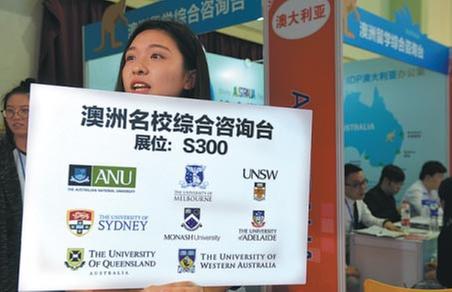 |
| There is often a gap between their expectations and the reality that faces Chinese students when they arrive in Australia. [Photo provided to China Daily] |
The concept of a "parallel society" is one that Vincent has witnessed for himself, and is in his eyes, one of the main reasons why it is particularly difficult for Chinese students to make non-Chinese friends.
"The Chinese community in Australia, and particularly Sydney, is so huge, and that's great but I think society should be like a bowl of salad, it should be mixed," he said.
"In the suburb of Hurstville, there is a very big Chinese community, and you don't have to reach out to other cultural communities, you have everything you need-from Chinese butchers to Chinese grocers, and Chinese staff at the post office."
"You don't even have to speak English," he added.
Tran noted that although being part of a dominant group can "create a sense of comfort and identity reinforcement," these groups also create barriers to social integration, and discourage Chinese students from venturing out of their comfort zone
"When you are from the most populous group, it's very easy to find co-nationals to socialize among," she said.
"If we look at Burmese or Cambodian international students, there are much smaller groups of these students, so perhaps they might socialize together if they had the chance but because of the limitations, they know they have to reach out in order to make friends in their host country."
The large number of Chinese international students in Australia is something that Sarah felt has impacted her willingness to "reach out" to non-Chinese students, as it makes finding a friend much simpler.
"There are more Chinese students here than international students of other backgrounds, and I think people want to make friends with someone who is from a similar background to them," Sarah said.
"If someone was the only person from their cultural group, then they would have no choice but to get familiar with other cultures."
Tran urged against students adopting a laissez-faire attitude toward interacting with those from different racial and cultural groups, and stressed that by not capitalizing on the opportunities to broaden their horizons, students could potentially be damaging their future career prospects.
"Socializing into Australian society can help the students enhance their intercultural understanding and knowledge, and even increase employability, by the simple act of expanding their network," Tran said.
Australia and other countries in a similar situation may miss out on the benefits of an internationalized education system if such barriers to social integration persist, Tran said, noting that "people connections" are fundamental to future prosperity.
"With increasing transnational mobility, as well as the growth of collaborations between countries, we could miss out on valuable resources in terms of reciprocal understanding and international knowledge," she said.
"These Chinese international students are key actors in making those important connections, and whether they choose to stay in Australia or go back to China, they have enormous potential to form future connections, and we shouldn't underestimate it."
The students' names have been altered for their privacy.