More graduates choosing to work in second-tier cities









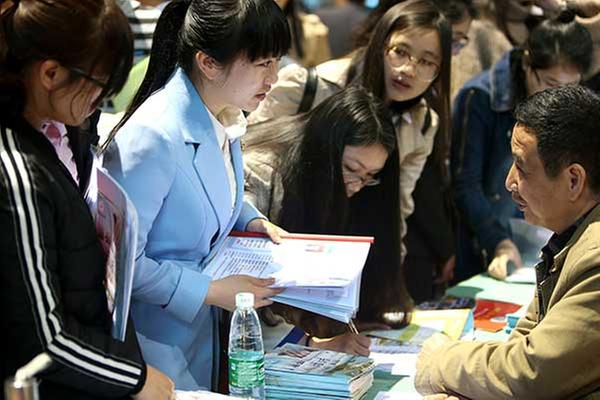 |
| Graduates from normal universities in Hunan province interact with their potential employers at a job fair in Hengyang in March. [Peng Bin/For China Daily] |
"In cities like Chengdu, I can still pursue my dreams, but without all the struggling," said the 24-year-old graduate.
This year, the number of China's college graduates is expected to reach 7.95 million, an increase of 300,000 on last year, according to the Ministry of Education.
Other than swarming into megacities such as Beijing, Shanghai and Guangzhou, more students want to start their careers in second-tier cities, including the provincial capitals and coastal cities, according to a recent survey.
The survey carried out by Zhaopin.com, one of China's leading recruitment websites, showed that 37.5 percent of China's new college graduates in 2017 wanted to work in second-tier cities, while 29.9 percent preferred top-tier cities.
"A few years ago, only a couple of students graduating from universities outside Chongqing came for our job interview, but this year we have a long queue of people with master's and doctoral degrees from Beijing, Shanghai and Guangzhou," said Huang Zuge, an HR official in a Chongqing internet company.
Booming economy
Statistics from the National Bureau of Statistics showed that besides Beijing, Shanghai, Guangzhou and Shenzhen, eight smaller metropolises stepped into China's 1-trillion-yuan ($148 billion) GDP club in 2016, including Chongqing, Chengdu, Wuhan, Suzhou and Hangzhou.
The rapid economic development of second-tier cities was the main factor attracting fresh graduates, said Su Hainan, vice president of the China Association for Labor Studies.
Hangzhou, capital of East China's Zhejiang province and host city of the 2016 G20 summit, hit a record with double-digit GDP growth for seven consecutive quarters in 2015 and 2016.
As the city where China's e-commerce giant Alibaba is located, Hangzhou is famous for its online business development. The export of its cross-border e-commerce reached $5.27 billion from January to November of 2016.
Chengdu, capital of Sichuan, is home to offices for 278 Fortune Global 500 companies, and also a key city in China's Belt and Road Initiative.
"I think Chengdu will continue to benefit from the Belt and Road Initiative, and I see ample opportunities in trades with the advent of the China (Sichuan) Pilot Free Trade Zone," Xu said.
Sichuan's free trade zone was launched this April, and over 7,000 new companies have registered in Chengdu during the past three months.
Favorable policy
Besides economic growth, the implementation of favorable employment policy in these cities is appealing to new college graduates.
Changsha, capital city of central China's Hunan province, provides housing and living subsidies from 6,000 to 15,000 yuan per year for graduates with different types of degree.
Those with doctoral degrees who work in Changsha can get 60,000 yuan of subsidies when they purchase their first residence in the city.
Liu Xuezhi, an analyst with the Bank of Communications, said adopting favorable employment policies met the need for innovative development in second-tier cities.
The government of Southwest China's Chongqing Municipality has financed 595 entrepreneurial programs, disbursing 16 million yuan of subsidies and reducing 30 million yuan of guarantee fees since 2015, according to the city's Employment Service and Administration Department.
High-quality human resources are becoming a strong drive in the industrial transformation and upgrading of middle-level cities, said Liu Yuanchun, an economist and vice-president of Renmin University of China.