Don't miss opportunities Islamic fintech gives HK









In late May the Bank of England completed a public consultation on a sharia compliant liquidity tool for Islamic banks; the deposit facility is expected to be ready by next spring. Meanwhile, in April, the Financial Conduct Authority approved the first Islamic financial technology startup which manages real-estate investment for retail clients.
The potential of Islamic financial markets is too big to be ignored. According to the Pew Research Center, it is estimated that due to their high population growth, the population of Muslims will grow from 1.8 billion in 2010, nearly 25 percent of the global population, to 3 billion, or 31 percent, in 2060.
It is anticipated there will be a gigantic demand for Islamic financial services but development is relatively slow today, especially in fintech. Consultancy firm Accenture said global fintech investment amounted to more than $50 billion since 2010. Only 1 percent of this was spent in the Middle East and North Africa, where Muslims are a majority.
Sharia forbids speculation, gambling and usury, and advocates hard work. Interest is considered usury, so is prohibited. In short sharia-compliant financial services are very different from those we are familiar with.
In recent years, Islamic countries have focused on developing financial services without violating their doctrine. Wamda, an entrepreneurial promotion platform for the Middle East and North Africa, pointed out that there were less than 20 fintech startups in the Middle East in 2010 but by 2015 this had increased to 105. It is expected the number will rise to 250 by 2020.
One prevailing business is cross-border remittance and payment services. The World Bank said the number of migrant workers in the Middle East amounted to 80 percent of its population, the highest proportion of migrant workers in the world, which provides many business opportunities for remittance services. Many developing countries rely on remittances from nationals working in foreign countries to improve their economies. The World Bank estimated the amount of remittance is huge, reaching $583 billion in 2014.
Other fintech services are under development. For example, Dubai in March this year signed a cooperation agreement with the Singapore Monetary Authority to jointly develop a mobile payment and blockchain project. At the same time, it introduced its first-ever fintech sandbox in the area, allowing new products to be tested for two years. Cairo launched two startup projects last year.
Ernst & Young last year reported that the 40 largest Islamic banks had approved budgets ranging from $15 million to $50 million to expand digital business in the next three years.
What is Hong Kong doing with Islamic finance? The Hong Kong Monetary Authority offered its third US dollar sukuk earlier this year. Since 2013, offering and trading of sukuk in Hong Kong enjoyed a 100 percent profits tax and stamp duty exemption to boost sales.
To grasp the emerging Islamic digital finance opportunities, in addition to the issuance of sukuk, we can also consider using Hong Kong's advantages in the development of Islamic cross-border trade and financing, and help Islamic countries develop smart-city infrastructure under the Belt and Road Initiative.
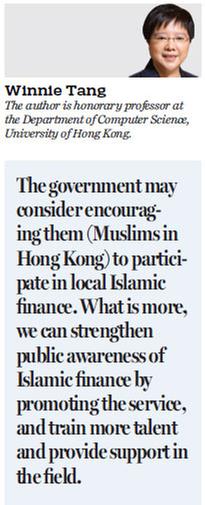
The Hong Kong Yearbook 2016 says the Muslim population of Hong Kong is about 300,000. Apart from 150,000 Indonesian domestic helpers, these comprise 40,000 Chinese and many native Southeast and South Asian people, such as those of Pakistani, Indian and Malaysian origin who were born in Hong Kong. The government may consider encouraging them to participate in local Islamic finance. What is more, we can strengthen public awareness of Islamic finance by promoting the service, and train more talent and provide support in the field.
The 2016 Top Markets Report - Financial Technology released by the United States International Trade Administration ranked Hong Kong just behind London and New York as a global financial center based on criteria including business environment, infrastructure, human capital and reputation. We should not miss out on the huge opportunities of Islamic digital finance in the long run so we can maintain our position as a global financial hub.
(HK Edition 07/31/2017 page10)






Today's Top News
- CPC leadership meeting urges steadfast implementation of eight-point decision on improving conduct
- Autumn grain purchases exceed 200m tons in China
- Wang to meet foreign ministers of Cambodia, Thailand in Yunnan
- China's top legislature concludes standing committee session
- Thailand and Cambodia agree to temporary ceasefire
- NPC's 4th annual session slated for early March