



Curbing financial risk helps tame property market









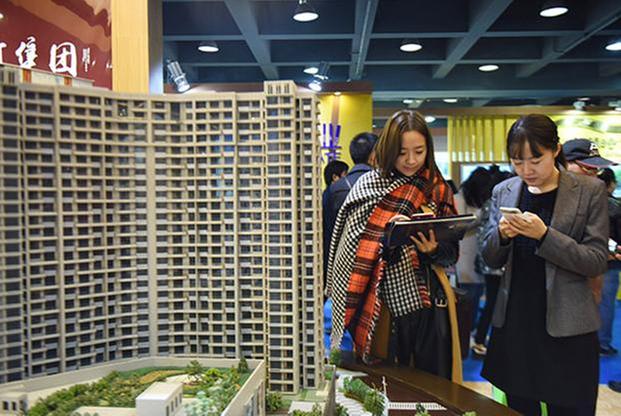 |
| A potential homebuyer checks out a property project in Hangzhou, Zhejiang province, Dec 17, 2016. [Photo by Long Wei / Asianewsphoto] |
Investment growth in residential property development looks certain to slow again in the second half of this year.
With tight liquidity and sluggish sales, developers could face financing difficulties, high costs and insufficient payment collection.
As a result, there might be another round of mergers and acquisitions in the coming year, forcing some small and medium-sized developers to withdraw from fierce competition.
Influenced by regulatory policies, housing prices are likely to go down in first-and major second-tier cities. But there should be property investment opportunities in third-and four-tier cities.
Still, until real economy weaknesses have been fundamentally changed, the real estate sector will hold its position as an important investment source in the short term.
After China's economy entered the new normal, the government focused on cutting overcapacity, reducing excess inventory, deleveraging, reducing corporate costs and shoring up weak spots.
Last year, there was a concentrated effort to cut overcapacity and reduce excessive inventory. In real estate, the market continued to grow significantly from 2015, stimulated by these policies.
The annual sales area of commercial housing grew 22.5 percent year-on-year, with sales volume jumping 34.8 percent.
Even so, this property boom was led by second-tier cities. Market transactions in Hefei, Nanjing, Xiamen, Suzhou and Wuhan saw a sudden surge in prices.
Before new regulatory policies were issued on Sept 30, 2016, year-on-year house price increases in these cities appeared to be more than 60 percent. Land auction prices also hit record highs.
Against the backdrop of a sluggish real economy and a weakness in the stock market, real estate had became to many a crucial investment sector, despite high leverage.
Naturally, an overheated market tended to drive people crazy.
Everybody in the property sector was convinced that prices would continue to rise. A classic bubble scenario.
Data collected by the People's Bank of China, or the country's central bank, showed annual new loans last year hit 12.65 trillion yuan ($1.9 trillion). Middle-and long-term loans grew 5.68 trillion yuan year-on-year.
But new loans by enterprises were reduced by 1.28 trillion yuan during the same period.
While this was going on, the government started to deflate the property bubble and by Sept 30 a new regulatory policy was introduced.
In the following six months, various policies were rolled out in a bid to limit property purchases, loans and sales to combat speculation.
In various cities, new guidelines were used in land auction procedures to curb housing and land prices in an effort to stabilize the real estate market.
These decisions and other policies have effectively restrained market turnover.
Since March, residential housing transactions in first-tier cities and major second-tier cities have dropped sharply. Prices have begun to fall.
In Beijing, the price of secondhand housing, which accounted for 75 percent of the city's sales, showed negative growth. But, again, markets in third-and fourth-tier cities maintained an upward trend.
The author is head of North China Research, Cushman & Wakefield



















