



To boldly go where no startup has gone before









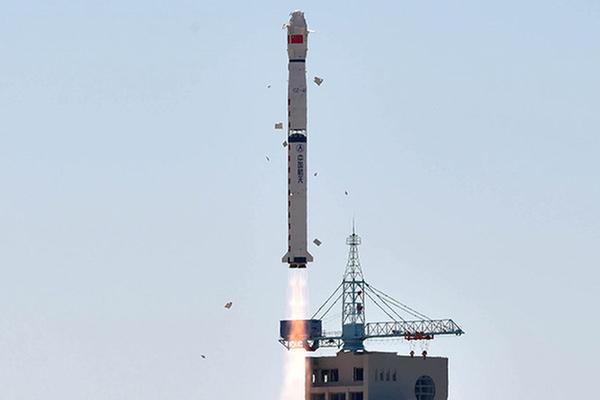 |
| A Long-March IV rocket blasts off at Jiuquan Space Launch Center in Northwest China's Gansu province. A key problem for commercial space companies is the lack of launch sites. [Photo/Xinhua] |
Space is the final frontier for private firms as they muscle into an area dominated by State-owned companies
A satellite the size of a teakettle will be launched into space by the end of this year.
Once the cubesat starts circling the earth at tens of thousands of kilometers an hour, it will be used to teach astronomy to Chinese high school students.
Backed by space startup Commsat Technology Development Co Ltd, this project is just one of a wide range of private sector ventures.
"Many investors are optimistic about the industry," said Huang He, a partner of Northern Light Venture Capital, which has already injected funds into another startup Spacety Co Ltd.
In the past few years, the commercial space sector has come alive in China as private companies jostle for launch dates.
Before, the final frontier was the preserve of government-backed programs from State-owned companies.
But now a slew of startups have appeared and along with established tech outfits are rolling out new business models for the space sector at competitive costs.
"Private firms can make swift decisions to meet consumer demand," said Peng Yuanyuan, co-founder and chief operating officer at Commsat. "Plus, our trial and error costs are relatively low."
In 2015, the global space economy rocketed to $323 billion. Commercial operations accounted for up to 76 percent, or $246 billion, according to The Space Report 2016, which was released by The Space Foundation.
By 2020, China's commercial space market is expected to expand to 800 billion yuan ($120 billion), the China Securities Journal reported.
Already the country's new boys are moving in with Spacety launching the microsatellite, Xiaoxiang No 1, or Ty-1, for the scientific community last November.
Other startups such as Commsat Technology, Zhejiang Lizhui Electronic Technology Co and Guangdong Kechuang Spaceflight Co are just behind them, waiting for the right window.
Even though private companies have come late to this business, they believe they can push the boundaries of space by using more market-oriented models.
Yang Feng, founder and CEO of Spacety, pointed out that the next five satellites being rolled out by his company are all "fully booked" although he did not reveal detailed financial numbers.
He did make it clear, though, that the satellites will be launched in the second half of this year.
Commsat is in a similar position and has almost recouped the cost of its planned educational satellite, Peng stressed.
"We are able to increase the capabilities of the spacecraft without adding greatly to the costs," she said.
Peng is expecting Commsat to turn over revenue of 30 million yuan this year although she declined to disclose detailed financial figures.
But she did reveal the company has reached agreements with more than 70 public schools in Beijing, Guangzhou, Anhui and Shanghai to beam in astronomy courses.
Just like with earth-bound businesses, finding the right recipe for success is crucial for these new pioneers of space.
They need to put clear sky between themselves and State-owned companies, which dominate telecommunications, remote sensing and navigation or GPS.
"The best opportunities for private firms lie in exploring undiscovered fields and creating new demand," Peng at Commsat said.
It is a view that appeals to Yang, of Spacety, who believes startups will end up "supplementing rather than substituting" existing businesses.
By April, a total of 14 commercial space companies were registered in the country, including 10 which were privately owned, according to CASI Cloud.com, a website affiliated to China Aerospace Science & Industry Corp.
They all tend to specialize in satellites involved in internet communication, remote sensing or scientific research.
In addition to the new kids on the block, technology giants are jumping on the bandwagon.
Later this year, Alibaba Group Holding Ltd plans to launch the world's first e-commerce satellite to provide consumers with customized products.
By analyzing agricultural cultivation and harvesting data provided by satellite images, the company aims to buy and then sell the "world's best vegetables", it promised.
Many might think this is a publicity stunt, but the internet group is deadly serious about taking its first step in space.
As for rival Tencent Holdings Ltd, it invested in the startup Moon Express, which was founded by a group of Silicon Valley space entrepreneurs, in 2013.
The company, which is based in the United States, has an ambitious program, including using drones to mine asteroids.
Indeed, this spirit of galactic adventure is reflected in the desire by Chinese companies to capture a slice of the space pie.
Fuelling the trend has been the government's challenging plans to develop the sector.
Back in 2015, China's top economic planning body, the National Development and Reform Commission, unveiled a 10-year blueprint for the commercial space sector along with the Ministry of Finance, and the Commission on Science, Technology and Industry for National Defense.
Since then, this fledgling sector has attracted renowned investors such as Matrix Partners China, Northern Light Venture Capital and Cash Capital.
Yet the complexity of spacecraft, satellites and the shortage of skilled talent have provided challenges for the industry.
"Most of the key people working in space startups used to be employed by SOEs," said Huang at Northern Light Venture Capital.
"The companies are still looking at viable solutions to tackle the growing shortage of talent and help them build a sustainable career," he added.



















