



Wild blueberries juice up Canada's exports









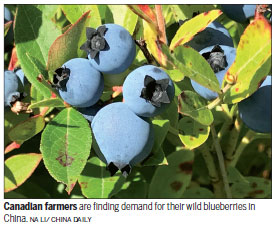
Wild blueberries from Atlantic Canada and Quebec are surging in popularity among the world's health-conscious - and adding to Canada's export coffers.
The rising demand for the low-brush blueberries and byproducts - especially from the massive Chinese market - has stimulated development of farms and related businesses and contributed significantly to the economies of five Canadian provinces.
Atlantic Canada includes the provinces of New Brunswick, Nova Scotia and Prince Edward Island, and Newfoundland and Labrador province.
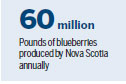
Nova Scotia is the wild blueberry capital of North America. With its favorable oceanic climate and soil, its wild blueberries are managed on a two-year crop rotation cycle, leading to the production of about 60 million pounds each year.
That translates into C$100 million in worldwide sales, mainly to the US, Europe and East Asia.
There are an estimated 1,100 wild blueberry growers in Nova Scotia, many who have passed the farmland and family businesses from generation to generation.
Art Sargent, who runs an old garage, C.E. Sargent & Son Ltd in Parrsboro, owns 850 acres of wild blueberry farms on the outskirts of Halifax. He has tended to the family farm business for decades.
In an interview with China Daily, Sargent introduced his daughter Stephanie as a third-generation hand at running the sprawling family blueberry farm.
"The wild blueberry business has been a great family business for us the last 25 to 30 years, and we hope to get another 50 years out of it," said Sargent. "Nova Scotia is a

natural producer of wild blueberries; there is a big market, and it works both ways."
Sargent's parents started the business in 1951. They regularly bought and leveled land, cultivating and expanding as well as pruning crops manually.
"Now harvesting machines have been added to the farm, as nobody wants to tend to it," he said.
Last year, the Sargent family farm exported 1.8 million pounds of wild blueberries. An average of 3,000 to 6,000 pounds per acre could be harvested under the right weather conditions.
"But last year's output of 1.8 million pounds was the largest," he added.
According to Sargent, wild blueberries should get at least an inch of rain per week, and during drier weather, some irrigation.
Sargent believes that the big Chinese market would give the industry a much-needed boost. "We need new markets now, and we hope more and more of our products can be sold to China."
Michel Baril is another second-generation grower, who owns 200 acres of wild blueberry land in St-Felicien, Quebec. Although the berry price has fallen compared to last year's price of 35 cents a pound, Baril and his family would like to spend more time harvesting at night while there is always dew on the crops to ensure their freshness.
"You have to love and have a passion for what you do," Baril said. "We have been in agriculture for a long time, and there's ups and downs, and if you're not passionate about it, (and) you're only in it for the money, that's not going to work. You have to be passionate about getting quality product."
Peter J. Rideout, the executive director of the Wild Blueberry Producers Association of Nova Scotia, said that global demand for Canada's wild blueberries, known for their excellent taste, nutritional value and other health benefits, has increased.
The industry in Nova Scotia encompasses 44,000 acres of naturally grown wild blueberries that could further drive the growth of the crop in the Atlantic region.
"Farmers, producers, manufacturers and officials have been encouraged by the immense economic contribution of this crop," said Rideout, who is also the head of the Wild Blueberry Research Institute at the Dalhousie University. "Our research centre had been set up to encourage cultivators to ensure a reliable and sustainable supply to meet global demand."
The suppliers
One of the success stories on the processing side is that of Matthew Bragg, vice-president of sales and marketing at Oxford Frozen Foods Ltd, whose family business is part of the C$100 million wild blueberry industry in Nova Scotia.
Started by his father John Bragg in 1968, the family business now can process up to 1.5 million pounds of frozen blueberries and byproducts per day.
"We have been freezing Canadian wild blueberries for exports over the past 49 years. We sell to over 30 countries around the world, including the US, Japan and Europe, and more recently, China," Bragg said.
Like many other wild blueberry business owners in Nova Scotia, Bragg's company is increasingly looking to expand to China due to surpluses, high production costs and competition in Canada.
"We worked on Chinese e-commerce site JD.com to promote our products both online and offline in China. We chose to launch Canadian wild blueberries in China on Canada Day on July 1 recently," Bragg recalled.
During the harvesting season, which started in mid-August, the frozen berries are shipped in containers from Oxford to the Port of Halifax, where they set sail to ports in Tianjian and Shanghai, and retail partners like JD.com accept deliveries.
"We visited big companies in China from time to time with government missions, and in return, they came here to know what wild blueberries were and decided to buy blueberries and other products like seafood," said Bragg, who has traveled to China six times.
In neighbouring Prince Edward Island (PEI), Jasper Wyman & Son is another frozen wild blueberry company that was established in 1874 in the US and expanded its Canadian facilities in 2014.
Homer Woodward, the company's vice-president of operations, said they are further tapping into the Chinese market.
"We are presently selling blueberries all over the world and are looking forward to developing some partnerships with Chinese companies," Woodward said. "We received lots of assistance from the Canadian government in developing our foreign trade."
Wade Dover, the company's general manager, said the PEI facilities have improved their processing and distribution technology.
"We'd love to be able to sell more of the best wild blueberries to China. We know there is a high demand for quality Canadian products, and we are ready to expand into new markets and take on new customers," Dover said, adding that he hopes "what we bring to the table would lead to more people wanting to buy our wild blueberries".
Bleuet Nordic is a wild blueberry supplier of infused and dried wild blueberry, based in the Lac-Saint-Jean region - the heart of the industry in Quebec.
Starting from the fields to the freezers to dehydration processing, the company's president Mario Bussire said it is fully confident it can sell its products to the world.
"We are very interested in the Chinese market, and we are going to work with our partners to promote our products in China," he said.
Founded in 1984, Quebec Wild Blueberries has worked in close collaboration with China since 2009.
"We've been selling to China for about eight years, and I've been to China five times over the past few years," said Jean-Pierre Senneville, president of the company.
"We sell mostly to the business segments, such as food preparation makers, the yogurt makers and the jam manufacturers. We are happy to see the growing demand from China."
Trading with China
An increasing number of wild blueberry companies in Canada are looking to expand trade and enhance investment overseas.
David Hoffman, co-CEO of Bragg Group, an international wild blueberry company, said it had been selling around the world for many years, and more of the exports have gone to China lately.
"Chinese middle class consumers are looking for new, healthy, imported food like wild blueberries," said Hoffman. "One of the things that we pride ourselves on is the quality of our products, in whatever traditional Chinese dish that they want."
Hoffman noted that governments on both sides play a big role in their success.
About 20 years ago, a Chinese business group visited Oxford. After the meeting, Oxford started to follow up with municipal government officials and recognised that it is important to have good government-to-government relations when it comes to doing business with China.
Now there is a trade association of growers and processors of wild blueberries from Maine and Canada - the Wild Blueberry Association of North America (WBANA), which helps promote the crop to the global market.
"Our association offers information and education on wild blueberries, helps the industry promote wild blueberry products in the world. Our agent in China works for customers by explaining the health benefits and unique difference between normal blueberries and wild blueberries," said Neri Vautour, executive director of WBANA Canada, which represents major exporters and more than 4,000 growers in Atlantic Canada and Quebec.
The association also works and cooperates with regional politicians and trade missions to China and invites Chinese groups to visit Canada to grow more business.
According to Neri, the current Federal government in Canada has been actively pursuing a pro-China trade policy, which has significantly improved relations between the two countries and boosted the industry's business prospects in China.
"While we feel positive about this, our next objective is to remove trade barriers between the two countries. Right now, there is a 47 percent tax on our products going to China overall."
He suggested both sides get together and discuss the issue and resolve the matter, as the producers want to see tariffs reduced and have greater access to the Chinese market.
In Quebec City, Alan Boivin, the vice-president of the Syndicate Producers Blueberry Quebec (SPBQ) - a union with a membership of more than 400 Quebec-based growers, also said that the province has done well as demand has risen from China.
"More growers got involved in this great potential market, now Quebec producers are working with WBANA to get the produce to China, just like other competitors," Boivin said.
Prime Minister Justin Trudeau, during his first official visit to China in August 2016, stressed the importance of agricultural products such as blueberries to Canada's economy.
Jus Nova - a Halifax based distributor, has benefited from the Canada-China trade link.
Selling Nova Scotia lobsters to China for a long time, Jus Nova began looking for other products to plug into its distribution chain and started selling wild blueberry products to China three years ago.
Kong Weiyu, a descendant of Confucius and a director of Jus Nova Agriculture Ltd, approached a 40-year old family business with a deal to market and distribute the company's blueberry juice under the Jus Nova banner.
"No doubt China is the biggest-growing market in the world," said Kong. "Chinese customers are very smart, and we get a lot of inquiry about the product."
Early next month, Keith Colwell, Nova Scotia's minister of agriculture, fisheries and aquaculture, will lead a trade mission to China, where he look to promote the provinces blueberries and build a long-term relationship with suppliers and customers.
Kong, a member of that delegation, is optimistic: "This time we will visit some major distributors in China. We are looking for further partnership with our current clients; hopefully we can increase our sales, and Chinese consumers will like our new products," Kong said.
In 2016, Nova Scotia produced and exported $490.9 million worth of goods to China.
renali@chinadailyusa.com

(China Daily USA 08/31/2017 page1)


Today's Top News
- Building of rare earth hub highlighted
- Seedance 2.0 signals big shift in AI sector
- United front work urged to pool strength
- Beijing refutes US nuclear test accusations
- Xi sends festive greetings to all service personnel
- Stability, vitality and creativity appeal to all: China Daily editorial







