



Envoy's job is to mend ties, not drive a wedge









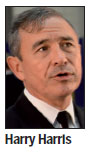
The Washington Post reported on Tuesday that Harry Harris, the commander of the US Pacific Command, is likely to be the next US ambassador to Australia.
The Post and several other news outlets have focused on Harris' past tough rhetoric about China on the maritime territorial disputes in the South China Sea and assume that he will rally Australia to counter a rising China.
Even though Harris' record seems to justify the speculation, I believe that's an inaccurate job description for Harris, or anyone who takes up that post. His mission should be to improve US-Australia relations rather than drive a wedge between Australia and China, who have seen their relations grow by leaps and bounds over the past decades.
US-Australia relations took a hit in February after President Donald Trump blasted Australian Prime Minister Malcolm Turnbull on the phone over a refugee resettlement agreement former president Barak Obama had made between the two countries. While the two leaders' meeting in New York in May seemed to be mending ties, leaked video showed that Turnbull sarcastically mocked Trump in June at the Australian Parliament's annual midwinter ball.
That of course is not the whole of long-standing US-Australian relations. But if Trump's obsession with US trade deficits is justified, then the US needs to address its large trade surplus with Australia.
Australia runs by far the largest trade deficit with the US - it was about $18 billion in 2016. Meanwhile, it enjoys $24.7 billion in trade surplus with the Chinese mainland, according to the Australian government.
China is Australia's largest trade partner. Their bilateral trade is 2.4 times larger than that between Australia and the US.
Chinese investment in Australia also reached its highest level since the global financial crisis of 2008, at $11.49 billion in 2016, up 12 percent from 2015, according to a May report by the University of Sydney and accounting firm KPMG.
For those who want to play up the threat of Chinese investment in Australia, they should know that the accumulated US direct investment in Australia is five times that of China's.
The China-Australia Free Trade Agreement, which went into effect in December 2015, has been described by the Australian government as the most favorable trade deal China has ever struck with a developed economy. It is set to greatly expand win-win cooperation between the two Asia-Pacific nations.
Expanding China-Australia ties have gone far beyond trade and investment to include education, culture, science and technology, tourism, political and military areas. Chinese Premier Li Keqiang met Turnbull in Canberra in March for the fifth China-Australia Annual Prime Ministerial Meeting.
On Monday, the Chinese and Australian militaries held their 20th defense strategy consultation to discuss bilateral and regional issues.
It is true that China and Australia may not see eye-to-eye on every issue.
But tension in the South China Sea has greatly eased in the past year. The relationship between China and the Philippines has improved greatly. China has been working with ASEAN countries to implement the Declaration on the Conduct of Parties in the South China Sea, deepen their maritime cooperation and push forward consultations on the Code of Conduct in the South China Sea.
These are positive signs both the US and Australia should encourage. It is absurd for anyone to assume that China - whose economy, more than any other country's, depends on the peace and stability in the South China Sea - wants to destabilize the region.
Some Americans believe Harris, if he does get the ambassador post (as former White House chief strategist Steve Bannon hoped he would), wants to prevent Australia from getting too close to China. They expressed deep concern after then Australian Prime Minister Tony Abbott ignored a US warning in March 2015 and joined the Asian Infrastructure Investment Bank.
Australian leaders have repeatedly expressed the sentiment that they don't want to be forced to choose between China and the US.
That is what Harris, or whoever becomes the next US ambassador to Australia, should bear in mind.
The author is deputy editor of China Daily USA. chenweihua@chinadailyusa.com
(China Daily USA 08/31/2017 page2)


Today's Top News
- Building of rare earth hub highlighted
- Seedance 2.0 signals big shift in AI sector
- United front work urged to pool strength
- Beijing refutes US nuclear test accusations
- Xi sends festive greetings to all service personnel
- Stability, vitality and creativity appeal to all: China Daily editorial







