The 'secret' language of women









Hunan province leads the revival of Nushu, the female-only writing system
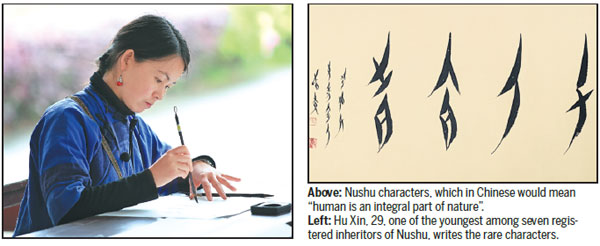
In mountainous Jiangyong county in Central China's Hunan province, Hu Xin is busy receiving the crew of a popular reality TV show. The team has come to find out more about Nushu, a writing system that can look like symbols to a first-time viewer. Hu, a 29-year-old local, writes the rare characters.
"I want to promote Nushu and pass it on to the younger generation," she says. "There are many touching stories behind the characters."
Nushu, which literally means "female script", is derived from regular Chinese characters that were once used by the female residents of Jiangyong. These slimmer and seemingly italicized variants of standard written Chinese are often called "the world's only surviving characters exclusively for women".
| Nushu characters that in Chinese would mean "favorable climatic, geographical and human conditions". Photos Provided to China Daily |

Nushu was named as a national intangible cultural heritage in 2006.
In the olden days, Nushu was taught by elderly women to girls at home because female children weren't allowed to attend formal school. During gatherings in villages, women used the characters to write poems or song lyrics to express emotions that were hidden from men. Hu first came in contact with Nushu at the age of 8. She painstakingly practiced the handwriting through her school years and is now one of the youngest among seven registered inheritors of the writing form. Her works have been exhibited in public, including at the Shanghai Expo in 2010.
"It needs patience to explore the writing system's cultural meaning," she says.
Zhao Liming, a professor at Tsinghua University in Beijing who has studied Nushu for more than 30 years, is considered to be China's top scholar in this field.
"The Nushu script was everywhere in the local communities," she says. "Some was in books. Some was written on folding fans or stitched in clothing. More was just in scattered papers."
Zhao explains that unlike the standard written Chinese, in which each character is a part of a word, each character in Nushu - based on local dialect - represents a syllable. She once categorized more than 220,000 words and found only 396 characters were commonly used.
"But these are enough to convey people's emotions," Zhao says. The earliest known artifact in the Nushu script was an 1850s coin. Though its history may date back further, its origin is unknown. In an ongoing project hosted by Zhao, a phone app is being designed by Talkmate, a Beijing-based online language education platform, to teach Nushu to more people. Hu is also helping with the standard writing of the characters. The first edition of the app is scheduled to be released during the first Beijing International Language and Culture Expo in September.
Zhao expects the app to present a true image of Nushu for the public after myths about it have spread. For example, people often misjudge the characters as "symbols of some secret cult". She says Nushu is not exclusive to any ethnic group, as Jiangyong has a mixed population. Though many old poems written in Nushu were women's autobiographies, talking about their difficulties in life, the professor says she didn't find suicidal thoughts expressed by the writers.
"The words were full of encouragement and positive energy, and showed an uncommon open mindedness among the women at the time."
She says Nushu shows a sisterhood rather than the brotherhood usually referred to in Chinese culture. She considers it misleading that some novels and films have hinted at homosexuality in presenting the writing form.
"It created an atmosphere like the salon culture of the West," she says. "When women gathered to sing together, the courtyards became their classroom and a place to chat."
Ji Xianlin, the late historian and linguist, once said that Nushu is a feminist symbol.
"It's a unique writing system created by talented women who were deprived of the right to education," he wrote in an article. "It has significance in various fields like linguistics, anthropology, sociology and literature, and represents Chinese people's strong spirit."
Zhou Youguang, another late linguist, said: "Nushu was an early-stage women's liberation tool." Zhao, the Tsinghua professor, attributes the revival of the characters to modern society's advocacy of self-expression.
"After public education was established and women got the right to attend school, Nushu lost its functionality," Zhao says. "However, feminist ideas are getting more emphasis today."
The last living "natural inheritor of Nushu", described by Zhao, is 77 years old. Younger generation practitioners such as Hu learned the writing system in school.
"It's not a natural inheritance because people's lifestyles are now thoroughly different," the professor says. "However, new methods are a must to keep it from disappearing."
According to Hu, Nushu classes have been set up in Jiangyong, where music and folklore are taught as well. Some men have started to learn the writing form. As a syllabic script, Nushu, in theory, can be translated into other writing systems, Zhao says, adding that it can thus be used to record modern content and have a continuous life. Nevertheless, she warns that the culture cannot be consumed in a superficial way. For example, Zhao has found many newly created characters in recent years in Jiangyong. Counterfeits of old Nushu books pop up.
In nearby Hubei province, a so-called Nushu village was once set up by a company that hired people from Jiangyong to perform handwriting there.
Thanks to Zhao's efforts, Nushu was included in Unicode, the computer industry standard for writing of text, earlier this year. "We used to worry about Nushu dying, but now we worry its original face will be lost," Zhao says."Modern adaption is inevitable to save cultures from fading away, but regulations are needed."
Hu says: "Nushu is not widely used in daily life today, but it is a legacy recording our history."
Consequently, she has refused many proposals to use the cultural heritage for commercial activity.
wangkaihao@chinadaily.com.cn
(China Daily European Weekly 09/01/2017 page21)





Today's Top News
- China to expand fiscal spending in 2026: finance minister
- CPC leadership meeting urges steadfast implementation of eight-point decision on improving conduct
- Autumn grain purchases exceed 200m tons in China
- Wang to meet foreign ministers of Cambodia, Thailand in Yunnan
- China's top legislature concludes standing committee session
- Thailand and Cambodia agree to temporary ceasefire