



Experts: Heavy polluters can make cities cleaner









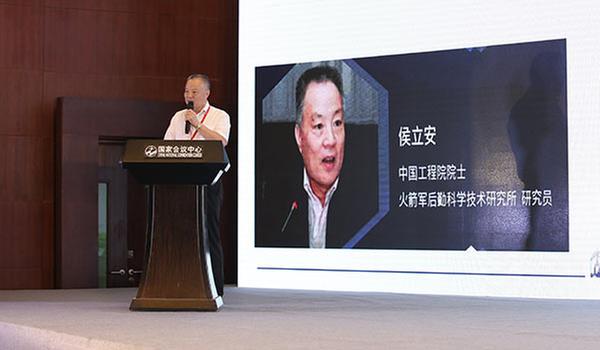 |
| Hou Li'an, an academician with the Chinese Academy of Engineering and an expert on environmental engineering, speaks at the 2017 International Forum on Sustainable Development of Steel and Coal Chemical Industry on Sept 7, 2017 in Beijing. [Photo provided to chinadaily.com.cn] |
By encouraging the application of new technologies, building industrial parks based on sound research and innovating with financial tools, iron, steel and coal petrochemical industries can do their part to clean up their surroundings, thus giving back blue skies and green waters to host cities, said attending experts at a seminar in Beijing.
Coal will continue to be a dominant source of energy for China in the upcoming 50 to 100 years and the nation's development in the 30 years to come demands 67,000 tons of iron and steel, so the coal and steel chemical industry will continue to play an important role in the national economy. This means there is great potential for engineering innovation and sustainable development of relevant industries, said Qi Tao, deputy director of the Institute of Process Engineering of the Chinese Academy of Sciences.
“My institute is now exploring new models to apply leading technologies by building pilot industrial parks based on research centers, which is expected to develop into mature industrial parks of ten billion yuan ($1.53 billion),” Qi said. “This will contribute to regional development.”
Sustainable development of the steel and coal chemical industry should also be studied in the context of the sustainable development of mankind and the integration of the global economy, said Zhang Yi, an academic with the Institute of Process Engineering of the Chinese Academy of Sciences.
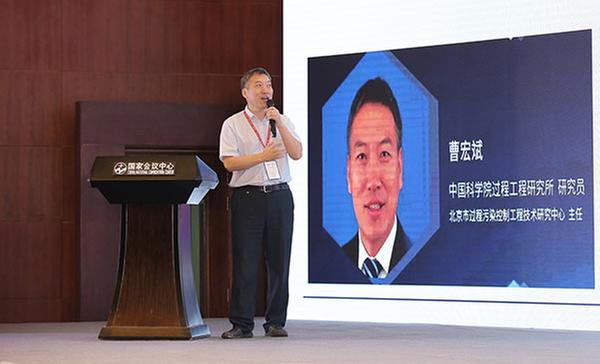 |
| Cao Hongbin, a researcher with the Institute of Process Engineering of the Chinese Academy of Sciences and an expert on process pollution control, speaks at the 2017 International Forum on Sustainable Development of Steel and Coal Chemical Industry on Sept 7, 2017 in Beijing. [Photo provided to chinadaily.com.cn] |
China is the first developing country to take actions against fine particulate matter, or PM2.5, and the country's air quality improved on the whole last year. Heavily polluted areas, such as the Beijing-Tianjin-Hebei region, the Yangtze River Delta region and the Pearl River Delta region, saw even cleaner air and the density of polluting particles decreased steadily.
Despite all these improvements, China's air quality failed to meet the standards of China and the World Health Organization, and the country is still faced with the arduous task of cleaning the air, said Hou Li'an, an academician with the Chinese Academy of Engineering
Most of the smog in the Beijing-Tianjin-Hebei region is generated by large coal and steel chemical plants in the neighborhood, and making the plants greener can greatly improve the air, said Zhou Hongjun, a China University of Petroleum professor.
The major challenge for China's steel industry is to find ways to effectively reduce new types of pollutants, such as nitric oxide and PM2.5, after bringing regular indicators like chemical oxygen demand under control so as to achieve harmony with surrounding cities, said Cao Hongbin, a researcher with the Institute of Process Engineering of the Chinese Academy of Sciences. The solution lies in developing sustainable, ecological steel companies.
By recycling the low-temperature residual heat and alkaline solid wastes, Baosteel, a leading Chinese steel maker, helped improve the quality of the soil and water by providing the neighborhood with 500,000 tons of water. The process also helped treat 9,000 tons of wasted oil annually, Cao said, citing a successful example.
“Making traditional industries cleaner also requires an expansion of financing and investment channels,” Hou said. “The development of ‘sponge cities’ and the treatment of polluted water systems both employ the public-private partnership model, and there is still a lot we can do to improve the model to allow the private sector to play its full role.”
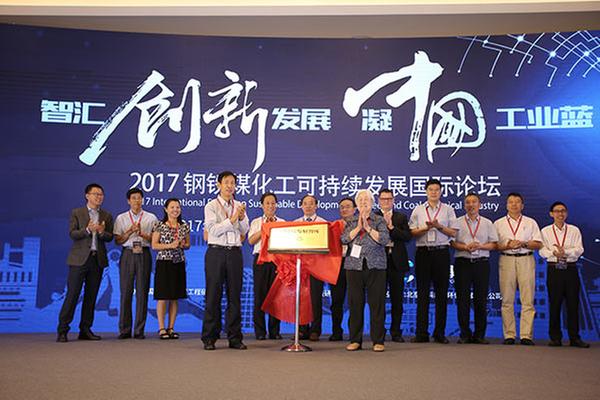 |
| Experts launch a think tank on sustainable development, the first of its kind in the steel and coal chemical Industry, at the 2017 International Forum on Sustainable Development of Steel and Coal Chemical Industry on Sept 7, 2017 in Beijing. [Photo provided to chinadaily.com.cn] |
Think tank launched
Those attending the seminar were witness to the establishment of the first think tank on sustainable development in the industrial sector.
The think tank is built on three well-attended industrial forums sponsored by Beijing Sino-Sci Columbus Environmental Science Institute, said Lin Xiao, a doctoral scientist with the institute.
With attendance from the scientific and research field, government departments, industrial associations and the business circle, the three forums on nonferrous industry, petrochemical industry and steel and coal chemical industry have accumulated a database of experts’ reports and information on the latest developments in related industrial sectors.
Aiming to develop into a long-term cross-industry and trans-regional exchange mechanism, the think tank will promote the commercialization of cutting-edge research results and the integration of traditional and emerging industries so as to upgrade the traditional industries with green technology, solving regional pollution problems caused by steel and coal chemical plants, Lin said.
Two academics with the National Academy of Engineering of the US, nine academics with the Chinese Academy of Engineering and 40 leading experts were hired as the think tank’s first batch of members.


- China's rail network sets new Spring Festival travel records
- Yunnan trains offer stools for standing passengers without seats
- China releases full text of government work report
- China advances biotech innovation: Expert
- Call to expedite visas for ASEAN patients
- School spring breaks set to spur tourism





