Healthcare will get a private boost









State Council OKs measures to improve services and expand nursing home choices
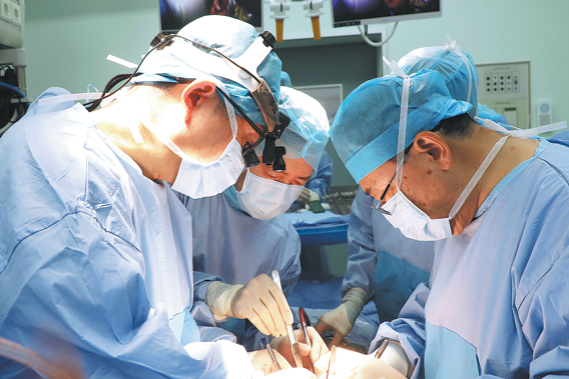
People will enjoy a greater variety of healthcare services, and have more choice of nursing homes as China encourages enhanced private investment in the sector as part of supply-side economic reform.
The State Council's executive meeting on Aug 30, presided over by Premier Li Keqiang, decided on a number of measures to remove unnecessary institutional barriers in medical and healthcare services to boost the sector's growth.
According to a statement released after the meeting, China's National Development and Reform Commission will introduce more streamlined approval procedures across different departments for the establishment of private healthcare and eldercare institutions. The meeting also urged related departments to work out solid measures to overcome limitations and speed up development of health services.
Li stressed that the health service industry is an important part of China's supply-side reform and is also of great concern for people.
"China still has immense market potential and demand for medical and health services," Li said at the meeting. "We should take concrete measures to boost development in the sector in the face of international competition."
The meeting called for the establishment of long-term, comprehensive guidelines to develop the healthcare industry with a combination of care for the elderly, tourism, sports and the internet.
It also called for more simple, streamlined approval procedures and administration for socially invested healthcare services as well as emerging types of healthcare institutions. Personnel training in healthcare and rehabilitation will be further enhanced, the meeting also decided, and policy incentives will be given to inventions and research involving innovation of medical and rehabilitation equipment.
Social investment in medical and health services has surged since 2013, along with the burgeoning demand that has come with the country's aging population and improvements in standards of living.
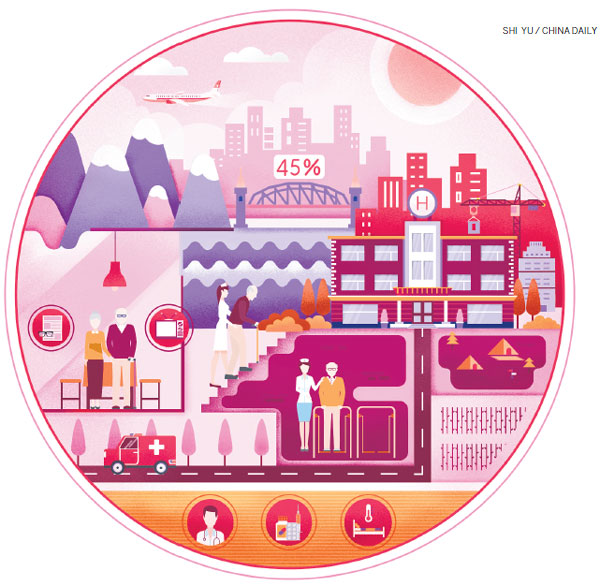
Private medical and healthcare institutions now account for 45 percent of overall healthcare organizations across the country, it was disclosed at the meeting, and the past several years have seen rapid development in rehabilitation services as well as healthcare through traditional Chinese medicine.
In 2016, health expenses in China totaled 4.63 trillion yuan ($708 billion; 595 billion euros; £548 billion), accounting for 6.2 percent of GDP, a number still much lower than that of developed countries.
The meeting also called for tax incentives for medical and healthcare industries.
Figures from the National Health and Family Planning Commission show that by April, China had more than 444,000 privately invested medical and healthcare institutions, and the number has doubled since 2011.
Xu Weijun, who runs a private nursing home for the elderly in South China's Guangdong province, feels greatly encouraged by the new policy and wants to expand his business.
"China will definitely have a large demand in private healthcare services, since the country's aging population is increasing and people's traditional ideas about the elderly are also changing," he says. "The key is more policy incentives for private investors and fewer administrative hurdles.
Having worked in the private healthcare sector for more than a decade, Xu points out some problems facing the industry. For example, most nursing homes are required to have their own medical clinic, but these clinics only provide treatment to the nursing homes' residents and do not treat patients from nearby communities.
"For the clinics within nursing homes, they should also be open to people outside the nursing homes, because this way they will improve their medical techniques and services," Xu says. "Also, when a clinic helps local communities, it will attract well-developed general practitioners."
zhangyue@chinadaily.com.cn
(China Daily European Weekly 09/08/2017 page14)






Today's Top News
- CPC leadership meeting urges steadfast implementation of eight-point decision on improving conduct
- Autumn grain purchases exceed 200m tons in China
- Wang to meet foreign ministers of Cambodia, Thailand in Yunnan
- China's top legislature concludes standing committee session
- Thailand and Cambodia agree to temporary ceasefire
- NPC's 4th annual session slated for early March