Ecological focus boosts tourism, agriculture









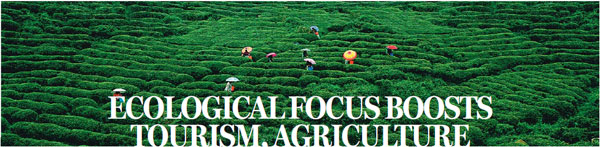
Decades ago, residents of Changshui village in northern Jiangxi province's Wuning county made a living by cutting down trees. Today, they earn more money by taking care of trees.
With a landscape featuring more hills than farmland, the village has conducted forestry industry reforms for about 10 years, shifting the focus from traditional farming and forestry to tourism.
Wuning's magnificent lakes and mountains are drawing tourists from around the world. Many European tourists come for an annual art festival. In the stunning mountain valley of Changshui, the government policies are drawing migrants to return from big cities to start businesses.
"What would attract the tourists if we cut down all the trees?" said villager Lu Xiancheng.
Lu and his two brothers operate an inn and sell local specialties, such as honey and fruits, which are popular with the tourists.
Throughout Jiangxi, cities and counties are pushing green development by conserving and protecting their lakes and streams, green hills and blue skies. But in contrast to many other regions in China, which focus on treatment after pollution, Jiangxi is seeking greater value from its already excellent natural environment.
Forests cover 63.1 percent of the province. Energy consumption per unit of GDP produced has reduced by 22 percent over the past five years.
The local governments in Jiangxi do not see economic benefits as the sole criterion when deciding to approve or introduce an industrial project. They also consider the environmental effects.
In 2015, a company wanted to invest 18 billion yuan ($2.7 billion) to build a thermal power plant in Zixi county. But before formal negotiations started, the local environmental protection authority launched an investigation and found the project would cause harm. So the county government rejected the project.
Similarly, the Ganzhou government rejected a building materials factory last year, even though it wanted to invest 500 million yuan and promised high revenue and tax payments.
Each governmental unit in Jiangxi has set up an ecology office to push green economic development and improve people's livelihoods through innovative policies.
Zhang Wei, director of the ecology office of Fuzhou city, said the mayor and other leaders are focusing strongly on the environment. The city has set up a high-tech zone focusing on new materials, traditional Chinese medicine, pharmaceutical manufacturing, big data and logistics.
Farmers are also required to use organic fertilizers and are not allowed to raise livestock along streams or lakes. Zhang said that farmers actually welcome these restrictions because they lower their capital costs and allow them to sell their products at higher prices. Many farmers can also attract eco-tourists to their villages.
As a national pilot smart city, central Jiangxi's Xinyu is attempting smart environment protection by establishing a real-time emissions and consumption monitoring network for the city's polluting companies, as well as its high-energy consuming companies and public buildings. Data for air and drinking water quality is also automatically publicized via official websites and social media.
An environmental and resource crime investigation division was set up under the police authority of Yanshan county in February, the first of its kind in the province.
In Shangrao, major tourism sites, including the Sanqing Mountain and Wuyuan area, attracted 78.6 million visitors in the first half of this year, increasing 32.6 percent from the same period last year. Tourism revenue rose to 68.2 billion yuan, up 32.4 percent year-on-year.
In Shangrao's Dexing area, the government has introduced a household waste treatment service that is commonly seen in urban areas to the countryside. It invested more than 17 million yuan to hire professional companies to collect and remove waste in Dexing.
davidblair@chinadaily.com.cn