Tackling graft is good for a nation's economic future









US free market absolutist ideologists pump out more irrelevant and confusing rhetoric than a giant squid pours out ink - the wave of criticism for China's anti-corruption policies being a case in point.
Critics claim China's economic slowdown is primarily due to President Xi Jinping's anti-corruption campaign, which has been carried out nationwide over the past five years, and that the country needs a drastic reduction in free private sector regulation to restore the sky-high annual growth rates it enjoyed for so many years.
Nothing could be further from the truth. These critics are mistaking a positive process of economic transformation and the maturing of China's economy and society as signs of terminal structural weakness. This is similar to a doctor looking at the hormonal change and other physical changes of growing teenagers and diagnosing them as dying of terminal cancer or old age.
While it is certainly true that China's export-driven growth has slowed in relative terms in recent years, it continues to enjoy massive surpluses, and China's economic growth and dynamism continue to dwarf those of other major Asian nations.
Japan especially has still to shake off the dire effects of more than 25 years of economic stagnation. The simplistic pump-priming infusions of cash favored by Prime Minister Shinzo Abe have failed to remedy the situation.
Were it not for massive spending on high-tech defense industries using know-how bought from the United States that is driving Japan's public sector even further into the red, the state of the Japanese economy would be even worse.
The massive scale and achievements of China's anti-corruption program are willfully misunderstood in much of the Western media. Far from slowing growth, the anti-corruption campaign is preventing or at least greatly reducing the incidences of corruption that if left unattended would divert the benefits of growth to a handful of people at the top of the national pyramid.
Correctly interpreted, the anti-corruption campaign should be seen not as the enemy of growth or as disrupting the benefits of growth, but rather as being essential to the growth process.
It is a universal truth that as societies generate more wealth, a handful of oligarchs at the top, if left to their own devices, will seize for themselves all the economic and political power and administer it narrowly and selfishly.
This was the pattern in the US during the half century of gigantic industrialization that followed the Civil War. The first two-thirds of the 20th century then saw long, slow and usually far too delayed efforts to slow down and eventually reverse this process.
However, in the four decades since the election of president Ronald Reagan, the US government has increasingly abandoned its crucial role as a moderator of economic concentrations of power in the country.
The result has been the devastating destruction of well-paying industrial jobs and the consequent growth of social pathologies across the US heartland, especially the current hard-drug pandemic.
That is why in my book, Cycles of Change, which tracks the patterns in US politics from Thomas Jefferson to Barack Obama, I entitled the political era launched by Reagan in 1980-81 as "Evening in America" - since it heralded decline, not growth.
The same US pundits who flatly refuse to acknowledge the corruption, unfair concentration of wealth and abdication by government of its responsibility to enforce economic and criminal justice have committed precisely the opposite error in the case of China. They look at policies that are both the consequence and necessary correction to economic success and industrial growth, and falsely mislabel them as signs of decline.
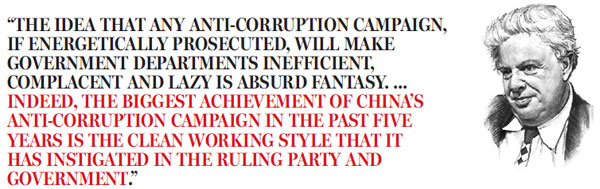
The idea that any anti-corruption campaign, if energetically prosecuted, will make government departments inefficient, complacent and lazy is absurd fantasy. Observed experience and recorded history show that the opposite is invariably the case. Indeed, the biggest achievement of China's anti-corruption campaign in the past five years is the clean working style that it has instigated in the ruling Party and government.
There are many reasons why China's growth in absolute terms has slowed, and Chinese leaders and economic planners have been coping with the impact of climate change patterns across Eurasia.
China has been energetically investing in land and maritime communications networks across Asia and in cultivating vast quantities of land across sub-Saharan Africa and Latin America.
These policies are proving immensely beneficial in raising the living standards and professional opportunities for hundreds of millions of people across China, and for billions more around the world.
The economic history of all prosperous industrial nations shows that a society needs more anti-corruption monitoring and restraint as an economy grows, not less. It also shows that the central government must not abdicate its responsibilities to protect its own people from such forces, and must also be vigilant in ensuring the industrial base and economy as a whole do not suffer from unfair patterns of international trade.
China's government has proven to be highly successful and responsible in carrying out these core obligations.
On the contrary, it is US growth rates that have remained at miniscule levels for decades.
According to Wall Street analyst Gerald Celente, median US income is now at 1999 levels; 51 percent of all people working full time in the US now earn only $30,000 or less and household ownership is at a 50-year low.
China's economic policies have raised a larger number of people out of poverty in a shorter period of time than any other recorded period in history.
The current slowing of overall growth rates and the success of the anti-corruption campaign therefore need to be recognized as inevitable and desirable outcomes of this remarkable success.
| Martin Sieff, senior fellow at the Global Policy Institute in Washington, US |






- China moves to set national standards for pre-made dishes
- Chinese company unveils plans for commercial space flights
- Latest addition to Shiziyang Bridge constructions brings main tower above 300 meters
- Hebei's 'ancient pressure cooker' setting internet ablaze
- Major urban renovation restores Xi'an's ancient moat
- China launches nationwide employment assistance program