



Space-age rail network may be in pipeline









Designers are investigating a revolutionary system that would employ magnetic levitation and hyperloops, as Zhao Lei reports.
A poll recently conducted by Beijing Foreign Studies University showed that the speed and convenience offered by high-speed rail, online shopping, shared bikes and mobile phone-based payment apps are the four things young expats in China view most favorably.
And of those four items, it seems likely that high-speed rail will remain on the list for a long time as the country works to retain its place as the home of the world's fastest trains. Now, Chinese designers are developing a bullet train capable of achieving a top speed of 400 kilometers per hour on conventional tracks, along with a magnetic levitation, or maglev, train that is expected to run at 600 km/h.
The country is even considering the possibility of building a system based on a transnational tube that would allow specially designed trains to travel at 4,000 km/h.
Last month, designers at China Aerospace Science and Industry Corp, one of the country's biggest space contractors, announced that they had started research and development work on a futuristic ultrafast transportation system popularly known as a hyperloop.
The CASIC hyperloop will see maglev lines running in partially elevated tubes or tunnels along which streamlined, engineless trains will travel at speeds of 1,000, 2,000 and 4,000 km/h, according to Mao Kai, chief designer of the system at CASIC. So far, there is no indication of how much such a system would cost.
By comparison, China's fastest wheeled train in commercial operation travels at about 350 km/h, while large commercial jetliners usually fly at 900 to 1,000 km/h.

The highest speed ever achieved by a railway vehicle was 603 km/h. That record was set during a test run of the Japanese L0 Series superconducting maglev in April 2015. However, the fastest operating speed of a commercial rail vehicle is 430 km/h, and was attained by the Transrapid maglev, developed in Germany, on a 30.5 km stretch of line that runs to the Pudong International Airport in Shanghai.
CASIC is the first Chinese enterprise to begin developing a hyperloop system capable of allowing trains to travel at 1,000 km/h or faster.
Depth of experience
The project will benefit from the company's experience in systems engineering and supersonic vehicles, CASIC said in a statement. The company is the third in the world to embark on such a venture, following Hyperloop Transportation Technologies and Hyperloop One in the United States.
Mao said CASIC is working with more than 20 institutes at home and abroad on the project and its technicians are striving to develop key technologies, such as those required to construct elevated hyperloop tube systems.
He added that once the project has been developed sufficiently, CASIC plans to construct a short line for trial runs for the 1,000 km/h version.
The 1,000 km/h and 2,000 km/h versions of the system would be used for intercity travel, while the 4,000 km/h version would form part of a transnational ultrafast transportation network, according to Mao.
"The reason we are eager to develop a 4,000 km/h version is that we believe such a line is technologically feasible, and that it will have business potential in terms of long-distance transportation in the future," he said. "Of course, safety and comfort will be at the top on our agenda when we develop hyperloop lines."
The maglev train's acceleration and deceleration within the tube would have to be relatively gradual and smooth to ensure passenger comfort, he said. Moreover, landforms and engineering considerations would determine what proportion of the line would be aboveground and how much would run underground.
Research competition
Zhai Wanming, an academician at the Chinese Academy of Sciences and a professor of traction power at Southwest Jiaotong University in Chengdu, Sichuan province, previously told Xinhua News Agency that when trains travel at 400 km/h or faster more than 80 percent of its traction power is used to counter air resistance. Therefore, a train can only maintain ultrafast speeds by running within a partially elevated tube, he said.
The idea of using magnetic levitation within a partial vacuum to carry people or cargo was floated by scientists many years ago. However, it gained new traction in 2012 when tech tycoon Elon Musk, CEO of SpaceX and Tesla, announced his ambition to build a hyperloop between Los Angeles and San Francisco.
Hyperloop Transportation Technologies and Hyperloop One have designed and produced prototypes and have signed agreements with several countries to conduct feasibility studies, according to media reports.
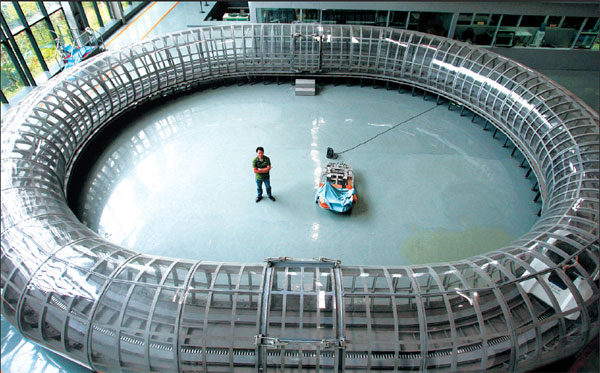
In May 2014, Southwest Jiaotong University announced that it had built the world's first experimental elevated loop tube for technological demonstrations of a high-temperature superconducting maglev vehicle it has developed.
A senior Chinese maglev scientist, who spoke on condition of anonymity, said vehicles reached constant speeds of 40 to 50 km/h during trial runs in the university's loop tube that were conducted to assess the system's overall design and resistance to vibration.
The scientist, who is close to the university's research program, said the college plans to develop vehicles capable of running at 400 km/h in a partially elevated loop tube. He added that the institute is also in talks with provincial authorities regarding research and development of a next-generation maglev/tube system with an estimated speed of about 1,200 km/h.
With regard to the feasibility of CASIC's hyperloop plans, the scientist said the company's researchers will need to address a number of technical issues, including communications and equipment-cooling techniques in an elevated environment.
"Moreover, CASIC will have to pay great attention to its project's profitability. My estimation is that the 1,000 km/h version will be economically and technically feasible," he said.
"Of course, from a technical perspective, the 4,000 km/h model could also become a reality if the engineers are able to work out solutions to issues related to propulsion, levitation and control."
Those points were echoed by Zhao Lin, an associate researcher at the National Laboratory for Superconductivity at the Chinese Academy of Sciences. Zhao said any enterprise that is seriously considering investing in a hyperloop system will have to take a wealth of factors into consideration.
"For example, the ultrafast speed would generate a lot of demands on the track and the material from which the maglev system is made. In addition, the cost of constructing and maintaining a long-distance, elevated tube would be extremely high," he said.
'Traditional' approach
Even before CASIC announced its hyperloop program, engineers at the State-owned railcar manufacturer CRRC Corp, the world's largest train maker, had started developing a new-generation bullet train with an operating speed of 400 km/h, which will probably become the fastest train in service on the planet.
It will be deployed on a series of new lines the government is planning to connect nations participating in the Belt and Road Initiative, a multinational economic venture proposed by President Xi Jinping in 2013.
The initiative consists of the Silk Road Economic Belt, which will link China with Europe via Central and Western Asia, and the 21st Century Maritime Silk Road, which will stretch from southern China across Southeast Asia, and even to Africa. The government estimates that the initiative could benefit approximately 4.4 billion people in 65 nations.
The axles and wheels of CRRC's new bullet train will be designed so they can be adjusted to fit a range of track gauges used outside China.
At present, goods can only continue their journeys after they have been transferred to rolling stock with the appropriate gauges when they cross national borders, according to professor Jia Limin of Beijing Jiaotong University, who heads China's high-speed railway innovation program, in an earlier interview with China Daily.
Experts have also been testing an ultrafast bullet train capable of traveling at about 600 km/h, but its designers have stressed that it has been built to test next-generation railway technologies rather than for commercial use.
Moreover, CRRC is designing two types of maglev - a 600 km/h high-speed version and a 200 km/h mid-speed version. The company expects to put them into service sometime around 2021, according to the designers.
At present, China operates 124,000 km of rail lines. That figure includes more than 22,000 km of high-speed track, about 60 percent of the global total.
Every day, at least 4 million people use the nation's high-speed trains, accounting for 50 percent of daily user numbers on the country's entire rail network.
Contact the writer at zhaolei@chinadaily.com.cn
| A scientist surveys a hyperloop used for trials of maglev vehicles at Southwest Jiaotong University in Chengdu, Sichuan province.Provided To China Daily |
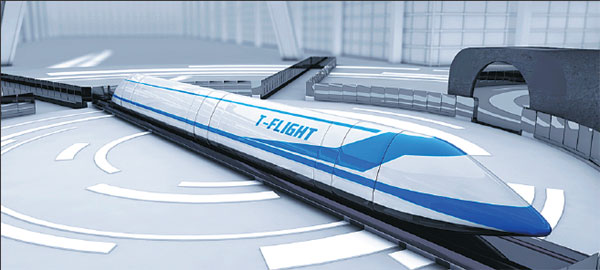
| An artist's impression of a maglev train that may be used on China's rail network in the future.Provided To China Daily |
(China Daily 10/09/2017 page6)


- Former deputy head of national forestry and grassland body charged with bribery
- China's basic medical insurance covers 1.33 billion people
- National Drum King Convention draws 14 top troupes to Hebei
- Documentary series Qiao! Beijing launches tomorrow!
- Horse herders turn icy grasslands into hot spot
- Paomapai pageantry puts hamlet in national spotlight





