



Battle to survive, in the water and air









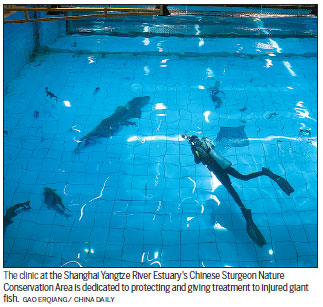
The clinic that Liu Jian manages on Chongming island northeast of downtown Shanghai is unlike any you will ever have seen. It is quiet, spacious, and empty - and indeed is desperately keen to have patients.
The clinic, covering 55,900 square meters and built in 2014, is officially named the Shanghai Yangtze River Estuary's Chinese Sturgeon Nature Conservation Area, dedicated to the giant fish believed to have existed for more than 140 million years since the age of dinosaurs.
The fish, known in Chinese as the Zhong Hua Xun or submarine panda, is 2 to 5 meters when it is fully grown, and is native to China. It mostly lives along the Yangtze River but has been on the brink of extinction for 20 years.
"It would be a gross understatement to say the Chinese sturgeon is at risk," said Liu, director of the administration office of the conversation area.
Liu, who has worked with the fish for almost 20 years, said that while overfishing and river pollution have caused the sharp fall in numbers, it has been discovered that it has stopped reproducing.
Chinese sturgeons spend most of their life at sea but because they migrate to the Yangtze River to reproduce they are regarded as a freshwater species. Dozens of dams have been built on the river since the 1980s and this has put its habitat at risk. In 2013, 32 years after Chinese scientists started to monitor and record the productivity of the fish, it was discovered no wild fish spawned naturally.
"It is as though the entire species has been sterilized," said Liu, in front of banks of sparkling, new medical equipment tailor-made for the sturgeon, all of it thus far unused.
But Liu and his team, as well as the Chongming district government, are not giving up.
Apart from working with other institutions to artificially breed the endangered species, the office has helped save hundreds of young fish from the 276 square kilometers where the Yangtze River enters the East China Sea and where the young fish would spend their lives before going out to sea.
"People often ask us what exactly a world-class ecological island is, or whether there is a prototype for the project we are working on," said Wu Zhaozhong, deputy governor of Chongming district. "I have to say there is none. But we believe that if we create an environment that is as friendly for humans as for animals that is bringing us closer to being ecological."
Under a plan made public by Shanghai municipal government at the end of last year on turning Chongming into a world-class ecological island, preserving Chinese sturgeon is one of the six key measures that would make the island a natural ecological region.
Another is protecting the migratory birds that stop off on Chongming and increasing their numbers.
For these birds, Chongming is a hospitable stopover site, a place where they can recharge and seek shelter during bad weather on their way to and from Australia and Russia, and it is estimated that the island receives an average of 290 species of birds, their numbers climbing to about 1 million in total a year thanks to the island's well-preserved wetland and natural habitats.
"We are running one of the world's busiest airports for birds," joked Tang Chendong, director of Chongming Dongtan National Nature Reserve.
Unlike Liu and the endangered sturgeons he is fighting to save, Tang faces a much more optimistic situation because the number of birds that flock to Chongming seems to grow every year.
Reserve officials estimated that last winter 60,000 more birds than in the previous year made a stopover on the wetlands, which cover 84 square kilometers, twice the area of nearby Pudong International Airport.
"That was the best I have seen in the 17 years I have worked here," Tang said.
In 2002 the region was listed as a Wetland of International Importance under the Ramsar Convention, also known as the Convention on Wetlands.
xujunqian@chinadaily.com.cn
(China Daily USA 10/13/2017 page8)


Today's Top News
- Intl brands see strong rebound in China
- Japan urged to adhere to a peaceful path
- Jimmy Lai sentenced to 20 years in prison
- Xi stresses sci-tech self-reliance in building modern socialist country
- Takaichi's election 'victory' calls for vigilance: China Daily editorial
- Jimmy Lai verdict shows Hong Kong's rule of law tolerates no foreign meddling







