Huiyan satellite helps measure new type of gravitational wave









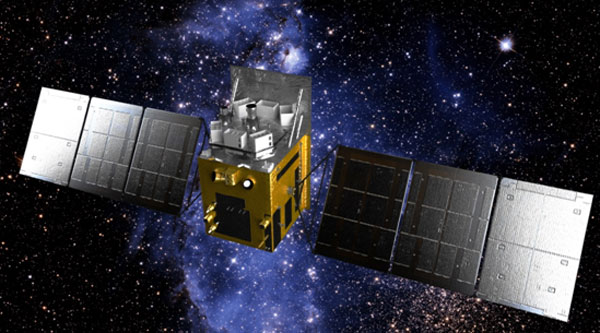 |
| A diagram of Huiyan satellite. |
A Chinese satellite helped define the energy level of a newly discovered gravitational wave — tiny ripples in the fabric of space-time caused by violent cosmic events.
Scientists at the Advanced Laser Interferometer Gravitational-Wave Observatory in the United States announced on Monday night they had discovered the first-ever gravitational wave created by the collision of two neutron stars — superdense remnants of massive stars — on Aug 17.
Huiyan, or Insight, China's first Hard X-ray Modulation Telescope put into orbit on June 15, has been cooperating with other observatories and located the source of the wave some 130 million light years away, according to a news release from the Institute of High Energy Physics, a unit of the Chinese Academy of Sciences.
Detectors from the US and Europe also found the collision had produced a short gamma ray burst — extremely energetic explosions often regarded as the brightest electromagnetic event in the universe.
This is the first time scientist has discovered gravitational waves and a gamma ray burst from the same event — important because scientist might be able to directly see the event thanks to visible light.
"Finding a cosmic event that can produce both gravitational and electromagnetic waves has been an aspiration of scientists," the news release said. "Studying such an event will have an irreplaceable, decisive significance in understanding the universe and fundamental physics."
To better understand the aftermath of a cosmic collision, the institute plans to build a telescope specifically for detecting gamma ray bursts from events capable of creating gravitational waves.
The project is called Shan Dian, meaning lighting, and, after approval, will be put into orbit by 2020. "It will make China a world leader in studying the electromagnetic aftermath of these cosmic crashes," the release said.
In the neutron crash, Huiyan defined the energy range of the gamma ray burst at between 0.2 million to 5 million electron volts. This energy level is "surprisingly weak" relative to the extreme properties that neutron stars have, the news release said.
Neutron stars are the superdense cores of massive stars that went supernova and died. They have a mass about 1.5 times that of the sun packed into a sphere around 20 kilometers in diameter.
They are so dense that a single teaspoon of neutron star would weigh a billion metric tons. They also have extremely strong electromagnetic fields and some are capable of firing radiation at nearly the speed of light — such stars are called pulsars.
In February 2016, the observatory announced it had confirmed the first-ever direct observation of Albert Einstein's gravitational waves — 100 years after the genius predicted them.
The first discovered gravitational wave was caused by the collision of two black holes, which are much denser than neutron stars. Since a black hole's gravity is so strong that not even light can escape, scientists could only illustrate and describe what happened, rather than seeing it directly.
Three US physicists — Rainer Weiss, Barry Barish and Kip Thorne — were awarded the Nobel Prize in physics this year for the discovery of gravitational waves.






- China moves to set national standards for pre-made dishes
- Chinese company unveils plans for commercial space flights
- Latest addition to Shiziyang Bridge constructions brings main tower above 300 meters
- Hebei's 'ancient pressure cooker' setting internet ablaze
- Major urban renovation restores Xi'an's ancient moat
- China launches nationwide employment assistance program