Let the good times flow









On the verge of failure after laying out 3 million yuan on a rice winery, a bridge rescues an entrepreneur and helps protect a local tradition from newer drinking trends
If there were just one man who disagreed with the sentiment that good wine sells itself, it would probably be Yu Jianrong.
Fifteen years ago, the government official quit his job at the age of 38 after deciding to seek his fortune by making laobaijiu, or sticky rice wine. But by 2010, Yu, a native of Chongming Island, northeast of Shanghai, was still far from realizing his ultimate goal: to make his hometown specialty as popular as China's national alcohol drink, Moutai, the manufacturer of which, Kweichow Moutai, overtook Diageo PLC as the world's most valuable liquor company this year.
| The Shanghai Yangtze River Bridge connects Chongming with downtown Shanghai. Chongming Island is the third largest in the country after Taiwan and Hainan. Gong Shengping / China Daily |

| Dongtan Wetland in Chongming. The region is to be developed into a "world-class ecological island" by 2040. Provided to China Daily |

| The island's laid-back lifestyle attracts people from mainland Shanghai to spend their weekends there. Gao Erqiang / China Daily |
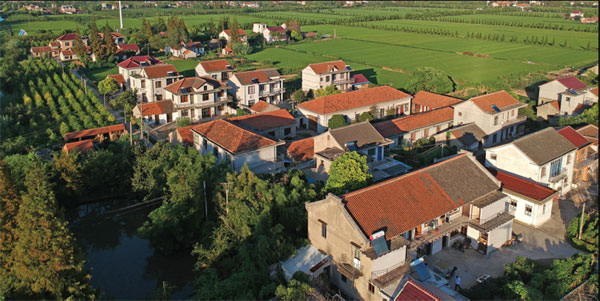
Just as he was about to give up, after having spent more than 3 million yuan ($455,000; 386,000 euros; £342,000) of his savings, his fortunes took a turn for the better when the Shanghai Yangtze River Tunnel and Bridge was completed and opened in 2009.
The world's largest tunnel-bridge structure, at almost 26 kilometers, has cut the travel time between downtown Shanghai and the island to 20 minutes from more than one hour. Previously, the only way to get to the island, at the mouth of the Yangtze River, was by ferry.
Since 2010, the number of tourists visiting the island - mostly from Shanghai for a weekend getaway - has doubled every year, the local tourism bureau says. Last year, more than 4.9 million visitors traveled to the island, which has a population of about 670,000.
"A Chinese saying has it that the bouquet of a good wine transcends the walls of the alley in which it is hidden to attract drinkers," says Yu, the founder of Nongben Winery. The name Nongben means the origin of agriculture.
"However, as confident as I was about my rice wine, I never expected it to travel across the Yangtze River, which it now does thanks to the bridge."
Residents of Shanghai once passed over the only wine that is produced locally in favor of other varieties such as yellow rice wine made in Shaoxing, Zhejiang province. They also continued to favor foreign imports such as red wine, something they started doing in the 1980s when the country began opening up to the world. For many of these drinkers, the local rice wine was old hat.
So during the 1990s, the retail price of laobaijiu dropped to 10 yuan a kilogram or less, almost the same as the price of the rice it is made from.
The Chongming district's government archives show that before the 1980s, the number of factories producing laobaijiu peaked at 50. Today, only five in Chongming produce grain-based wine, and Yu's is the only one that is privately owned.

Shi Zhongxiu, a researcher with Chongming's intangible cultural heritage preservation office, says the artisanal skills involved in making laobaijiu used to be something every family on the island cherished and passed on between generations. The "invasion of Western alcohols" has not only diminished the number of drinkers of laobaijiu, but also "killed the once-prevalent tradition of making sticky rice wine every autumn, after the rice harvest", Shi says.
In 2009, the municipal government designated the skill of making laobaijiu as an item of Shanghai's intangible cultural heritage that needed preservation. Later that year, the central government listed the wine as one of the country's Protected Geographical Indication Products.
Laobaijiu, which literally means old white wine, is believed to have been invented 700 years ago in Chongming, about the same period as Moutai, the wheat-based liquor, was first made.
By mixing and brewing the locally produced glutinous rice with qu, a special yeast made from Chinese herbs for fermentation, the wine takes on a distinctive sweet taste similar to rice wine but with a much stronger aftertaste close to spirits, despite its low alcohol content, which is usually less than 15 percent.
"The unique taste of laobaijiu has made it a hit with both males and females because it is sweet yet strong," Yu says. "Once people get a sip of it, they are just hooked."
Yu says he grew up with the aroma of the wine.
Last year, his sales were worth 3 million yuan, up by 20 percent from the previous year, he says.
In the difficult years, as a cost-saving measure, Yu had no retail space or sales staff and he managed to sell most of his produce, at between 136 yuan and 276 yuan a kilogram, on the phone to visitors who had been to Chongming and had drunk his laobaijiu in local restaurants.
In a BBC travel and food program about Shanghai last year, presented by British celebrity chef Rick Stein, Yu's wine was featured, together with soup dumplings and pork lard scallion oil pancakes, as the city's culinary specialties.
As for the ambition to compete with and even beat Moutai, Yu says he has not given up.
"However, it's no longer about sales. I think I've earned my pension. I just hope that one day when people talk about Shanghai, laobaijiu will be something that is as much a signature for the place where it is made as are Moutai and champagne."
xujunqian@chinadaily.com.cn
(China Daily European Weekly 10/20/2017 page16)



Today's Top News
- Militarism revival efforts criticized
- Leadership highlights Party conduct
- Forging a human-centered future in era of smart machines
- Land-sea trade corridor key to regional progress
- Local rules to be reviewed to help disabled
- Stronger RMB points to resilience