Handling contradictions in the 21st century









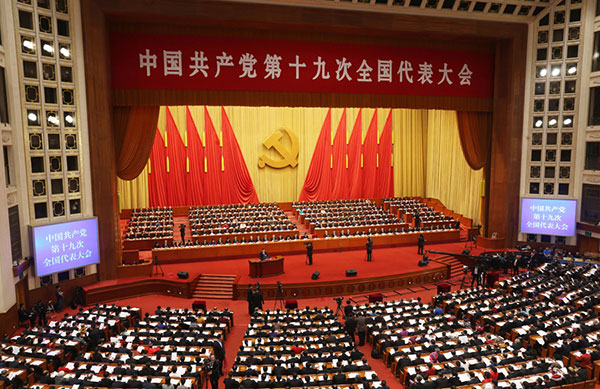 |
| The Communist Party of China (CPC) opens the 19th CPC National Congress at the Great Hall of the People in Beijing, Oct 18, 2017. [Photo by Edmond Tang/China Daily] |
Continuing China’s role as a leader in green technology expansion, fostering strong, equitable relationships with other countries, creating an example for the world in poverty alleviation — all these are noble achievements for which the Chinese people deserve credit, and objectively so.
But the moment that most stood out to me was one which undoubtedly left many in the West scratching their heads: the declaration China had entered a “new era”, one in which the “principal contradiction” had changed. No longer was the primary problem in Chinese society the clash between “material needs and backward social production”; we were now, Xi said, in an era where “unbalanced and inadequate development” is at cross-purposes with the “need for a better life”. This, according to Xi’s report, is the biggest dilemma facing the country, one in urgent need of resolution.
My guess is after this statement was made, a great deal of internet searches followed. I, on the other hand, found it hard to disguise my delight. See, in my university years, extracurricular reading tended to include writers who weren’t being taught in class. So when I wasn’t studying for film or literature courses, books by Marx, Engels, Lenin or Mao came off the shelf. The latter took on enough importance that my undergraduate thesis was on, in large part, Mao’s theory of contradiction. (It was received about as well as you’d expect at a US school.)
So hearing a direct reference to Mao’s philosophy in a major political speech came as a pleasant surprise. Sadly I, like many others in the Western left, wasn’t even aware the theory of contradiction had been maintained by the CPC. This can be attributed to a lack of serious study of China by English-speaking Marxist scholars since the 1960s. Most academic opinion written on the PRC these days is economic in nature, rather than philosophical. Because of this, topics in the basic education of every Chinese citizen are rarely researched outside niche intellectual circles in the West.
What, then, to make of this change? A vast philosophical shift of this kind — the first since 1981 — must have major implications for the future of the country. To explain it, one has to delve deep into dialectical materialism, a foundational concept in Marxist philosophy.
Luckily, much smarter people than I have already done that. In its essence, dialectical materialism is the “unity of opposites”, or the constant collision of opposing forces, combined with the understanding social practice — not the mind — determines reality.
Other philosophers and revolutionaries have expounded upon this theory, but where Mao and the modern CPC are concerned, one addition is key: the idea of the primary contradiction. In his 1937 pamphlet On Contradiction Mao argued, among other things, that not only does contradiction define all aspects of life, but certain contradictions emerge as the most imperative. Within these “primary” contradictions, or dialectical opposing forces, smaller contradictions appear. Apprehending the nature of the primary contradiction has been of paramount importance since the founding of the CPC, and, Mao argued, if contradictions are not handled correctly, societal disharmony will follow.
Previously, the primary contradiction has been between “foreign imperialism and domestic reaction and the masses of the people” during the War of Liberation and after; between the “bourgeoisie and proletariat” for much of the early years of the PRC; and “material needs and backward social production” since 1981. The third provided the philosophical underpinning for the market reforms of the 1980s, policy which propelled China into becoming the economic powerhouse it is today.
At the time, Deng Xiaoping and others concluded that despite China’s revolutionary success, the country’s level of development was insufficient to provide the Chinese people the quality of life they deserved. To resolve this contradiction, the “productive forces” — essentially the whole infrastructure plus labor power — had to be expanded and advanced. In other words, the economic base of China needed to be modernized in order to fulfill the people’s material needs. Thus, reform and opening-up began under the guidance of the government and the CPC.
The results are self-evident. In the years since, China has grown rapidly, becoming the second-largest economy in the world. A robust manufacturing sector complements higher-end tech and service industries, along with rising wages, low unemployment and a poverty alleviation campaign which has seen tens of millions living happier, more secure lives.
It is against this backdrop of accomplishment Xi has made a bold pronouncement, that the primary contradiction has transformed and the people face a conflict between “unbalanced development” and the “need for a better life”. This seems to signal a policy change for the future: no longer will growth happen for its own sake, and as development continues, the gains from this progress will be enjoyed equally.
This is heartening news to those who have been impressed by the historic eradication of poverty undertaken by China, but note persistent income inequality and a stark rural-urban divide. It also suggests future economic expansion will occur with the whole people in mind, meaning a continued reliance on green energy rather than pollutant fuels. Clean air is, after all, part and parcel of living a better life.
The broad philosophical implications of Xi’s National Congress speech are fascinating, but ultimately what matters is how government policy improves people’s lives. This is the test Marx himself articulated in his Theses on Feuerbach, so eloquently laying out differences between theory and practice while upholding the necessity of each: “The philosophers have only interpreted the world, in various ways. The point is to change it.”
For those of us in the West who still abide by this doctrine, last week’s speech was eagerly anticipated, as we look to China for global leadership. How happy we were to find in Xi and the CPC exactly what we wanted to hear.
The author is a copy editor with chinadaily.com.cn.