A view of the dawn of China









The people had an eye on heaven and a hand on the present, being masters of art and nation building
Chiming music rings out. Women with willowy waists dance, throwing their arms, enveloped in billowing long sleeves, this way and that. Scent wafts from a gilt bronze incense burner, perfuming the room and seemingly hypnotizing every guest.
The scene they contemplate is one of abandon, wine being pumped from a bronze wine retriever with a bird-shaped handle, and then copiously poured into jade-stem cups whose intricate cloud pattern must have taken hundreds of hours to make. Steam rises from a bronze hotpot as the sauce it holds begins to boil, ready for the dipping of meat.
| From left: Bronze wine retriever with bird-shaped handle; gilt bronze elephant and groom; gilt bronze incense burner; female musicians thought to be playing stone chimes and bells with batons that have long since ceased to exist. Photos by Jiang Dong / China Daily |

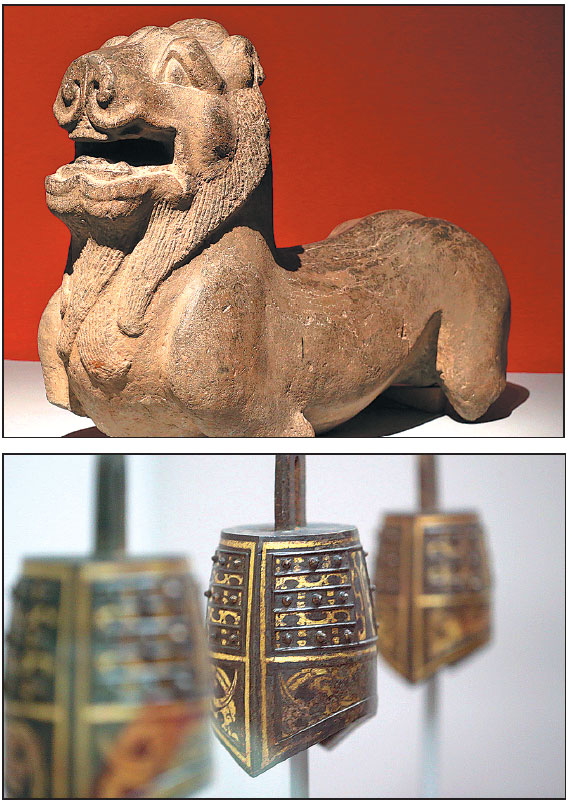
| Stone lion (top) made by Liu Han from Luoyang; bronze bells (above) inlaid with gold. |
When night falls, gilt bronze lamps light up, one in the shape of a ram whose back, semi-detachable from the rest of the body, can be inverted to form the oil holder. The gleaming light casts brooding shadows on the faces of the revelers, giving a sculptural feel to this ephemeral scene of carousal.
That kind of scene is what a visitor may well have in mind walking away from an exhibition at the National Museum of China titled The Glory of Qin and Han. The exhibition casts light on a distant era, offering a tantalizing view of a dynasty during which the notion "China" was formed and gained meaning. That dynasty was Han (202 BC-AD 220).
"The people of Han believed firmly in an afterlife," says Shan Yueying of the National Museum, who curated the exhibition. "So no effort was spared in preparation for that life in the underground world, especially given that it was supposed to be inhabited by the rich and powerful.
"Everything they had grown accustomed to, which made up their luxurious lifestyle, would remain unchanged."
That explains the existence of gilt bronze chime bells, pottery musicians, jade wine cups, elegantly shaped wine retrievers, beautifully patterned food vessels and an ingeniously designed hotpot, all excavated from Han tombs and all part of the exhibition that seeks to bring the magic of a bygone era back to life.
But before diving into that era, the exhibition glances at an empire that directly preceded Han, the Empire of Qin (221-206 BC), founded by Emperor Yingzheng, who united China for the first time in the country's history. The Qin Empire, which was supposed to last forever, lasted for a mere 15 years, with its demise coming 10 years after the death of Ying, who had tried to realize his vision with an iron hand. The fall of the Qin was followed by a period of chaos, when different forces vied for power. Eventually, Liu Bang, founder of the Han Dynasty, triumphed.
Thus began a golden era, whose achievements in nation building as well as arts and sciences provided textbooks for those who came after. One easily overlooked item in the exhibition is a palm-sized remainder of a Han Dynasty map. Against the earth-colored background, the black lines used to illustrate mountains, rivers and roads are still clearly visible. "This map, drawn on paper made of hemp linen and dating back to a period between 179 BC and 157 BC, directly contradicts the common view that papermaking was invented in China around 105 AD," Shan says.
Judging by the evidence, Han artists and artisans were strong believers in "form follows function", two millennia before the principle was enunciated by some advocates of modernist architecture in the early 20th century. However, unlike the modernists who in their practice often come up with minimalist, industrial designs, the Han seemed to believe that more is indeed better. Whatever they made, whether a lamp or a sword, or anything else, they spared no detail on it. Yet that detail, apart from being decorative, was also highly functional.
One example is a phoenix-shaped bronze lamp. The beak of the mythical bird, which is glancing backward, flares up to form the lamp shade, directly above the oil tray embedded in its back. When the lamp oil is lit, the smoke carries into the shade, entering the bird's long neck and from there is channeled into its chest. "The chest, filled with water, served as a cooling chamber for the smoke," Shan says.
The wine retriever, built on the siphon principle, is another example of combining beautiful design and clever engineering, and one to illustrate how far imagination could guide a Han craftsman.
"Unlike in following eras, in which an aesthetic mode gradually formed that could prove restrictive in many cases, the Han Dynasty was a period marked by unbridled imagination," Shan says. "Meanwhile, this free-flowing imagination went hand in hand with a solid and sober use of color that could only be described as regal."
One common combination is gold and bronze (as in metalware). Another is black and red (as in lacquerware). The latter coupling has in fact inspired Shan to wrap the entire show in "Chinese red" as appears in the interior of the lacquer vessels and plates on display.
"The craft of creating gold patterns on a bronze surface - sometimes silver is added to great effect - came into being with the widespread use of bronzeware," Shan says. "Later, when the use of bronze declined, the craft went down with it, before gradually slipping into oblivion. In the years that followed, the subtlety enabled by the use of contrasting colors was to completely give way to the unabashed glare of gold."
Reflecting on the wild imagination and majestic aesthetic of the Han Dynasty, Shan says it was underlined by the religious beliefs of the Han people, beliefs that informed their attitude regarding death.
"The people of Han, especially its ruling elite, were steeped in the idea of deification, and they relied on imagination to build the flight of stairs between their world and the world of immortality," she says, pointing to the nine-tailed fox and the three-legged crow that appear as brick relief in the exhibition. And in the overall design, they surround a female figure known as Mother Queen of the West, who was believed to hold the secret medicine to ward off aging.
The journey to eternity is lit up by, among other lamps at the show, a piece of painted pottery, one measuring more than one meter. With mountains interspersed with rivers and roaming wild animals and human beings forming its base, the lamp tree grows upward to form three tiers, each with a tray for lamp oil at its center and soaring birds as well as dragons carrying winged men on the rim.
"They are the heralds of another world," Shan says. "In a sense, the pursuit of immortality lifted the art of Han from the trenches of the mundane into a realm where imagination found no boundary."
But that does not mean those aiming high did not seek all the pleasures of the here and now - quite the reverse.
On display at the exhibition are a gilt bronze rhinoceros, an elephant and their two grooms, all unearthed from the tomb of Liu Fei, a Han Dynasty vassal king, in Jiangsu province.
"It's very likely the king raised these exotic animals in his own garden, animals coming from outside the Han borders," Shan says. (The king probably had also listened to bears roar - the animals continued to embellish his afterlife as jade mat weights.)
In an interesting echo to Liu Fei's rhino and bear, a carved stone lion turns up before the end of the exhibition. The lion, unearthed in Shandong province, bears an inscription on the back of its neck saying a stonemason named Liu Han had been brought to Shandong province from the city of Luoyang in what is now Henan province, just to make the lion, which once sat guarding the pathway to its owner's burial ground.
"Luoyang was the capital for the East Han," Shan says. "The Han Dynasty was divided into two periods: the Western Han from 206 BC to AD 24 and the Eastern Han from 25 to 220. Lions were probably kept in royal gardens in Luoyang. Although Liu Han, who did not enter royal service, probably had no chance to see a real-life lion, others did and recorded the images that eventually seeped out from inside the high walls of the palaces to provide a template for other artisans."
Meanwhile, the various pottery figurines unearthed from Xuzhou, Jiangsu province, seem to have been captured in a trance, in a fleeting moment that was rendered lasting.
Two kneeling female musicians are believed to have been hitting a chime bell, while four sitting chariot drivers are reining in the horses, with another four armored drivers sitting right behind them. But the batons with which the women ostensibly played the music are gone, as well as the ropes, whips and weapons that should be in the hands of the drivers.
The wooden batons and the ropes had long rotted, but the hollowed fists are still closed, a powerful reminder of a time when China started to become China.
zhaoxu@chinadaily.com.cn
(China Daily Africa Weekly 10/27/2017 page6)






Today's Top News
- Xi taps China's deep wisdom for global good
- New rules aim for platforms' healthy growth
- Chinese web literature grows overseas
- Postgrad exam trend points to thoughtful approach
- World's highest urban wetland a global model
- How China's initiatives are paving a new path to a better world