A German writer's perspective on China's soul-touching stories









Stefan Schomann attempts to stitch together a real-life impression of the country
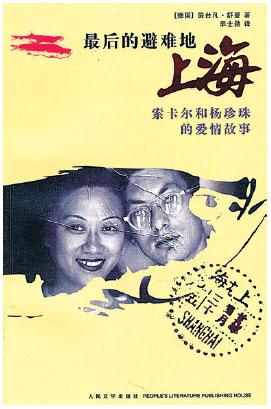
With its long history, China has always been a treasure trove of soul-touching sagas of epic proportions. The intercultural love story of a young Jewish man and a Chinese woman in war-torn Shanghai during World War II is one of them.
It was discovered by German writer and freelance journalist Stefan Schomann and became the subject of his book Last Refuge in Shanghai. Schomann calls it "a crazy story that happened in a crazy time" in an "exotic location".
In 1939, when Nazi Germany annexed Austria, Robert Reuven Sokal fled his country with his family, joining the band of fewer than 20,000 Jews who embarked on an odyssey from Central and Eastern Europe to the foreign concessions in Shanghai, one of the few places that didn't require Jewish refugees seeking sanctuary to have a visa.
| In the 1930s and '40s, thousands of Jews escaping Nazi Germany arrived in Shanghai, a place they could enter without a visa. Vision Shanghai / sh.qq.com |
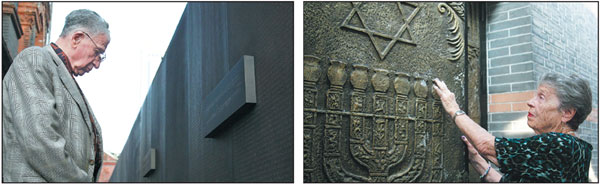
| A memorial wall at the Shanghai Jewish Refugees Museum lists the names of 13,732 Jews who found a haven in Shanghai during World War II. Vision Shanghai / sh.qq.com |
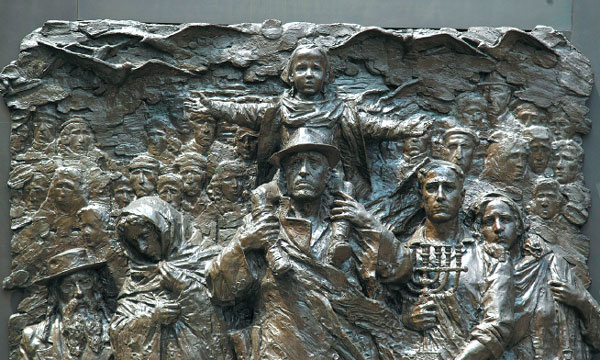
In Shanghai, while studying at St. John's University, Sokal, the son of a Viennese paint factory owner, met Julie Chenchu Yang, who was born into a wealthy Chinese family. By then, Shanghai was experiencing the pain of the Japanese invasion, and Shanghai's Chinese and Jewish communities shared a common sorrow.
"I was looking for a story that tells more than just this epic story of Jewish immigration to China, to Shanghai. I wanted to tell how China experienced the war ... what happened in China," Schomann says.
To combine a Eurocentric perspective with a Chinese one, which is rarely seen in earlier books on the Jewish community in Shanghai, Schomann talked to the Chinese neighbors of the refugees and Jewish survivors.
Since very few people know what really happened in the city in 1937, he thinks Last Refuge in Shanghai may serve to fill in gaps in history. "It was... important to me to tell this (story)," he says.
The young lovers supported each other through countless challenges, including turmoil and the cruelty of war, opposition from Yang's family and other obstacles in their intercultural marriage, eventually embracing a happy ending
Born in 1962, Schomann, a student of German literature, has been a frequent visitor to China for almost 20 years. He has been writing articles on China for leading German media outlets and has published four books on the country in German and Chinese.
He began to write in both languages after being inspired by Lin Yutang, the Chinese author who lived between 1895 and 1976 and wrote in a polished style in both Chinese and English. The German author says it was Lin who helped introduce China to him.
"It was absolutely fascinating to encounter such a bright mind from China, who was writing with such (ease)," he says.
Schomann describes Lin as a fascinating writer, philosopher, thinker and cultural activist, saying, "His books have a lot to (contribute) for a better understanding of Chinese culture and history and Chinese mentality."
Yet, understanding China is not an easy task for a Westerner.
"I think it's impossible to perceive (China) as a whole, or to judge (it) as a whole, or to make statements about (it) as a whole. It will just lead to strong simplifications and generalizations," he says.
He compares forming an image of China to piecing together a mosaic: "The big image is composed of many little images - pieces of the mosaic. And you are always working on one piece."
This perspective is best illustrated in his latest book, released in June, China - Strolls Through an Empire, which features 10 individual travel stories covering trips to a variety of Chinese landscapes, from wild deserts in the northwest to modern cities in the coastal east, as well as landlocked cities with ancient history and precious cultural heritage.
Schomann uses an article in the book to illustrate the concept of a mosaic. He writes about the two-day annual traditional storytelling festival in Central China's Henan province, where "the whole universe of Chinese culture, mentality and entertainment" is present, and he tries to present "the essence of this culture" in a 2,500-word narrative.
"As a journalist you take something quite limited, but then you open up a whole world within this topic," he says.
Schomann believes he is a peer of Chinese storytellers - one who, by using a different medium, shares his experiences, thinking and observations over the years "to create a comparatively easy access to China." He calls it a personal access.
"People are intimidated by China. It's such a big country and such a complex subject," he says, explaining how the language, with its system of characters instead of an alphabet, is alien to Westerners. And that is just one factor.
His aim is to help readers "overcome this intimidation of China, basically by telling people that you don't have to understand everything, just to make the first step, and the second, and the third, then you will be able to get somewhere".
To create a real-life impression of China, Schomann resorts to other things besides writing. While researching the Shanghai refugees, he came across some historical footage taken by German photographer Eugen Flegler (1897-1981).
Flegler went on excursions to take photos of the countryside and the peasants in and beyond Shanghai from 1936 to 1938. Very few people took pictures of China's rural areas in those years.
Schomann curated an exhibition of these historical images. It was held eight times in Germany and China.
Having documented China for years, Schomann has his own understanding of the Chinese Dream. He describes it as China "becoming a well-respected member of the global community, and increasing China's importance and significance on an international level".
Within two decades, China has made great progress toward that aim, he says. "China has become more international, more cosmopolitan, more respected on (the) international stage."
Xinhua
(China Daily European Weekly 11/03/2017 page22)



Today's Top News
- Forging a human-centered future in era of smart machines
- Land-sea trade corridor key to regional progress
- Local rules to be reviewed to help disabled
- Stronger RMB points to resilience
- US defense policy act fuels Taiwan tensions
- Japan's nuclear ambitions call for high alert: Editorial