A stream of entrepreneurs









In the stunning mountain valley of Changshui in Jiangxi province, government policies are drawing migrants to return from big cities to start businesses
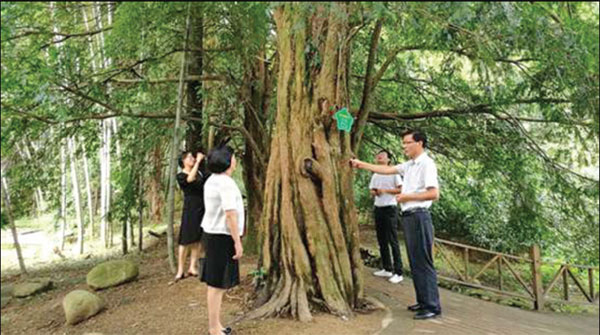
Two decades ago, residents of Changshui village in northern Jiangxi province's Wuning county made a living by cutting trees. Logging was degrading the environment and destroying rare Chinese yew trees, some nearly 1,000 years old.
Since the discovery in the 1990s that the trees create chemicals that can be used for cancer treatment, more than 50 percent have been felled, so it is considered especially important to protect them now.
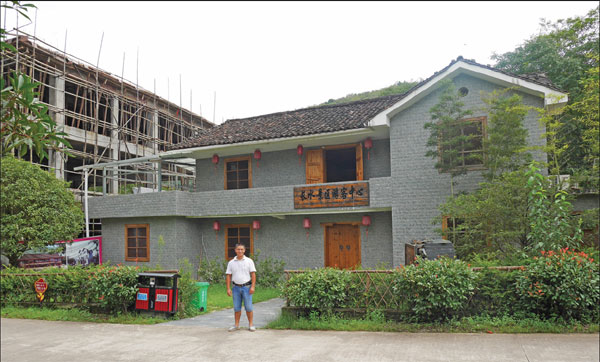
| Wan Liyun, a villager from Changshui village in northern Jiangxi province's Wuning county, prepares to open his inn. |
| Ke Shuisheng (right), deputy director of the Wuning county publicity department, with a 1,000-year-old Chinese yew tree. Photos Provided to China Daily |
Today, the villagers earn more money by taking care of trees, and many are seizing the opportunity to start small businesses throughout the valley.
The Changshui valley follows a rushing stream through lusciously green mountains for more than 12 kilometers. The spectacular views, clean air and forests are a natural attraction for tourists. "What would attract the tourists if we cut all the trees?" asks villager Lu Xiancheng.
Lu proudly shows photos of former premier Wen Jiabao's visit to his small inn in 2007. He says that, before the visit, he was a logger and carpenter, like most of his neighbors. At that time, the forest was held in common, so everyone had an incentive to log, while no one had a reason to protect it. But Wen's visit was the start of forest property reform, which gave the villagers individual plots and also paid them to maintain the trees.
Logging is now prohibited, so the villagers protect the forest because it attracts tourists. Lu says, "Mountains are like a green bank from tourism."
Lu and his two brothers now make around 200,000 yuan ($30,100; 25,900 euros; £22,900) profit annually and employ three or four workers, operating a small inn and selling local honey and fruits.
According to the World Bank, the introduction of eco-compensation programs and reforms in forest ownership starting in the 2000s stopped the earlier heavy cutting of China's forests. The central government provided cash payments and other incentives for farmers to engage in such activities as restoring marginal lands in fragile watersheds, planting shelterbelts to protect against sandstorms, and protecting natural forests. Reforms introduced nationwide in 2009 extended the contract period for household forest rights to 70 years and allowed households to mortgage their rights, strengthening the incentive for rural people to invest in sustaining forests.
A few kilometers up the valley, Wan Liyun has built a nursery growing Chinese yew trees for sale in Guangzhou and Shanghai. In addition to their beauty, the slow-growing evergreens are believed to help clean indoor air. Wan has also built a hotel and a tearoom that cantilevers over the stream.
Wan earlier worked as a delivery man in Guangzhou, where he was able to save enough to open a small supermarket. After he saved 600,000 yuan, he decided to move back to Changshui, his home village.
In addition to his desire to return home and breathe clean air, he says that government policies were key to his decision. National policy is that there is no tax on people who return to their home village to start an agricultural business. Also, the local government offered a low-rate loan and training to improve his business skills.
Farther up into the hills, at the point called Seven Mile Stream, entrepreneurs are cooperating to build an agritourism resort. Seven hotels and restaurants cooperate with each other, but each owns his or her plot and business. The government built the basic infrastructure such as the roads, forest hiking paths and a small museum of traditional agricultural life in the region.
Sun Gongjiao converted her home into a hotel and restaurant in 2015. She says tourists are attracted to the ecological environment. She also says good food is key, so she cooks authentic local specialties for visitors.
Before returning home, she owned a small shop selling vegetables in the nearby city of Jiujiang, in northern Jiangxi province. She says that she found it harder and harder to start a business in Jiujiang. But the Wuning government's support for environmentally sustainable business allowed her to return to her home village. The government offered training, a 400,000 yuan loan and construction of the required infrastructure. Her next step is to build 20 Bavarian-style cottages to house the many tourists.
Ke Shuisheng, deputy director of the Wuning county publicity department, stresses that the 13th Five-Year Plan's (2016-20) goal of building an ecological civilization, rather than pushing pure GDP growth, has been key to the area's development strategy. "Ecology is the biggest advantage of Wuning, and now ecological civilization is the strategy of China," he says. "Now we don't have any pressure just to push development. Now we can work hard to pursue a rich, happy and beautiful Wuning."
davidblair@chinadaily.com.cn
(China Daily European Weekly 11/03/2017 page8)





Today's Top News
- Sanctions show China's resolve to safeguard its sovereignty and territorial integrity
- China OKs three action plans to build pilot zones for a Beautiful China
- CPC leadership meeting stresses steadfast implementation of eight-point decision on improving conduct
- China launches steps against US defense firms, individuals
- Militarism revival efforts criticized
- Leadership highlights Party conduct