Giant plant could boost rice harvests









The increased capacity for aquatic products can also raise income of farmers, says expert
The scientist behind China's "giant rice" says he believes the crop could boost yields across Southeast Asia and other Belt and Road Initiative countries, helping to ease global concerns over food security.
Xia Xinjie, chief researcher at the Chinese Academy of Sciences, says his newly developed rice plant can better adapt to conditions such as climate than the rice plant strains currently in use.
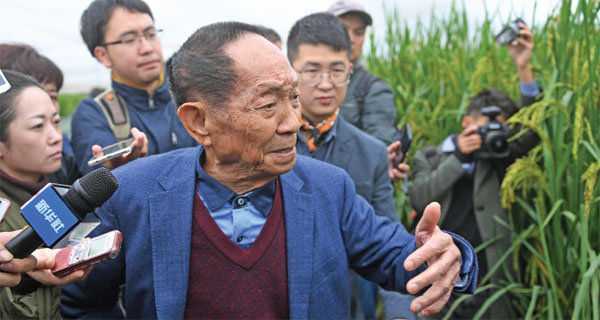
| Biologist Yuan Longping at the "giant rice" test field in Changsha, Hunan province. |
| Xia Xinjie, chief researcher at the Chinese Academy of Sciences, checks the growth of the "giant rice". Photos by Xinhua |
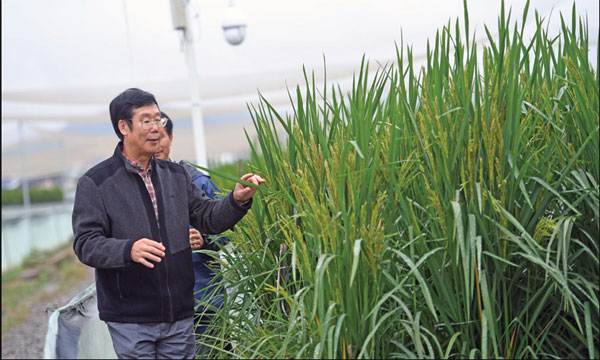
The new plant grows to about 2 meters, almost twice the height of standard varieties, and has a longer growth cycle. A test in Hunan province this month yielded 15,000 kilograms per hectare, just short of the record 17,000 kg set by the newest hybrid rice strain.
Xia is confident his rice will one day surpass hybrid rice yields. "Hybrid rice has almost reached its maximum capacity, but (the research team developing) giant rice is charting a new route to record-breaking yields by increasing the biomass, or weight, of the plant," he says.
The taller plant also allows increases in the capacity for aquatic products in paddy fields, which can increase farmers' incomes, he adds.
"For common rice plants, the water level is low and there is limited space for raising aquatic products. Sometimes, overcrowded aquatic products can reduce the rice output. But with higher rice plants, 300,000 frogs could live comfortably within a hectare of paddy, and bring in an extra 300,000 yuan ($45,000; 38,800 euros; £34,200) per hectare for farmers."
However, after the initial media reports about Xia's giant rice, concerns have been raised over its cost-effectiveness and whether it would increase the use of fertilizers.
A user of Zhihu, a Chinese question-and-answer website, wrote that "extra tall rice plants would require newly developed reaping machines and certainly more fertilizers, thus compromising the cost-effectiveness of the new breed".
Xia says the harvest of giant rice can be managed by standard reaping machines, although "it could lead to some waste". He adds that if the giant rice is to be planted on a large scale, "some modifications" to the reaping machines will be needed.
As for fears over the need for more fertilizer, he says that although the higher rice plant requires more nutrition, farmers do not need to apply extra fertilizer.
"It's because many paddies are already suffering from ... too much fertilizer," the scientist says. "Giant rice can grow to 2 meters even though farmers do not increase the fertilizer volume. Besides, the excrement from the aquatic products provides a natural fertilizer."
Xia began his research in 2006, after he was inspired by the achievements of biologist Yuan Longping in developing super hybrid rice.
"I was working for a US agricultural biotechnology company then. After I watched a TV program introducing Yuan's super hybrid rice, I was encouraged and wanted to return to China to continue my previous research on paddy rice," he says.
After continuously selecting and breeding plants that met his requirements to create a taller, stronger rice plant with bigger flower clusters and stronger stalks, he started trial planting in 2014.
He says the new breed is "100 percent free of genetic modification".
"Tens of millions of yuan were invested in the research. Quite a few entrepreneurs offered to sponsor the project at the beginning, but many withdrew because the breeding process was too long and the result was uncertain," he says.
He plans to expand the planting of the giant rice plant to more than 130 hectares next year, if authorities grant approval. Currently, only several dozen hectares of giant rice have been planted in Hunan.
Contact the writers at lilei@chinadaily.com.cn
(China Daily European Weekly 11/03/2017 page25)




Today's Top News
- Militarism revival efforts criticized
- Leadership highlights Party conduct
- Forging a human-centered future in era of smart machines
- Land-sea trade corridor key to regional progress
- Local rules to be reviewed to help disabled
- Stronger RMB points to resilience