Beijing's growing backbone









The capital's north-south axis reflects Chinese culture as well as the country's history
Chinese architect Liang Sicheng, a pioneer of heritage preservation, says the "unique beauty of Beijing's design is due to its zhongzhouxian".
The capital's north-south central axis, or zhongzhouxian, possibly the world's longest and greatest, according to the architect, has been extended and rejuvenated many times over the centuries.
The original zhongzhouxian during the Yuan Dynasty (1271-1368) stretched to 3.7 kilometers. During the Ming (1368-1644) and Qing (1644-1911) dynasties, its length increased to 7.8 km, from Yongdingmen in the south to the Drum and Bell Towers in the north.
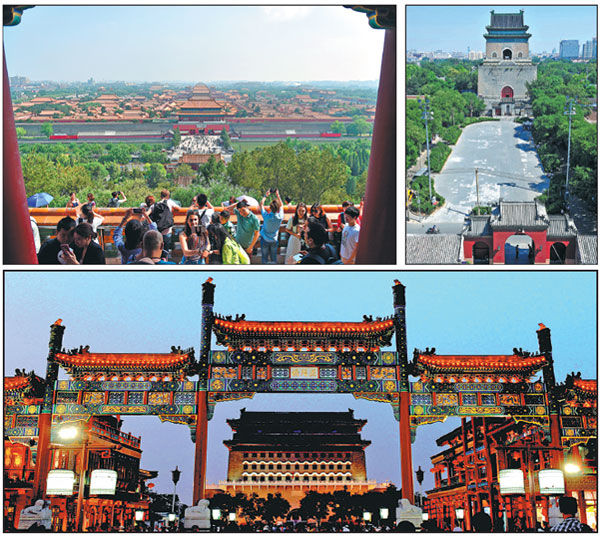
| Clockwise: Tourists look at the Palace Museum at Jingshan Park; a photo from 2008 shows the Bell and Drum Towers; a night view of Qianmen Street in 2009. |
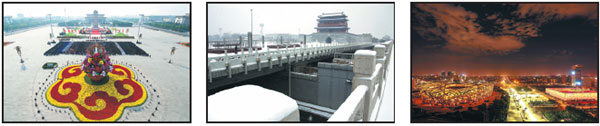
| From left: Tian'anmen Square in the center of the capital features the Chairman Mao Zedong Memorial Hall and the Monument to the People's Heroes; a 2011 picture shows Yongdingmen Gate; a night shot of the Beijing National Stadium, or the Bird's Nest, and the Beijing National Aquatics Center, or Water Cube. Xinhua Photos |
The axis was extended again in 2003, when the city prepared for the 2008 Olympic Games. Olympic Park is considered to be one of the most important areas along the axis today.
The China Science and Technology Museum there has been open to the public since 2009. Next door, the new China National Sinology Center building has been completed. And construction of the headquarters of the Asian Infrastructure Investment Bank began in September last year.
Zhao Jin, operations director of Beijing Inno-Olympic Group Co, which is Olympic Park's property management company, says the China Intangible Cultural Heritage Hall and the new site of the National Art Museum of China are also to be built along the zhongzhouxian.
"Together with the Bird's Nest, the Water Cube and the China National Convention Center, the northern extension is expected to be a national hub for culture, sports, technology and finance," Zhao says.
Olympic Park has hosted a total of 410 million people, including tourists and visitors, from 2008 to 2016, according to Zhao.
On a clear day, from the top of Yangshan, the main peak of the Olympic Green, it is possible to see Jingshan, the highest point of the original zhongzhouxian, 8 km to the south.
"It is like the backbone of Beijing's urban spatial structure," says Beijing historian Li Jianping.
Li says it reflects Chinese culture, in which the center is viewed as the focus. The zhongzhouxian separates the central districts of Dongcheng and Xicheng.
Along it are the historical buildings of Qianmen, the gate that once guarded the southern entry into the inner city, the Forbidden City, Jingshan Park, and the Drum and Bell Towers.
The Chairman Mao Zedong Memorial Hall, the Monument to the People's Heroes and Tian'anmen Square are lined up along the axis.
"This reflects the Chinese idea of 'center worship'," says Li.
The aesthetic of symmetry is found along the zhongzhouxian. The Great Hall of the People and Beijing Zhongshan Park, or the Park of Sun Yat-sen, are on the west side, while the National Museum of China and Beijing Working People's Cultural Palace are on the east.
"Beijing has been built according to a 'checkerboard' planning system since the Yuan Dynasty," says Wang Shiren of the city's history and culture preservation committee, "while many of the capitals of other countries have less-structured layouts influenced by the Renaissance."
The Beijing municipal government officially kicked off its campaign to have the main historical sites along the city's central north-south axis included as part of the world's cultural heritage in 2011.
Wang says the zhongzhouxian used to have 42 historical sites, and 36 of them have been preserved or rebuilt, including Beijing Zhongshan Park, which used to be the imperial altar of land and grain, built in 1425, and the Beijing Working People's Cultural Palace, which was the royal ancestral temple before the founding of the People's Republic of China in 1949.
Meanwhile, there has been criticism that some of the preservation has seen excessive renovation, such as Yongdingmen Tower. The original south end of the zhongzhouxian was rebuilt in 2004.
Feng Feifei, director of the Urban Design Department of the Beijing Municipal Institute of City Planning and Design, says the city has experienced different historical periods with different value orientations. "The zhongzhouxian's urban function has also differed," she says.
For this reason, various cultures are on display along the axis, including the culture of old Beijing from Yongdingmen to Qianmen, the culture of New China from Mao Zedong Memorial Hall to Tian'anmen, and the imperial culture of the Ming and Qing dynasties from Duanmen to Jingshan Park, historian Li Jianping says.
The city is aiming to make progress in becoming a top international capital over the next five years, according to the city's new development goals unveiled in June.
The capital is striving to improve as the country's political, cultural, international and innovation center. "A long history means a rich cultural heritage," Feng says.
Ji Xiang and Zhang Lili contributed to this story.
China Features
(China Daily Africa Weekly 11/10/2017 page20)




Today's Top News
- Macao SAR holds flag-raising, reception to mark 26th anniversary of return to motherland
- China issues rules to regulate pricing practices of internet platforms
- US hits over 70 IS-linked targets in Syria in massive retaliatory strikes
- Technological innovation brings cultural heritage alive
- Consumption to play bigger part in growth
- Opposition moves to impeach Lai