Building a modern economic system









Crucial steps are needed to capitalize on China's success and transform the nation for a greener and brighter future
China and the United States have relatively similar levels of trade, but the scale of the Asian nation's economy is less than two-thirds that of the US. If China is able to construct a modern economic system and a financial system to go with it, it will have huge room for development. In other words, if China wants to realize the sustainable development of its economy, it has to transform its economic system.
To understand the type of economic system that China should construct, I think there are several important elements that we should not miss considering.
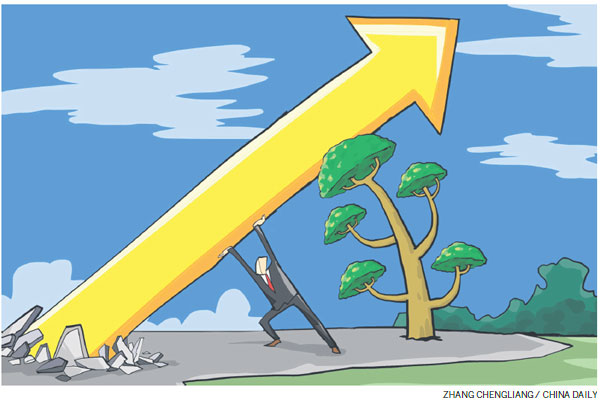
First, a modern manufacturing industry, a modern equipment industry and emerging advanced technology industries have to play a key role in the modern economic system. I think the modern manufacturing and modern equipment industries, which are very high-tech, will account for an increasing ratio in China's manufacturing sector. Moreover, service industries will also be really well-developed. This kind of industrial structure will be more competitive, with the traditional industries and industries that are over-reliant on resources reducing their ratios. So industry's technology level will be higher and the economic structure will be more reasonable.
Second, the modern economic system has to be green and be able to showcase an ecological civilization. Over the past 40 years, China's economy has witnessed quick growth, but an obvious feature has been its overuse of resources. Natural resources, a demographic dividend and other factors, boosted by China's reform and opening-up, have pushed forward the country's economic growth. But now China has a large population, and the demographic dividend is about to disappear. Artificial intelligence and technology will be able to make up for the negative impact brought about by shortages in the labor force. High-tech will ease the negative influence brought about by the population problem on economic growth.
In the past, our leading industries were highly related to natural resources, but that mode of development has severely damaged and threatened our ecological and living environment, so a green, environmentally friendly and ecologically civilized economic system is important.
Third, China's economic system in the future should pursue quality and efficiency rather than quantity. The report of the 19th CPC National Congress does not mention exact figures for a growth target in its development strategy for China by 2025, which means the country needs relatively stable growth, but with a more high-quality, highly efficient economic structure and system. It has to improve the social welfare level. In the past, we pursued GDP growth and growth in tax and fiscal revenue. These are important for a country, but social welfare is even more important. So we should make sure the whole of society enjoys an improvement in livelihood and quality, which indicates that industries that are closely related to social welfare - such as healthcare, the medical industry, education and elderly care - should improve.
Fourth, the modern economic system should be market-oriented rather than government-dominated. A planned economy doesn't have many advantages and would reduce the dynamics of the economy, even if it were based on big data technology. The modern economic system should be market-oriented, competitive and open. It should allow China's economy to integrate with and become part of the global economy. To some extent, China's economy in the future should play a leading role in the development of the world economy.
Fifth, the basis for the modern economic system is the real economy, including modern manufacturing and the modern equipment industry, but at the core should be a modern financial system. Compared with the traditional financial system, the modern financial system will play a role that is more important than ever in the modern economic system. At present, we cannot say that China's financial sector has become the core of China's economy. Even if it has, it doesn't mean the financial sectors would develop without the real economy's development. In the whole process of economic operation and resource allocation, the modern financial system would play a key role, but it cannot be self-cycling or based on false prosperity. A modern financial system would boost China's stable economic growth and reduce economic risks. Its core function is to help with risk decentralization and risk control, boosting the real economy and taking financial risks within a reasonable scope.
A modern financial system that is core to the modern economic system should have the following three characteristics.
First, it should be highly market-oriented, and financial resources should be allocated though the market rather than through organizations. At present, financial disintermediation is stronger than ever in the market. An important symbol of the modernization of a financial system is that in the whole of society's financial assets, the ratio scale of securitized financial assets should be growing. This means the modern financial system will be different from in the past, when financing was the main function, moving on to an era where financing and wealth management are both important.
Second, the modern financial system must be high-tech, as technologies' penetration into the financial arena will be stronger and more obvious than ever. The integration of finance and technology will create strong interest. Without high-tech, the financial sector will remain at a very traditional stage and financial services will be restricted. For example, in the past we needed to take our ID card to a bank if we wanted to transfer money, but when technology is used we can transfer money just by using our mobile phones. Technology is changing China's financial formats.
At present, China's fintech, or the third-party payment technology based on the mobile internet, is very influential in the world. The new payment format is helping boost China's economic restructuring and transformation.
Third, the modern financial system must be open, as should the modern economic system. From a global perspective, China's financial sector has great potential for growth. China also aims to become an international financial center. In May, 2009, the State Council, China's cabinet, decided that by 2020, China will build Shanghai into an international financial center to match the country's economic and financial environment. This means that, by then, the yuan could be freely exchanged.
Free trading and exchange of the yuan is also important for constructing a modern financial system. On Oct 1 last year, the Chinese currency joined the IMF Special Drawing Rights basket. The US dollar has a weighting of 41.73 percent in the new basket, with 30.93 percent for the euro, 10.92 percent for the yuan, 8.33 percent for the Japanese yen and 8.09 percent for the British pound. Though the yuan is listed as the third, its real market share hasn't reached that far yet, but we are confident of increasing its ratio. With yuan internationalization and the forming of international centers, overseas capital could also better invest in China's capital market. Bond markets and stock markets that are open, well-developed and with good flow ability will be important for attracting overseas capital to China.
All in all, if China is able to construct a smoothly modern economy and financial system, its economic development will be guaranteed.
Wu Xiaoqiu is vice-president of Renmin University of China and director of the university's Finance and Security Institute. The views do not necessarily reflect those of China Daily.
(China Daily Africa Weekly 11/10/2017 page10)




Today's Top News
- Judicial reform critical for modernizing governance
- Effective use of investment emphasized
- China's shuttle diplomacy strives to reach ceasefire
- Nanjing Museum's handling of donated art, relics being probed
- Key role of central SOEs emphasized
- New travel program hailed as 'milestone'