



From saving people to saving snakes









Former physician's curiosity leads to discovery and protection of Mangshan pit viper
At the gate of the Mangshan Museum of Natural History stands a statue of an elderly man with a snake wrapped around his shoulders.
Crowds of tourists visit the museum in Chenzhou, Hunan province, to see the Mangshan pit viper, a species endemic to China and more endangered than the giant panda.
They are also attracted by the story of the man commemorated by the statue - curator Chen Yuanhui, a 68-year-old former doctor who has gone from saving people bitten by snakes to saving serpents from extinction.
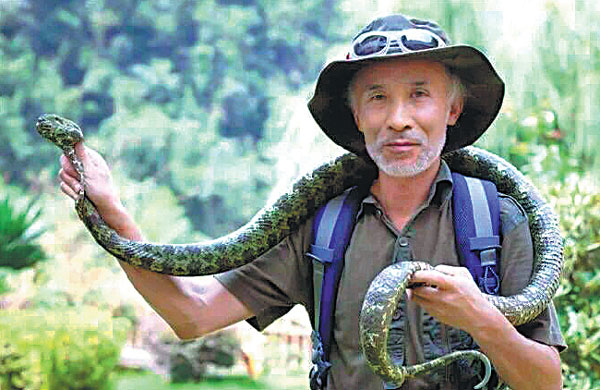
| Chen Yuanhui poses with a Mangshan pit viper in the Mangshan Mountain National Nature Reserve, Hunan province. Photos by Zhang Yi / For China Daily |
Last month, the museum received media attention after Chen's team observed 10 snakes hatch in a simulated wild situation for the first time.
It marked an important step in understanding the species and increasing its wild population, which stands at between 400 and 500.
Surprise discovery
In 1984, Chen, who was working as a doctor at the staff hospital of Mangshan Forest Farm, treated a worker who had been bitten by a snake. The patient described the snake as "thicker than a beer bottle" with "green markings and a white tail".
"I had never heard of such a snake," Chen said. However, it reminded him of the totem of the Yao ethnic group - a small green dragon, making him wonder if that dragon was really an unknown species of snake. Chen began to search for the snake in the dense primeval forest surrounding Mangshan Mountain.
In 1989, he heard that two villagers were selling rare snakes. Chen found them and discovered that the snakes matched the description given by his patient years before. He spent 400 yuan ($60), which he had set aside to buy a refrigerator for his home, to purchase the snakes.

"I was excited because I thought it might be a new species, but nobody would believe me," Chen said. He sent photos to provincial wildlife experts, but the black-and-white pictures were not enough to confirm the new species.
Chen took the snakes on a two-day train journey to meet the late prominent zoologist Zhao Ermi in Chengdu, Sichuan province. In 1990, the two scientists issued a paper announcing the confirmation of a new species of snake to the world. It was named Trimeresurus mangshanensis, commonly known as the Mangshan pit viper, after the mountain where it was discovered.
Dangerous obsession
Chen was not satisfied with just discovering the species, he wanted to protect it at a time when environmental awareness was not great.
He realized protection required scientific research. So he started a small-scale artificial breeding program in his home. This put the whole family in danger. A bite from a Mangshan pit viper can kill within two hours if the patient does not receive treatment.
Chen has survived more than 20 bites over the past three decades. In 2003, he was bitten as he tried to release a young snake he had treated for an injury. He was unconsciousness for three days and lost a finger.
There is a Chinese saying, "Once bitten by a snake, the mere sight of a rope will scare you for the rest of your life." Chen has defied this by continuing to work with the snakes after his injury.
During the recent decades, he has published more than 40 papers on the species, calculated the wild population and their distribution area.
There are fewer than 500 Mangshan pit vipers in the wild, far fewer than the population of wild giant pandas. Fame can bring trouble for men and snakes alike. As the existence of the rare species became known, smugglers tried to buy the snakes from Chen, but he refused.
"I needed money, but I knew if started selling the snakes, the species could disappear within three to five years," he said.
Chen also refused the help of a foreign zoologist who offered to set up a breeding program outside China. "I told him that China is able to protect the species," he said.
As China's wildlife conservation efforts and public environmental awareness have improved, Chen is no longer alone in protecting the endangered species.
Mangshan Mountain National Nature Reserve was set up in 1993. The species was listed as endangered on the International Union for Conservation of Nature's Red List of Threatened Species in 1996.
In 2004, the Mangshan Museum of Natural History was established, which is dedicated to the conservation of Mangshan pit vipers.
A rare snowfall in 2008, which killed more than 100 pit vipers, forced Chen and his colleagues to speed up research on artificial breeding. So far, over 100 snakes have been born through the breeding program and most have been released into the wild.
Around 200,000 tourists visit the area annually, attracted by the rare pit vipers and the natural scenery of Mangshan Mountain, providing more jobs and higher incomes for local residents.
"I never expected that protecting the snake would also benefit the local people, but it is also important to me," Chen said.
With his silver hair and whiskers, Chen is easily recognized by tourists who often want to take photographs with him. He is always open to meeting those who come to see his snakes.
"Snakes are coldblooded animals. My late wife used to joke that I am also coldblooded. But my heart is warm. I love the Mangshan pit vipers more than myself," Chen said.
Xinhua
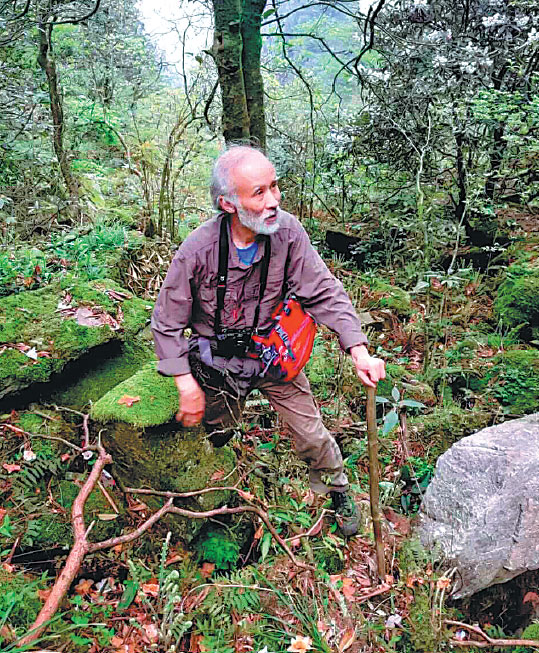
| Chen searches for a pit viper in the forest on Mangshan Mountain. |
(China Daily 11/14/2017 page7)


- Miss Jasmine on the Pleatau
- Royal College of Art center launched in Shanghai
- Beijing police intensify crackdown on counterfeit goods, piracy
- 9.41 billion cross-regional trips made during 2026 Spring Festival travel rush
- Rapeseed festival boosts rural vitalization in Sichuan
- Chinese astronomers discover star formation in high-velocity cloud





