Colleges should let quality, not a name, define them









They need to develop the majors they are good at, instead of trying to 'change' themselves into comprehensive universities
A new wave of an "academic" game to change names has been sweeping across China, as about 40 colleges in 13 provinces and municipalities have applied to change their official names. While some of them want to change their names from "college" to "university", others want to enlarge the region they "represent".
A deeper look into the issue will show that this trend has been going on for some years. Data show that from 2011 to 2015, at least 472 State-sponsored colleges, or 23 percent of the total, changed their names. In addition, many changed their names by adding newer, more popular words or replacing the original words, to signify the majors they offer. An apt example is Beijing Broadcasting Institute, which changed its name to Communication University of China in 2004.
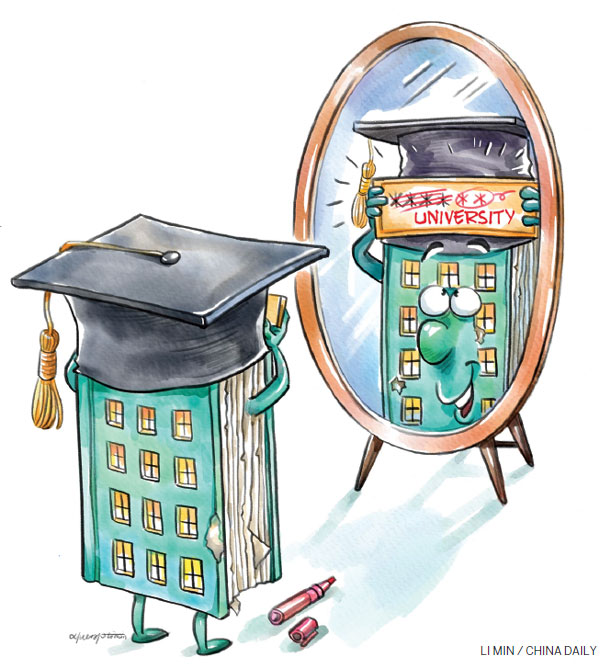
Some colleges had ample reason to change their names, because the new ones better suited the times or their requirements. They might have had new majors and new characteristics that the original names failed to represent. Communication University of China, for example, had introduced many media-related majors since the late 1990s, which Beijing Broadcasting Institute could no longer signify.
Moreover, the name of a college influences people's first impression about it, so therefore many colleges changed their names in order to attract more and "better" high school graduates to apply. When Hebei Union University in Tangshan, Hebei province, changed its name to North China University of Science and Technology in 2004, the minimum passing score that students needed in the college entrance examination to seek admission had already been rising for several years.
So merely changing the name cannot fundamentally improve the education quality a college offers. If the management of a college concentrates on changing its name instead of trying to improve the quality of the education it imparts to the students, its move can end up ruining the reputation of the institution.
A college often specifies only a few majors it offers, while a university is more comprehensive with the specifics. To "upgrade" their names from college to university, many colleges have introduced new majors in a hurry, and thus stretched their resources and compromised the quality of their old majors. In order to curb that trend, the Ministry of Education issued a guide document in February that vows to strictly review colleges' applications to change their names. The document also encourages colleges to invest more energy and resources in the development of majors with special characteristics.
In his report to the 19th National Congress of the Communist Party of China, General Secretary Xi Jinping said that the principal contradiction of Chinese society in the new era has evolved to be "unbalanced and inadequate development and the people's ever-growing needs for a better life".
But while the opportunities to receive higher education may no longer be scarce, good-quality higher education resources are still quite scarce.
In his report, Xi also said the aim of developing higher education is to "bring out the full potential of higher education". To help fulfill that aim, colleges need to develop the majors they are good at, instead of trying to "change "themselves into comprehensive universities.
Society has differentiated needs for higher education, so colleges should nurture and develop their special characteristics. If they all try to develop in a homogenized way, it will damage China's higher education sector and fail to meet the students' demands. The Ministry of Education has made the right move by strictly scrutinizing colleges' applications to change their names to universities, and we hope colleges will heed the call of the education authorities to develop their special characteristics.
The author is an associate researcher on education science at Beijing Normal University.
(China Daily European Weekly 11/17/2017 page13)


Today's Top News
- Militarism revival efforts criticized
- Leadership highlights Party conduct
- Forging a human-centered future in era of smart machines
- Land-sea trade corridor key to regional progress
- Local rules to be reviewed to help disabled
- Stronger RMB points to resilience