The honest truth









Since ancient times, building credibility by keeping promises has been foundation of relationships
One morning in 350 BC, citizens of the capital of Qin State - then based in Xianyang, Shaanxi province - gathered at the south gate of a market, murmuring at a 10-meter-tall block of wood that had been erected overnight.
Beside the wood was an announcement from an official, stating that anyone who could carry the block to the city's north gate would be awarded 10 pieces of gold. The crowd couldn't believe such a simple task could receive so rich a reward. They all hesitated to make a move. Soon, the reward was raised to 50 pieces of gold, a sum high enough to finally tempt one man to step forward, load the wood onto his back and march to the north gate. As the crowd watched, the man, to his own evident astonishment, was immediately presented with the 50 gold pieces as promised.

The point was: There was no catch. The whole exercise was to measure and establish the idea of "credibility" among the public, to prepare them for a new law in the Warring States Period (475-221 BC), masterminded by renowned Qin statesman Shang Yang (商鞅).
Shang was responsible for many of the reforms that ultimately led the Qin to transform a disparate collection of warring states into China's first unified empire. The tale of the wood is called 立木取信 (lìmù qǔxìn, "erect wood to win trust"), and is now one of China's most famous historical fables. Whether in ancient times or the modern day, trust and credibility essentially form the fabric of society. The Chinese character for "credibility" is 信(xìn). Its form is rather self-explanatory: On the left is亻, the "people" radical, and on the right is言(yán), meaning "words" - together, they suggest a person speaking honest words.
The original meaning of 信 is "honest" or "truthful". An early example was the idiom 信誓旦旦 (xìnshìdàndàn), which means "to pledge or promise in all sincerity and seriousness." First used in the Classic of Poetry ( 詩經), the idiom describes an abused woman recalling how her husband of three years had vowed solemnly to love her before their wedding. Still in use today, this idiom is usually applied in the negative, with the connotation that such promises were not kept.
Pretty words are not always truthful; indeed, the truth can often be ugly, as stated in the saying from the classic Taoist text, Daodejing《道德經》: "信言不美, 美言不信" (xìn yán bù měi, měi yán bùxìn; "truthful words are unpleasant, while pleasant words are not truthful").
Those who speak truthfully and always keep their promises are able to maintain credibility among their audience. Thus, 信 later took on the meaning of "credibility." Keeping your promise is 守信 (shǒu xìn, "keep credibility"), while breaking faith is 失信 (shī xìn], "lose credibility"). When it comes to the importance of being honest and honorable, one can expect a lecture from the likes of Confucius, who offers wisdom such as "Always keep your promises among friends" (與朋友交, 言而有信 yǔ péngyǒu jiāo, yánér yǒu xìn), and "Promises must be kept, and action must be resolute" (言必信, 行必果 yán bì xìn, xíng bì guǒ).
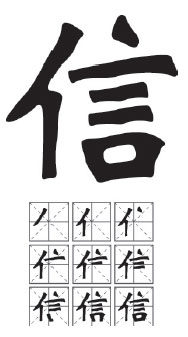
In the modern day, we could hardly operate without 信用 (xìn yòng, credit, credibility), especially in the financial world: We have credit cards (信用卡 xìnyòngkǎ), credit unions (信用社 xìn yòngshè), credit loans (信貸 xìn dài), and trusts (信托 xìntuō). Business has to be built on reputation and prestige, 信譽 (xìn yù). Credibility engenders trust, therefore, 信 can also mean "trust, believe," as in the verb 信任 (xìn rèn, "trust") and 相信 (xiāng xìn, "to believe"). Religious faith is 信仰(xìn yǎng), while superstitions are 迷信 (mí xìn), which means "confused belief." On the other hand, confidence, which is to believe in yourself, is 自信 (zì xìn).
The character 信 can also be a token of trust, or a form of credential. Letters are sometimes referred to as 信, because they carry trusted messages from one person to another (such as the confidential memos sent to emperors). Along this line, 信 can also refer to messages, news and information, which is 信息(xìnxī).
Living in the Information Age, in the midst of a boom in the IT industry (信息產業 xìn xī chǎn yè), credibility and trust are more important than ever. Technology constantly changes the way we conduct everyday activities, from making a simple purchase to managing our personal finances. So it's perhaps a good time to keep in mind one last meaning of 信: "casually, at will", as in 信口開河 (xìn kǒu kāi hé, "talk irresponsibly") and 信馬由韁 (xìn mǎ yóu jiāng, "to ride a horse with lax reins and let the horse go where it pleases"). This speaks of the consequences of blind trust.
From a piece of wood that helped bring ancient China together to the modern building blocks of our society, 信 is a character that is more meaningful today than ever.
Courtesy of The World of Chinese; www.theworldofchinese.com.cn
The World of Chinese
(China Daily European Weekly 11/17/2017 page23)






Today's Top News
- Opening up a new bridge between China and world
- Tour gives China-Arab strategic trust a boost
- China accelerates push for autonomous driving
- Opening of new gateway can help foster global economic and trade cooperation
- The farmer, the snake and Japan's memory hole
- Crossing a milestone in the journey called Sinology