Difficulty of speaking with one voice









Many hurdles still remain in the process of formulating a common integrated African policy on China
A China-Africa dialogue forum, known as the Africa-China Reporting Project, hosted a symposium earlier this year on a common integrated African policy on China. It was held at Witwatersrand University in South Africa in July with the aim of working toward a common African policy on China and was sponsored by the Institute for Global Dialogue associated with the University of South Africa, and Friedrich Ebert Stiftung, a German political foundation.
The symposium, with the theme "China-Africa: High time for a common integrated African policy on China", sought to conceptualize policies for the continent, from the continent. It featured a number of experts on Africa-China relations and several think tanks. In line with increasing calls for a unified African policy and strategy, the symposium presented a platform to critically examine the prospects for a pan-African policy and strategy to guide the continent's engagement with China.
Colonialism had social, economic and political impacts, including the introduction of Christianity. For instance, many Africans were forced to learn the languages of their colonial masters, such as English, French and Portuguese. Their land was also seized by Europeans to establish plantations for the growing of cash crops for their home countries, which had little or no benefit to local populations. As a result, African culture was diluted, traditions were taken away and their ways of life were destroyed and replaced by those of the colonialists.
Consequently, and because of other historical factors, we now have a continent of 54 sovereign states and more than 2,000 languages, including English, French, Arabic, Portuguese, Afrikaans and Spanish. There are also numerous indigenous religions and practices in addition to Christianity, Islam and Hinduism. This has left Africa fragmented and highly balkanized, based largely on external models, and the ensuing conflicts have often led to humanitarian tragedies of traumatized and displaced populations.
The discourse on whether an African policy on China should be common or individual is therefore just one of the numerous issues that African states need to confront. These include the fact that there are a number of competing, overlapping and divergent regional bodies in Africa. For instance, there is the Tripartite Free Trade Area, which covers 26 African countries alongside 17 other trade blocs. The TFTA aims to join up three of them, namely the East African Community, the Southern African Development Community and the Common Market for Eastern and Southern Africa.
This brings into question whether policy should be made individually by each of the 54 states on the African continent or collectively, despite the fact that China has already formulated two policies on Africa as a single entity.
During the symposium, it was argued that each African state should come up with an individual policy, and the idea of a common African policy was questioned, the argument being that African states have very little in common and policies should look beyond engagement through the Forum on China-Africa Cooperation. The 2015 Johannesburg Summit and sixth Ministerial FOCAC Conference marked the 15th year since the initiation of the FOCAC mechanism in 2000, and nearly a decade since the Beijing Summit of 2006.
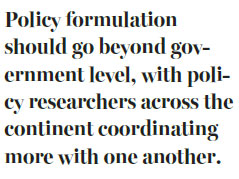
In this respect, policy formulation should go beyond government level, with policy researchers across the continent coordinating more with one another. In fact, it was argued, many African states, including Nigeria, Zimbabwe and Egypt, do not even have foreign policy documents, limiting their ability to have individual policies on China, let alone a common Africa-China policy. Furthermore, the narrative of China as an emerging nation should stop, since China is a superpower. However, a common policy is desirable and a homogenous African policy on China can exist, despite the fact that African states are so diverse in all aspects. In addition, Africa should also look beyond the Africa-China economic partnership into areas such as culture and people-to-people engagement. Since Africa remains diverse, it may not be easy, due to other factors and historical ties, to come up with a policy soon.
The Forum on China-Africa Cooperation has been seeking to consolidate the African agenda on Africa-China engagement, particularly in respect of greater collaboration with the outcomes of Africa's Agenda 2063. Accordingly, the second FOCAC Summit adopted two outcome documents, the Johannesburg Declaration and the Johannesburg Action Plan (2016-18), laying out comprehensive plans for Africa-China relations and practical cooperation for the next three years through a range of new ideas and policies.
At next year's Forum on China-Africa Cooperation, African states plan to present the African common policy on China. Meanwhile a workable platform for a common integrated Africa-China policy remains both challenging and elusive, with only modest progress recorded thus far.
The author is director of the Center for Strategic Policy Management at API. The views do not necessarily reflect those of China Daily.
(China Daily Africa Weekly 11/24/2017 page9)


Today's Top News
- China-EU dialogue aims to manage differences
- Rising tariffs set to threaten medical sector
- Airbus launches 2nd Tianjin assembly line
- Plenum doubles down on opening-up to deepen engagement with the world
- Talks rational means to settle differences
- Mainland to enhance exchanges with all political entities in Taiwan