



New era diplomacy will strengthen ties with CEE countries









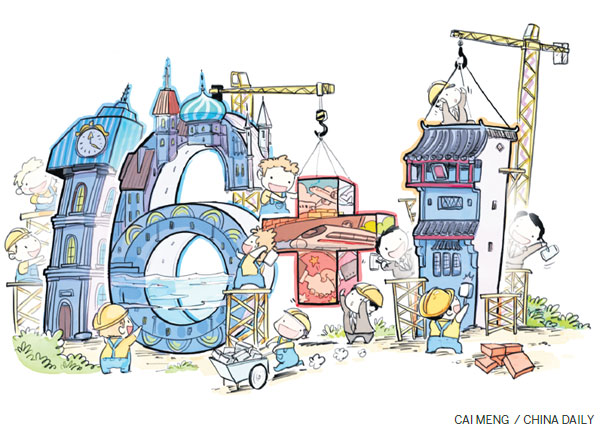
Editor's note: Premier Li Keqiang's visit to Hungary and participation in the Sixth China-Central and Eastern Europe Leaders' Meeting from Nov 26-29 are important diplomatic moves after the 19th National Congress of the Communist Party of China that will promote China-CEE cooperation in the framework of the "16+1" mechanism. Three scholars share their views on the issue with China Daily. Excerpts follow:
Initiative is boosting cooperation mechanism
Over the past five years, China's circle of friends among the Central and Eastern European countries has expanded rapidly. Before 2012, bilateral relations between China and the CEE countries had remained almost at the same level.
When China proposed to develop cooperation with the 16 CEE countries through the "16+1" cooperation mechanism, most of the leaders and diplomats from those countries were surprised. What followed was a drastic change in the "wait and see" attitude of the CEE countries. In the initial stage, the huge diversity among the 16 CEE countries was reflected in the attitudes and actions of the officials, diplomats and experts from those countries.

When the general program of the Belt and Road Initiative was made public in March 2015, the 16 CEE countries were viewed as countries along the Silk Road Economic Belt from China's perspective. On the one hand, thanks to the numerous mutual exchanges under the framework of the "16+1" mechanism, the CEE countries exhibited a more and more positive, or at least neutral, attitude toward China. On the other hand, the Belt and Road Initiative's focus on the five main pillars of policy coordination, facilities connectivity, unimpeded trade, financial integration and people-to-people bond made the CEE countries realize that these were also main areas they needed to improve. Of course, there are more opportunities in the fields of infrastructure, trade and financial cooperation.
Eventually, the positive response of a few countries in the beginning led to the establishment of the "16+1" mechanism after the Belt and Road Initiative was proposed by President Xi Jinping in 2013. In this way, the China-CEE cooperation mechanism and the Belt and Road Initiative are playing complementary roles in strengthening the relationship between the two sides.
China's initiative appealed to the CEE countries not only because of its potential to raise investments and profits, and expand markets, but also because of China's development approach, which could provide an alternative development model for developing countries.
Chinese wisdom is blazing a new trail in countries that want to expedite their development while safeguarding their independence.
The Belt and Road Initiative is also an expression of Chinese thoughts on international relations, and it demonstrates the Chinese concept of building a community of shared future for mankind. Therefore, strategic views and practical plans to solve the perception gap between the Chinese and CEE peoples will be critical to the development of the "16+1" cooperation mechanism in the next five years.
The author is an associate researcher at the Central Compilation and Translation Bureau of the CPC.
Transcontinental cooperation for shared goals
The Belt and Road Initiative as a transcontinental framework of cooperation couldn't be a better platform for collaboration for shared goals. The "16+1" mechanism being a part of that framework should thus extend the focus from individual sites and mutual economic benefits of the stakeholders involved to broader and more useful collaboration.

Possible fields might include international security, environmental issues, the challenges of urbanization, including energy and transportation, communications, sanitation and water supply. The growing urban inequality, poverty and exclusion in fast-growing agglomeration, too, need to be addressed. Better understanding of different cultures, cultures systems and multiculturalism seems crucial.
And the future of work and artificial intelligence is another area for serious discussions and solutions.
The establishment of a research network of scientific institutions from Central and Eastern Europe and China is the result of long-term efforts and the work of researchers from the partner institutions. It provides opportunities for scientific and research cooperation, interdisciplinary projects, exchange of scientists and students.
Also, and perhaps more important, it is a platform for dialogue and collaboration on global issues and joint research projects in fields such as economics, management, medicine, commodity science, construction, geology, electromechanics, telecommunications, biology, chemistry and meteorology. This is a first step toward establishing broader cooperation among universities and academic institutions from China and the Central and Eastern European countries.
Academic cooperation is a crucial pillar of the relations between China and CEE countries in the context of the Belt and Road Initiative. There is no better way to build trust and understanding than people-to-people contact. Besides, closer cooperation at the academic level should enable the flow of ideas, values, innovations and innovative thoughts to benefit from synergies, build mutual understanding between nations and to bring regions closer, concentrating on similarities rather than obstacles and impediments, contributing to the wealth of nations, civilization progress and a harmonious global community.
The author is an assistant professor at Poznan University of Economics and a member of the Committee of Future Studies at the Polish Academy of Sciences.
Building resilience in the '16+1' context
With three Central and Eastern European countries (Poland, Serbia and Hungary) raising their cooperation with China to a comprehensive strategic level, the successful hosting of the Belt and Road Forum for International Cooperation in Beijing in May, and successful Chinese investments in strategic points linking the Silk Road Economic Belt and the 21st Century Maritime Silk Road (COSCO at Piraeus Port, HBIS at the Smederevo steel mill - an intersection of pan-European corridors VII and X), contending strategic remarks from Belt and Road Initiative skeptics came as no surprise.

While such remarks should worry Belt and Road Initiative communicators, the intensity is also proof of rising legitimacy of the initiative, particularly in Central and Eastern Europe. It is a clear indication of future challenges and hurdles, but also a signal for strengthening the initiative's resilience, especially in the strategic communication framework.
Serbia is specific - it is militarily neutral and not a European Union member. In May, Serbia established the National Council for Cooperation with Russia and China, a channeling and coordinating body for cooperation that allows higher transparency, better coordination between ministries and faster contact with the administration.
Yet the success of Belgrade-Beijing cooperation lies in closing of the "say-do" gap. It has moved from sketches to implementation. Beyond well-known cases such as the building of the Pupin Bridge in Belgrade, other positive developments include the HBIS-run Smederevo steel mill plant on the Danube becoming Serbia's largest exporter in July.
China Communication Construction Co is moving ahead with plans to build the second part of the Belgrade-Adriatic highway, with the first progressing on schedule. Work on the Serbian part of the high-speed railway to Budapest is set to start. And the Belt and Road's north-south and east-west connections in Serbia are increasingly visible.
There is no doubt that the European Commission will closely scrutinize projects related to the Belt and Road. And yet another factor will put the strength and motivation of the "16+1" mechanism to the test. Will EU members in the CEE support the Belt and Road Initiative strongly enough in the face of potential challenges, legal hurdles in particular, created by the European Union? How resilient will the CEE countries that are also EU members be against the pressures exerted by Brussels and, possibly, Washington?
Official rhetorical support for the Belt and Road Initiative is important. But without political will, administrative capacity and foreign policy flexibility, it will have difficulties in meeting the objectives. And precisely these three factors will distinguish the "leaders" from the "laggards", and contribute to a multiple-speed "16+1" mechanism.
The author is president of the Center for Strategic Alternatives (Serbia) and a founding member of the China-CEEC High-Level Academic Platform.
(China Daily European Weekly 12/01/2017 page13)


Today's Top News
- Top nuclear power obliged to cut its arsenal: China Daily editorial
- Xi urges basic research push for original innovations
- Building of rare earth hub highlighted
- Seedance 2.0 signals big shift in AI sector
- Rational scheduling for year's largest film release window
- United front work urged to pool strength







