


Waste import ban designed to safeguard health










Domestic effect
The strengthened restrictions on some recyclable waste have also affected Chinese companies that rely on foreign recyclables, especially paper and plastics.
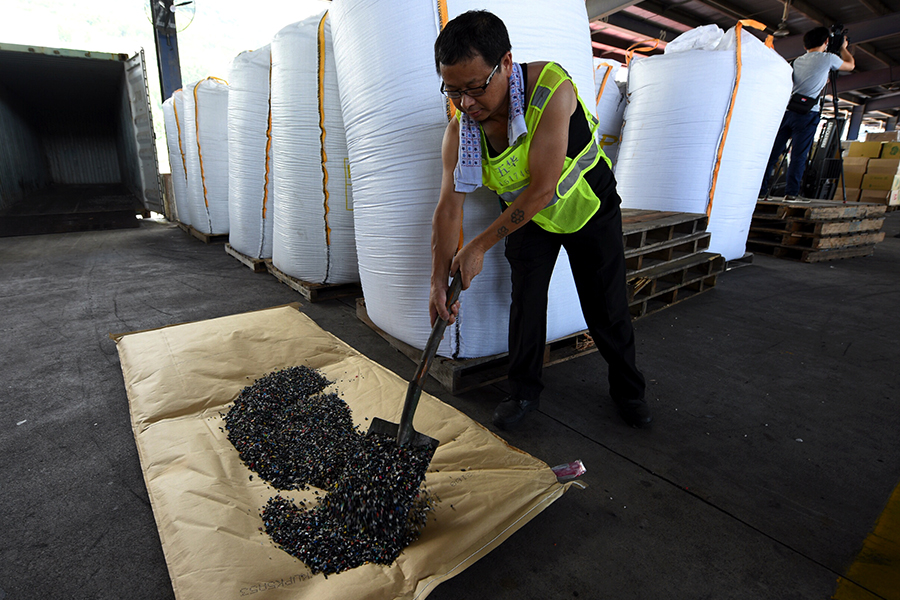
The Ziya Circular Economy Industrial Zone in Tianjin is the largest recycling facility in North China and was home to 387 companies by December. Now, some companies have closed or suspended activities as a result of the fall in the volume of imported waste.
"About 90 percent of the materials for companies that process plastic waste were imported, so they have been affected by the planned ban," said Tang Guilan, deputy director of the zone's management committee, adding that 96 plants used to process imported waste, but only a few are still operating.
It's estimated that next year, the zone's approved import volume of recyclables will be 118,000 tons, half the number in 2016, she said, noting that the volume of imported waste in the zone fell as stricter regulations were implemented in recent years.
Tang said the affected plants are being encouraged to turn to domestic suppliers to replace imported waste, but conceded that it will take time to shift their materials.
Some plants in Tianjin started processing imported solid waste from the US, Canada, Japan and South Korea in the 1980s, and many relocated to the industrial zone in 2003, establishing a recycling system based on the steady supply of material, Tang said.
According to Xue Tao, deputy head of the E20 Environmental Platform, a domestic environmental protection service, imported solid waste is cheaper to buy than some domestically sourced raw materials as a result of lower costs in the countries of origin.
He added that plants that rely on imported waste in other areas of China will also be affected, especially in the paper and plastics scraps industry, considering the large volume of imported recyclables.
In 2016, China processed more than 49 million tons of waste paper, with 28.5 million tons, or 57 percent, coming from overseas. Of the 18.78 million tons of plastic scraps processed in the same year, 39 percent, or 7.35 million tons, was imported, according to data from the Ministry of Commerce.
"Imported plastic and paper scraps accounted for a large proportion, thus the ban will significantly raise costs at processing plants, which will definitely have an influence on plants that rely on processed paper and plastic materials in the short term," Xue said.
In addition, stricter regulations have seen import volumes fall in recent years, which has resulted in a reduction in the number of companies processing imported waste nationwide, from 2,527 in 2013 to 1,766 in 2016, data from the Ministry of Environmental Protection showed.
Move forward
"By adopting the ban, China plans to change the current global structure in the division of work, eradicating its role as a dumping ground for leftovers from developed countries, which has grown in the past 30 years," Xue said.
The ban caters to a growing demand for sustainable development and public calls for a cleaner environment in recent years, and it's a step China urgently needed to take, he said.
Therese Coffey, parliamentary undersecretary at the Department for Environment, Food and Rural Affairs in the UK, said the ban may not be all bad news for Britain.
"It gives us an opportunity to reprocess more here, rather than exporting to the other side of the world just because it's a bit cheaper to do so," Coffey told the UK Environmental Audit Committee in November.
In the US, some processors are trying to find markets to replace China.
Xu Haiyun, chief engineer of the China Urban Construction Design and Research Institute, said the planned ban demonstrates the central government's strong determination to curb pollution from imported solid waste, which is quite encouraging, but he added "implementation may be not easy".
China has not established a household garbage sorting system or a waste-recycling network, which means a massive amount of waste ends up in landfills and incinerators, he added.
Xue, from E20, is optimistic about progress in establishing a recycling network before 2020 as a result of government support and rising private sector investment.
Domestic recyclers may discover replacement sources of solid waste soon, he said.
Pilot garbage-sorting projects have been established in more than 20 cities, and there are plans to boost the recycling industry so the total volume of recyclable waste grows from 256 million tons in 2016 to 350 million tons by 2020, according to statements from the central government.
More measures have been adopted to regulate solid waste imports, because the materials are often dirty, poorly sorted or contaminated with hazardous substances. Even when such waste is safely imported, it is not always recycled properly.
For example, in Tianjin, highly-polluting processing plants have been corralled in the Ziya Circular Economy Industrial Zone, and special equipment is used to tackle the pollutants emitted, according to Tang Guilan, the zone's deputy director.
Moreover, the zone strictly supervises every container to ensure that imported recyclables are processed inside the facility and no contaminated products are allowed to leave.
The 387 companies in the zone can process more than 1.5 million tons of solid waste, including imported material, every year, providing ample material for the domestic market, such as 300,000 tons of plastic products, without polluting the atmosphere.
Regulating solid waste imports is a major issue to protect the environment and public health, so China will employ a range of safety measures and will hit violators hard, said Li Ganjie, the minister of environmental protection.
Wang Keju in Tianjin contributed to this story





