Beijing’s blue sky reveals Chinese determination









The opinions expressed here are those of the writer and do not represent the views of China Daily and China Daily website.
Winter has arrived at the Chinese capital Beijing, bringing plenty of clear sky and low levels of feared PM2.5 particles, a dangerous element to human health. It's a new reality for the population, who were used to wearing masks and turning on air purifiers by this time last year. 2013 was particularly polluted, and the impetus for the government launching a five-year plan to clean up the environment — this period is about to end in 2018.
The geographic position of Beijing, its climate, the particles freed to the air by factories and vehicles, not to mention the use of coal as energy source, were the main factors for grey skies in the city during winter. With temperatures regularly dropping below zero, heating systems were turned on all around, even in residences and commercial and public buildings. And the majority of those systems were powered by coal. Orange and red alerts issued by the government were accompanied by advice to stay indoors and even not to bring kids to school.
Cold days were, most of the time, accompanied by smog — or the “grey layer”, as it’s known — since 2011. A thick curtain fell from the sky to the streets of Beijing and surrounding areas, and it was impossible to see something from one side to other on an avenue. Public health was in danger.
This environmental tragedy was an easy motif for newspaper covers across the globe and in China, and soon became a priority for the central government. In 2013, Beijing launched a plan to clean the air in five years. Ending pollution was the major target. Many were in doubt that efforts could work. But they did.
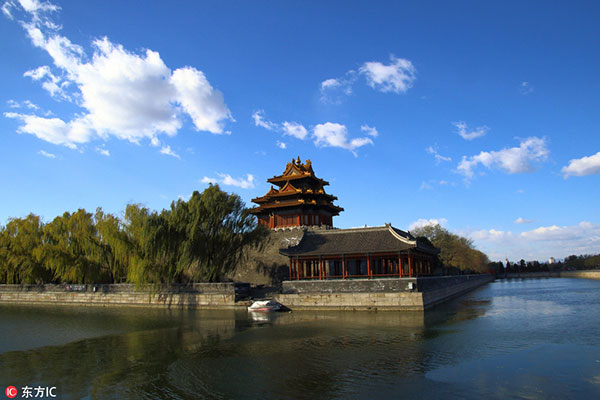
This winter, blue skies are the common backdrop. The main cause was the massive replacement of coal heating systems with ones fueled by gas — a quick movement that brought, in November, negative consequences. This was not just because gas prices increased, but because districts in the suburbs were left in the cold from shortages. The new heating system was not reaching all Beijing and regional neighborhood. Even schools were affected.One emergency solution was to replace the old system with electric heating, at least until new sources were presented.
Even with the setbacks, the speed with which the problem is being faced in China is surprising, especially for those who come from countries where structural imbalances or gaps and lack of infrastructure are rarely solved quickly, like Brazil. There, essential and fundamental improvements like better roads or railways and ports could spend decades as just paper projects. Meanwhile, demands and populations are increasing and something that is just a project becomes obsolete even before building starts. This is reality that hurts the country’s development and the hope for better days.
Even if the blue sky during winter in Beijing has come with heating problems and a surge in gas prices, efforts to change the energy source, stricter environmental regulations for industry, the closing of inefficient plants and limits to vehicles in 28 Chinese cities have worked, and this is palpable.
According to official data from the central government released Nov 15, the number of heavy pollution days in Beijing has dropped to 21 in 2017 compared to 58 in 2013. The government goals are ambitious. By 2030, Beijing plans to limit its 2.5PM particle emissions to 35 micrograms per cubic meter.
If the country sustains this pace, these goals will be achieved.
Janaína Camara da Silveira is a communications consultant at Radar China and a master’s of economics candidate at Unisinos University in Brazil.