



Literature will help West know China better









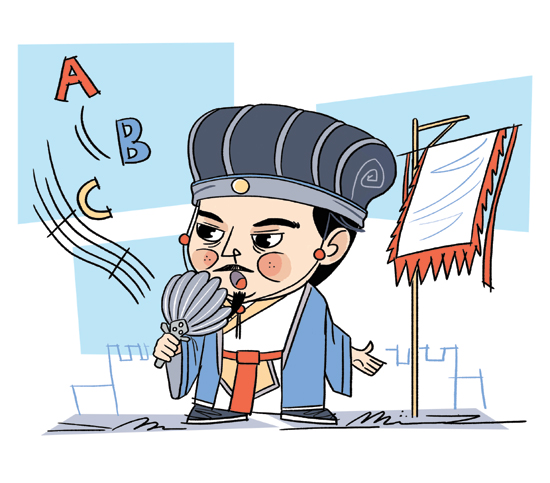
Wang Luoyong, the first Chinese mainland actor on Broadway, captured the hearts of many Chinese by reading a letter by political strategist and essayist Zhuge Liang (181-234) to the emperor of Shuhan during the Three Kingdoms (220-280) period in the new season of Growling Tiger and Roaring Dragon.
The letter has been recited by generations of students, and we would never have experienced that the text, written in classical Chinese, could be so beautifully rendered and recited in another language. As the rendering of the letter shows, China has a dazzling literary heritage that could enrich the repository of world literature.
However, China's literary influence in the world is disappointing. As a guest lecturer in world literature classes, I often asked how many people have read or heard of Journey to the West, a Chinese classic written by Wu Chengen during the Ming Dynasty (1369-1644). Usually nobody raised hands.
In the online bookstore Amazon, the translation of Journey to the West by Anthony Yu from Chicago University - a more popular translation - has fewer than 100 reader reviews. Other Chinese books fail in their journeys to the west as well. Pearl Buck's translation of All Men Are Brothers has 10 reviews. Gladys Yang's translation of Dream of the Red Chamber has 12 reviews. And Romance of the Three Kingdoms, translated by C.H. Brewitt-Taylor and Robert E. Hegel, has 31 reviews. Worse, few poems from the Tang Dynasty (618-907) have made it beyond the single digit in reader reviews.
In fact, Lao Gan Ma, a Chinese chili sauce, is doing better than any of them.
Chinese readers, in comparison, are far more informed about Western classics. I remember the translation of James Joyce's Ulysses by Xiao Qian and Wen Jieruo had been a huge cultural event in China in the 1990s. Similarly, the translations of Marcel Proust's In Search of Lost Time and Miguel de Cervantes' Don Quixote attracted widespread public attention.
Two years ago, I translated The Sound and the Fury by William Faulkner, a very difficult book even for American readers, and I was glad to find that this book, too, found many readers in China.
We have a "trade deficit" in literary import and export. And this deficit is disturbing because classical literature often shapes the soul of a nation. Why is this even a problem?
Basically, reading international literature is an effective way of increasing understanding of other peoples in the world. Literary texts give texture and depth to our otherwise biased and over-generalized understanding attained through distilled commentaries and potentially biased analyses. An in-depth understanding is not something for lip service. It requires thoughtful effort.
The obligation to solve this problem is mutual. Chinese scholars should do a better job of introducing Chinese literature to the rest of the world. Western academics, on their part, will benefit from an improved understanding of Chinese literature.
I have noticed that many people know about the Art of War by Sun Tzu due to its inclusion in Western anthologies of world literature and the ease of reading generic strategies without having to understand the nuances of the culture where it is embedded. It was once popular among businessmen as they looked for strategies to succeed in business wars. However, this book is not even included in the Chinese literary cannon, in contrast with the prose of the Qin Dynasty (221-206 BC), poetry of Tang and Song (960-1279) dynasties, plays of the Yuan Dynasty (1271-1368), and novels of Ming and Qing (1644-1911) dynasties.
I would encourage Western universities to try something different. If you understand the Monkey King from Journey to the West, or Zhuge Liang from Romance of the Three Kingdoms, you have a better chance of understanding a Chinese. And the more we understand each other, the less we blindly hate or fear each other.
The author is a US-based instructional designer, literary translator and columnist writing on cross-cultural issues.


















