



China to launch 40 carrier rockets for various space missions in 2018









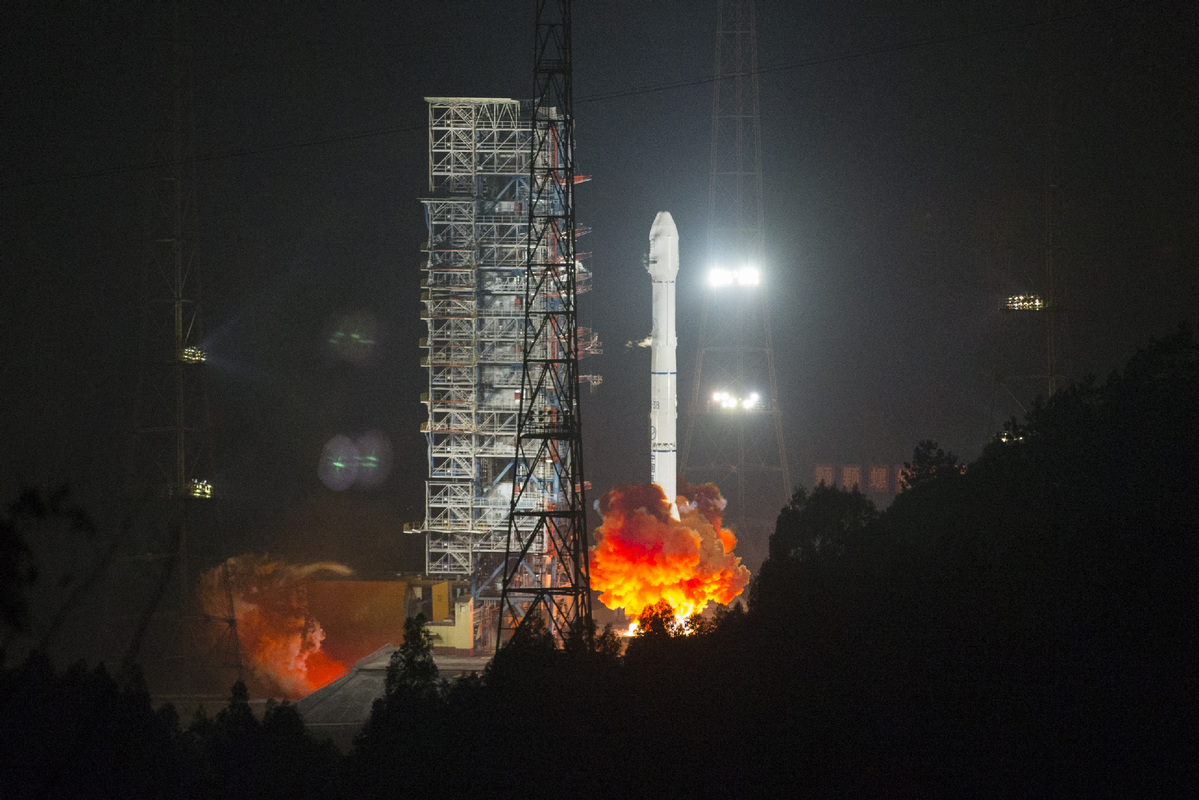
China will launch at least 40 carrier rockets this year to carry out its scheduled space missions such as Chang'e 4 lunar probe and BeiDou 3 satellites, Science and Technology Daily reported.
China Aerospace Science and Technology Corporation said it will launch 35 Long March carrier rockets in 2018, including Long March-5. China Aerospace Science and Industry Corp said it will launch 5 solid-fuelled Kuaizhou rockets this year.
Chinese scientists will continue the third launch of the Long March-5 carrier rocket this year, though its second launch suffered a failure due to malfunctions in July. Long March-5 Y3 will send Dongfanghong-5 satellite into space.
As the country's most powerful rocket, Long March-5 is important for China's future manned missions and deep space explorations.
If the third launch is successful, it will prepare for launches of China's new manned spacecraft and space station core module into space in 2019. It will also send Chang'e 5 to moon for taking samples.
A relay satellite will be launched in June to the Earth-Moon Lagrangian 2 (L2) point for communications between the Earth and the Chang'e-4 lunar probe that will be launched in the latter half of this year.
The Chang'e-4 lunar probe will undertake the first-ever soft landing on the far side of the moon and conduct in situ and roving detection.
The relay satellite at the Earth-Moon L2 point, where gravity allows it to maintain a stable position, can redirect communication from Earth to the far side of the moon.
China is soliciting 20,000 messages to be sent into space by the relay satellite. People all over the world can follow the WeChat account "slecbj" to submit their wishes until March 6, 2018.
With two BeiDou-3 satellites sent into space on a single carrier rocket in Nov, China is on track to create a global BeiDou Navigation Satellite System by around 2020, which will make it the third country after the United States and Russia with its own navigation system.
In 2018, China will launch more than 10 satellites through nine rocket launches to form a framework system of 18 BeiDou-3 satellites to provide services for countries involved in the Belt and Road Initiative. 35 BeiDou-3 satellites are expected to form the global navigation system by 2020.
Two BeiDou-2 satellites will also be launched into space this year to replace the retired ones.
Two high-resolution remote sensing satellites Gaofen-5 and Gaofen-6 will be launched into space this year. The goal of the Gaofen series is to provide all-weather, 24-hour service covering the entire globe.
Gaofen-5 will be launched in April from Taiyuan, Shanxi province, on Long March-4B carrier rocket. It will carry many equipment for detecting the air environment.
In Feb, the country's first electromagnetic monitoring test satellite named after Zhang Heng (AD 78-139), the inventor of the seismoscope, will be launched into space, as part of the country's seismic observation system.
It will collect data of the global electromagnetic field, ionospheric plasma and high-energy particles, carrying out ionospheric real-time monitoring and earthquake precursor tracking for China and its surrounding areas.
China's Kuaizhou-11 solid-fuelled carrier rocket is scheduled to launch for the first time in the first half of 2018, carrying six satellites into space, according to the rocket's developer and producer China Aerospace Science and Industry Corp.
The Kuaizhou-1 rockets will be launched four times to send satellites into space in commercial missions.
China's private company OneSpace is also expected to launch for the first time its OS-X series of rockets in 2018. The company said it conducted a successful ignition test of its rocket engine in Jiangxi province in Dec.


- China comes a step closer to crewed moon mission
- Beijing, a perfect location for 'set-jetters'
- United front work urged to pool strength
- Xi sends festive greetings to all service personnel
- Hainan's 1st batch of daily consumer goods duty-free shops for island residents opens
- Cross-Strait affairs should be settled 'like family', official says











