



Redrawing trade routes










Initiatives like China-backed RCEP and FTAAP have huge potential to free up commerce and promote globalization
With a leadership committed to more open global trade, China is rapidly emerging as a powerful driver of globalization and championing initiatives that could redraw the international trade map.
Trade globalization has made it possible for more firms in more countries to operate across borders and Asian economies to sustain rapid growth. By the end of 2016, global exports totaled $16 trillion, an eighth of that coming from China.
Despite a recent backlash in some corners of the world, trade growth is likely to continue.
"The positive impact of the spectacular rise of the People's Republic of China has been most tangible in East Asia and ASEAN (the Association of Southeast Asian Nations), that collectively form 'factory Asia', with the PRC at its center," said Lee Minsoo, an economist at the economic research and regional cooperation department of the Asian Development Bank. "The impact was not confined to those economies but reverberated across the whole region."
Lee said China's growing affluence and purchasing power has turned it into a "significant source of demand (for) ASEAN and other subregions of developing Asia".
Along with its growing wealth and influence, China is pushing deals that could redefine and strengthen global trade. Among the key initiatives are an existing but growing free trade deal with ASEAN, the proposed Regional Comprehensive Economic Partnership, or RCEP, and the paradigm-changing Free Trade Area of the Asia-Pacific, or FTAAP.
All of these are linked by the larger and more strategic Belt and Road Initiative, President Xi Jinping's plan to boost connectivity and free trade between China and the rest of the world. It will revive the ancient Silk Road routes through investments in infrastructure across the region.
These initiatives could replace the "noodle bowl" of deals that stretches across Asia and beyond. The Asia Regional Integration Center database lists 147 free trade agreements involving at least one Asian country and another 85 not yet ratified or being negotiated. China is part of 24 FTAs, while ASEAN has seven as a group.
For China, all those deals have helped grow a trade surplus that ballooned from $102 billion to $593 billion in the decade through 2015.
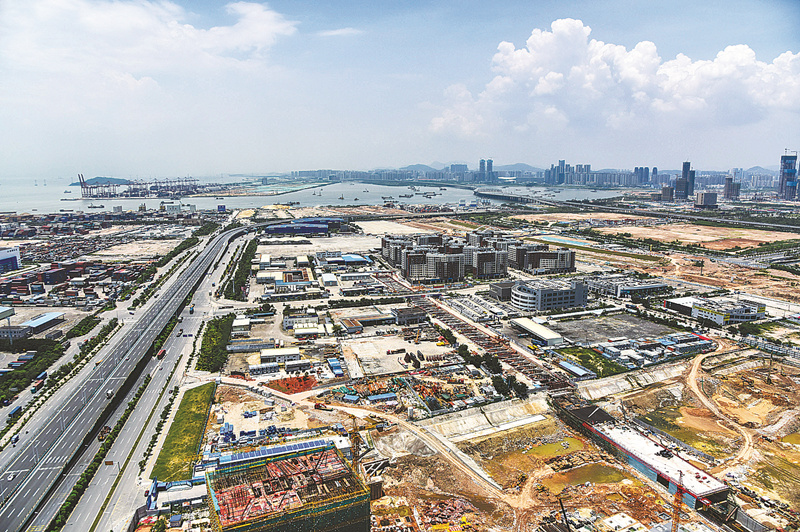
By the end of 2016, the Chinese mainland was the largest goods exporter in the world, with total merchandise exports of $2.01 trillion — well ahead of the second-placed United States, which exported $1.46 trillion, and Germany with exports of $1.34 trillion.
Japan was the second-largest goods exporter in Asia, with exports of $645 billion, and Hong Kong came in third in the region and sixth worldwide with exports of $517 billion — much of that being re-exports from the mainland.
All these goods can move more easily around the world if trade barriers are lowered. A case in point is the growth in trade between China and ASEAN since the FTA between the two took effect in 2005, when ASEAN exports to China topped $52 billion. A decade later, exports to China hit $135 billion.
Continued growth is expected. ASEAN's total trade with China was almost $346 billion in 2015, according to the latest available figures from the ASEAN Secretariat.
Trade between the two sides could hit $1 trillion by 2020, said Lee. China has been the largest trade partner of ASEAN for the last seven years. In turn, ASEAN has been China's third-largest trade partner for the last four years.
An upgraded China-ASEAN Free Trade Area Protocol took effect in July 2016 and calls for zero tariffs on as many as 95 percent of taxed items, improved rules of origin and simplified customs procedures, said Yang Chen, a senior partner at the Chinese law firm of Jincheng Tongda & Neal.
"China already has goods and services FTAs with ASEAN, which are working well," said Amitendu Palit, a senior research fellow and lead for trade and economic policy at the Institute of South Asian Studies in Singapore.
China also has bilateral deals with non-ASEAN members of RCEP like Australia and New Zealand, which have also helped make China an important partner to these countries.
With all of these existing deals in mind, China is now pushing forward with the larger RCEP that would include the 10 ASEAN members, Australia and New Zealand, as well as India, Japan and South Korea. These 16 countries cover roughly half the global population, almost 32 percent of global output and 28.5 percent of global trade.
The original framework for RCEP was first put forward in 2012 based on the ASEAN+1 framework that includes the 10 ASEAN countries and China. The goal of RCEP is to boost trade and investment among the 16 participating Asia-Pacific economies. When it comes online, it could potentially create a unified framework for trade among all the members.
Representatives from RCEP group met in Manila on Nov 12 on the sidelines of the East Asia Summit. A framework for RCEP that covers areas such as trade, rules of origin, customs procedures and trade facilitation was announced in November.
"RCEP will increase employment (opportunities), drive sustainable growth, promote inclusive development, push innovation and will fundamentally enhance people's living standards," said Yang.
The push to complete RCEP follows the stalling of the US-led Trans-Pacific Partnership (TPP). Before RCEP is completed, likely at the end of 2018, participants will have to overcome a number of differences, but "the delay is unlikely to affect China's trade prospects", Palit said.
"The RCEP negotiations are going on but, unfortunately, countries are not able to achieve breakthroughs due to sharp differences in opinions on several issues between negotiating countries," he added.
RCEP negotiations are being kept confidential, so the specific issues are hard to identify. But there are a number of stalemates over how far to reduce tariffs and the flexibility to adjust them later, as well as concerns that RCEP would provide China with a significant trade advantage given the trade surpluses it has with the other participants. India, for example, has a $50 billion deficit with China and its concerns have been a significant source of delays.
RCEP and China's FTA with ASEAN both pale in comparison with the proposed FTAAP, which could ultimately swallow both the other deals as well as the moribund TPP.
The fate of the original 12-nation TPP appeared to have been sealed when the US pulled out in January, almost as soon as US President Donald Trump started work in the White House Oval Office.
But in recent months, the remaining 11 members have floated the idea of moving forward with an agreement. Meeting in Da Nang, Vietnam, in November, the 11 nations — Australia, Brunei, Canada, Chile, Japan, Malaysia, Mexico, New Zealand, Peru, Singapore and Vietnam — agreed to the "core elements" of a reworked agreement.
But even a reworked TPP-11 could fall within the much larger group of countries that may eventually make up the FTAAP.
Various studies have suggested that the FTAAP could generate economic gains three times as large as those generated by any other agreement. China has become its leading advocate.
The FTAAP would include the 21 members of the Asia-Pacific Economic Cooperation forum, creating a massive free trade zone that would boost economic integration and eliminate the overlap created by the noodle bowl of FTAs. A report from the Pacific Economic Cooperation Council has estimated that the FTAAP, when realized, will add $2.4 trillion to the global economy.
"When FTAAP is agreed and comes into force, it will have significant impact on trade in Asia Pacific… However, terms will be key," said Tony Nash, founder and CEO of data analytics firm Complete Intelligence.
But to benefit all participants most, the terms of the deal will have to be evenly enforced. Unless participants are committed to adherence to a rules-based system, we won't see the full benefits, Nash said.
The FTAAP was first proposed in 2006 and a road map was endorsed at the 2014 APEC meeting in Beijing.
"Free trade will be good for the Asian region supply chain, which is already tightly integrated," said Ben Simpfendorfer, an economist and CEO at Silk Road Associates in Hong Kong. "Free trade will initially benefit established countries, like Singapore, Malaysia and Vietnam. The frontier markets like Myanmar might still have challenges."
The potential of RCEP, FTAAP and deals like the one between China and ASEAN is a major factor in the massive growth in global trade.
Total global exports amounted to just $61.8 billion in 1950, started growing exponentially after the 1980s and increased more than 56 times to $3.5 trillion by 1990. They almost doubled again by 2000 to $6.45 trillion and peaked at $19.4 trillion in 2014, more than 300 times larger than in 1950.
Through 2015 and 2016, however, globalization hit a snag and total global exports dropped to a little below $16 trillion even as China's own trade continued to rise to account for more than an eighth of the world total.
Despite all that growth, questions have arisen about the ideal balance between free trade and protectionism.
The debate has intensified recently at some of the most important global and regional trade, economic and policy forums. The question was front and center during November's APEC meeting in Vietnam and during a series of meetings held by ASEAN and its main partners at the East Asia Summit, which includes 18 countries and is traditionally held after the ASEAN leaders' meetings.
On the face of it, APEC is generally committed to the idea of more open borders and globalization.
Yang from Jincheng Tongda & Neal said APEC members generally "oppose trade protection and encourage open markets. (They) promote free and open trade and investment, enhance trade inclusiveness, and support better market access opportunities."
The push toward more comprehensive deals in the region is happening amid a backlash against free trade in places like the US and the United Kingdom.
In the meantime, however, Asian economies, led by China, have continued to build up the regional trade blocs, and there is much investment in infrastructure under the Belt and Road Initiative.
"Several ASEAN countries are also participating enthusiastically in the Belt and Road Initiative, which is facilitating China's outward investment in these countries and generating trade," said Palit from the Institute of South Asian Studies.
Timothy Barnes, president of Asia Pacific Consulting, said that China's global trade position has shifted dramatically over the last 12 months, primarily due to Trump pulling out of the TPP.
"If we look back to late last year, the US had led a 12-nation TPP agreement binding key Asian countries, effectively leaving China out in the cold," he said. "At the same time, the RCEP was on ice as it was widely believed the TPP was the better of the two (multilateral agreements), providing access to the US market."
Barnes noted that once the US exited the TPP, the RCEP began to gain momentum.
"This, coupled with China's (Belt and Road Initiative) and Xi's open trade policy rhetoric, has put China at the forefront of Asian trade, and will only consolidate its position as the US takes a more protectionist stance."


- Death toll rises to 8 in North China factory explosion
- Over 140m train tickets sold for Spring Festival travel rush
- Vice-president of Agricultural Development Bank of China under investigation
- PLA conducts routine patrols in South China Sea
- PLA conducts routine patrols in South China Sea: spokesman
- Annual session of Shanghai Municipal People's Congress concludes












