Improving people's livelihoods a priority









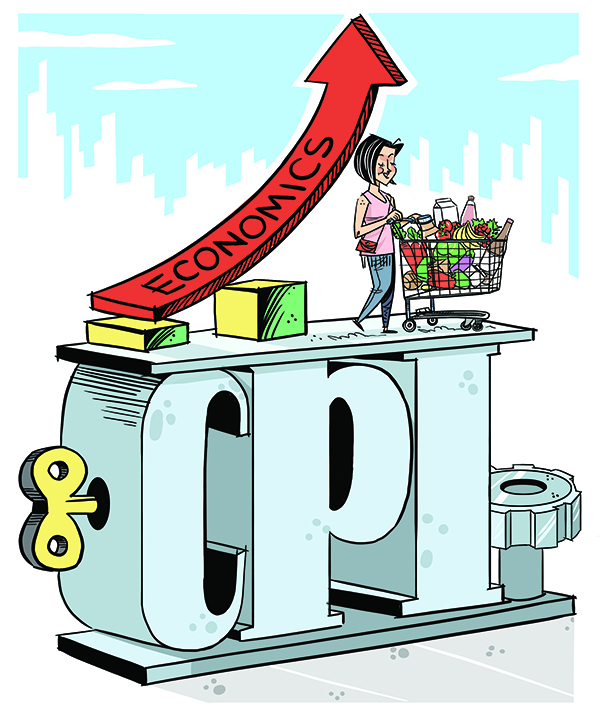
China's consumer price index, a measurement of inflation, increased 1.6 percent in 2017 compared with 2 percent in 2016, according to the National Bureau of Statistics. This means the 2017 Government Work Report's target of keeping the CPI rise below 3 percent has been achieved. On the other hand, the producer price index, which measures changes in wholesale prices, increased 6.3 percent in 2017, ending the five-year declining trend.
The CPI is closely related to people's everyday life. Although the increase in the CPI last year was less than in 2016, people felt its impact was stronger in 2017, as consumers are more sensitive to the rise in prices of products and services that are closely related to everyday life.
But the range of items included in the CPI tabulation is much wider, covering eight major categories, 262 basic categories of products and services related to people's overall consumption, with the statistical weight of various product and service prices being different. No wonder people's response to the overall rise in the CPI is one of surprise, because the prices of goods of everyday use may have been relatively high.
In addition, the NBS uses the monthly average price to calculate the CPI, while individuals are more concerned with the change in prices at a specific time. People may be upset by the price rise at a specific time while ignoring the overall price stability.
Besides, the CPI is a relative number reflecting the range of price change rather than the exact price. If the price of a commodity is already very high, even a slight increase in its price will have a huge impact on general consumers, with the low-income group being exceptionally sensitive to it.
According to the general rules of economics, a large-scale price decline could lead to deflation. And deflation suggests there are problems with the economy. To make price rise more acceptable to ordinary consumers and increase their real purchasing power, the authorities should not only control the price of essential commodities and services, but also take measures to see people's income rises faster than the CPI.
Noticeably, prices of nonfood items last year increased 2.3 percent, up 0.9 percentage points year-on-year. In general, service price increased 3.0 percent in 2017-but while price of domestic services rose 4.2 percent, the cost of medical treatment increased 6.5 percent. And since people nowadays spend a smaller percentage of their money on food and other necessities thanks to their higher incomes, the impact of a rise in non-food product and service prices is greater on them.
Commodity prices remained generally stable in 2017, which is conducive to maintaining macro-economy operations within a reasonable range and deepening the supply-side structural reform.
The recent Central Economic Work Conference said the top priority is to prevent, as well as overcome major risks, especially in the financial field, which means controlling money supply, deleveraging and enhancing supervision will be the key parts of macro-economic control this year.
The CPI is likely to increase to 2.5 percent in 2018, indicating moderate inflation, while commodity prices are expected to remain stable. And while the monetary policy will remain steady and neutral, the fiscal policy will continue to be active, facilitating the improvement of people's livelihoods.
With commodity prices basically remaining stable and China's foreign exchange reserves maintaining their rising trend, capital outflow will be effectively curbed and the renminbi exchange rate will be sustainable, helping increase the value of ordinary people's assets.
The active fiscal policy will focus on optimizing the structure of fiscal expenditure, and promote the improvement of people's livelihoods, through measures such as the targeted poverty-alleviation program and equalization of basic public service.
Since this is an important year for the promotion of high quality economic development, the authorities should pay greater attention to improving people's livelihoods, in order to further strengthen people's sense of gain.
The author is a research fellow at the National Academy of Economic Strategy, Chinese Academy of Social Sciences.