Squeezing cultural diversity to tell a story









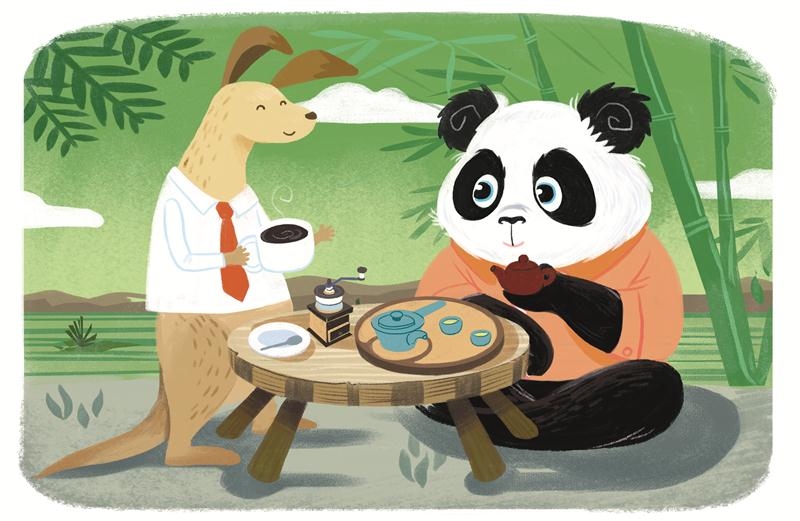
While attending a funeral in Melbourne after having spent 18 months in the city seeking higher education, I was surprised to see almost everyone laughing, which would be regarded as an unforgivable offense to the deceased in China. After I signed my name in the notebook as an attendee, I overheard someone whispering that the Chinese girl was so rude and arrogant that she didn't even pass the pen to the next person.
This small incident reveals a big cultural difference between China and Australia. In Australia, like most countries in the world, the media are the primary source of information on which a country's image is built. Apart from the views of a minority based on personal experiences and studies, most Australians are likely to base their opinions on what they hear or read in the media.
The images of China and the Chinese people in Australia have been built based on two distinct elements. The first is the process of newsgathering and presentation by reporters-and the internalization of the information received by media persons is the second. Image creation starts with the selection of a story for publishing in the Australian media. Millions of incidents and events take place in China that are worth reporting, and even if Australian reporters in China have access to just a small fraction of those, a radical culling process is needed to choose the stories to be presented to Australian readers and viewers.
Stories become "newsworthy" for the Australian media if they are unexpected or abnormal according to Australian norms, however commonplace or mundane they may be for Chinese observers. Besides, they also have to resonate either positively or negatively with Australian values-for instance, they have to deal with issues to which Australian viewers and readers can relate either positively or negatively.
The selection and presentation of news stories is not a value-free process, however. The choice of a story and the manner in which it is presented depends on the conscious or unconscious perceptions of the reporter.
As communication scholar Lee Chin-chuan explains, reporters view their host environment "through the prisms of their dominant ideologies defined by power structures, cultural repertoires, and politico-economic interests". A Chinese story becomes newsworthy not because of its inherent quality in the Chinese context but because a reporter "senses" it will resonate with Australians, and fits the story into his or her own contextual framework.
Those most likely to resonate the loudest are stories that reinforce Australian nationalist sentiments. And, as is universally true, nationalism equates with a sense of superiority-it is not only "us versus them" but also "we are the superior side" here. Not surprisingly, therefore, the stories most likely to catch the eyes of the Australian reporters-and which ultimately appear in the Australian media-are those that confirm Australians' notions of China and the Chinese people, which in turn demonstrates the superiority of Australian culture and values.
As John Henningham, the first professor of journalism in Australia, explains, journalists squeeze the diversity of social and political life in a different culture into an easy to digest "procrustean mould". In the case of images of China, this takes the form of easily understood dichotomies-"East versus West", "democracy versus authoritarianism", and/or "Australians versus others". Simplistic images of China that better fit local news consumers' schemas become the framework, stereotyping a nation and its people.
A range of interpretations of my actions at the funeral is possible-from this poor lady doesn't understand local habits through to a typically rude Chinese person. It is not surprising that negative stereotyping won. In the longer term, can the day-to-day behavior of Chinese people in Australia demolish the images planted by the media? That might be the responsibility of the next generations, schooled in Australia and with parents who are likely to have landed in the country without carrying cultural habits and baggage, and are thus instinctively Australian in their behavior.
The author is a PhD candidate at the School of Media, Film and Journalism, Monash University, Australia.