Check population decline with urgent steps









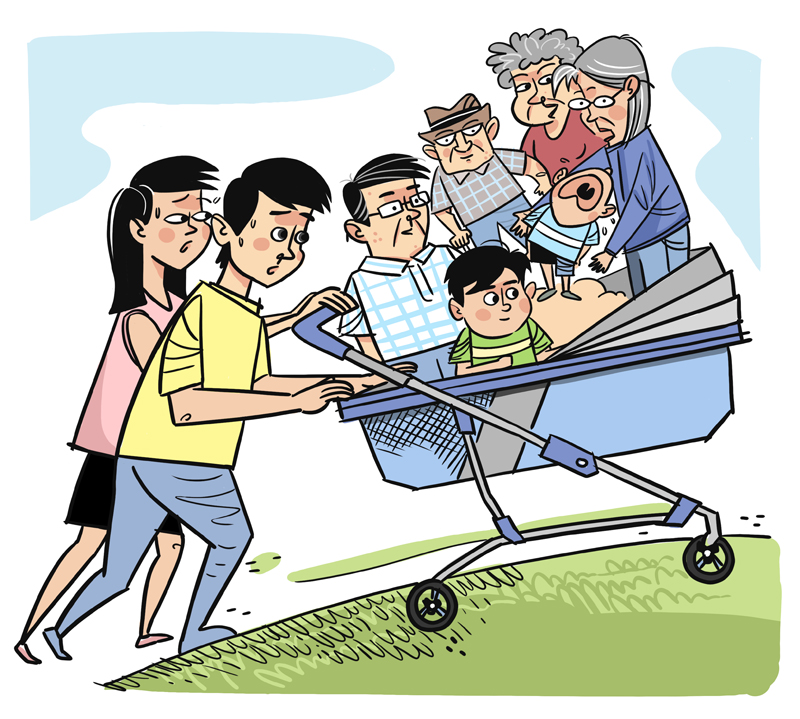
According to the National Bureau of Statistics, 17.23 million newborns were added to China's population last year, down 630,000 year-on-year, and the birth rate dropped from 1.295 percent in 2016 to 1.243 percent in 2017. The declining newborn population and birth rate indicate China could experience negative population growth in the near future.
The demographic reason for the decline in newborns' population is the fall in the number of women of childbearing age. In China, the population of women of childbearing age peaked in 2011. But in 2015 the population of women aged between 15 to 49 years dropped by 5 million year-on-year and that of women aged between 20 to 29 years declined by 1.5 million.
During the 13th Five-Year Plan (2016-20), the population of childbearing-age women is expected to reduce by 5 million a year, which will lead to fewer births.
But sociologically speaking, the decline in the number of newborns may have something to do with the changes in couples' desire to have children. The new "fertility culture"-of couples having just one offspring or not having any at all-has had a great impact on our society, especially because over the past two decades, the age at which Chinese women prefer to have their first child has changed from 22 years to 26 years.
Besides, a large number of women of childbearing age today were born in the 1980s and 1990s, and since many of them are the only child of their parents, they are more likely to have just one child themselves.
Studies show the overall "fertility desire" in China is about 1.6 to 1.8, far lower than sub-replacement fertility rate. In fact, the actual fertility level is much lower than the expected fertility rate. According to the fifth national census in 2000, China's total fertility rate was only 1.22; it further declined to 1.18 in the sixth national census in 2010.
Women's "fertility desire" has drastically changed from being eager "to give birth" to "don't want to" or "can't afford to" give birth. No wonder even after the family planning policy was eased allowing all couples to have two children, the fertility rate remains very low. Perhaps the reason for this is that the change in China's population policy lags behind the change in the "fertility culture".
In China the low fertility rate is a more serious problem than the aging population. Since 2012, the ratio of working age people in the total population has continuously decreased, leading to a gradual decline in the human resource advantage and population dividend that supported China's rapid economic growth since reform and opening-up.
The further decline in the newborn population and fertility rate last year indicates China has fallen into the low fertility rate trap. With the transformation of the entire society as well as the fast urbanization rate, a continuous low fertility rate era is taking shape. Even if China's fertility rate increases from the low of 1.3 to about 1.5, the population of the next generations in the next two to three decades could reduce by about 30 percent compared with this generation's population.
China's negative population growth, many demographers believe, will begin around 2025, with the overall population declining from 1.39 billion last year to about 1 billion in 2067 and the aging population continuing to rise.
The family planning policy that now allows all couples to have two children will not change the trend of the rising aging population. In 2016, the number of people aged 60 or above accounted for 16.7 percent of the total population, and the ratio is likely to have increased to 17.3 percent last year.
To cope with the aging population, China needs to take measures to create favorable conditions for young couples, so that they can have two children and thus help sustain the country's demographic and social development.
The author is a professor at the Population Research Institute of Peking University.