A year of success since Xi's Davos speech
One year ago, President Xi Jinping delivered a landmark speech at the World Economic Forum in Davos, Switzerland, outlining his views on the major trends and challenges affecting the world, from slow growth and climate change to rapid advances in technology, inequality and inadequate and unrepresentative global governance.









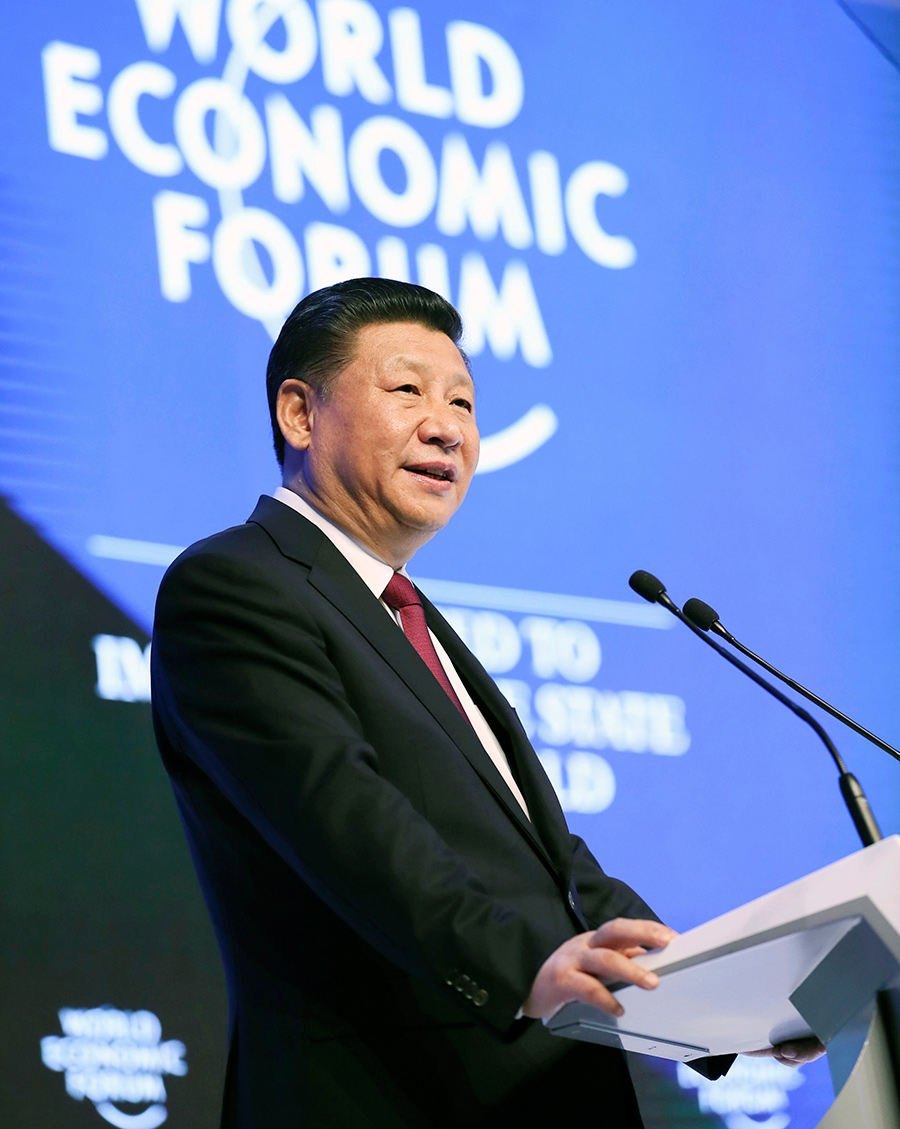
One year ago, President Xi Jinping delivered a landmark speech at the World Economic Forum in Davos, Switzerland, outlining his views on the major trends and challenges affecting the world, from slow growth and climate change to rapid advances in technology, inequality and inadequate and unrepresentative global governance. In the year that followed, China has doubled down on a number of core areas outlined in the speech, including increasing its innovation base, stepping up its environmental commitments, ramping up the Belt and Road Initiative, unveiling a new framework for its engagement on the world stage.
But how exactly does the year mark up against Xi's speech?
In his January 2017 speech, Xi stressed innovation thus: "First, we should develop a dynamic, innovation-driven growth model ... Unlike the previous industrial revolutions, the fourth industrial revolution is unfolding at an exponential rather than linear pace."
Some will remember 2017 as the year the world started taking China seriously as an innovator. This has been especially notable in advances in artificial intelligence (AI) capabilities and technology hardware innovation.
Becoming a technology leader and moving up the value chain toward higher-quality jobs has for long been an ambition for China. In the mid-2000s, international companies were encouraged to set up research and development facilities in China in exchange for market access, but these were largely paper tigers (built for show, to borrow a Chinese expression). This is no longer the case. In 2017 Google-a company with next to zero market share in China's lucrative internet search industry-opened an AI research laboratory in Beijing to get closer to the world-class talent in the country. Google has also announced the opening of an R&D facility in Shenzhen, South China's Guangdong province, to work on its growing hardware offerings.
China is fast becoming a global leader in AI, with all the major Chinese technology companies bolstering their ranks of machine-learning specialists. Earlier in the year, Chinese search giant Baidu was able to attract Microsoft's top AI talent Qi Lu to become their chief operating officer in a symbolic move that in a way reflects the center of AI gravity is moving Eastward. Baidu also tested its first self-driving car on the roads of Beijing and doubled down on AI as the core of their strategy.
Support for AI
In the global race for ever more useful and profitable AI, some have pointed out that laxer rules on and attitude toward data privacy will give Chinese companies an edge over their US and European counterparts. This is coupled with unflinching government support for the industry, compared with some people in Europe and the United States who remain circumspect about the potentially damaging effects of the technology.
The city of Shenzhen has become the global hub for tech-hardware innovation. The vast spare parts market-which started as a place to make patent defying copies of products designed elsewhere-has transformed into the world's most advanced and dynamic hardware innovation hub giving rise to disruptive startup companies inventing new products and industries such as DGI (consumer drones) and Royole (flat foldable screens).
Emphasizing the importance of unifying all countries to fight climate change, Xi said in January last year: "The Paris Agreement is a hard-won achievement ... All signatories should stick to it instead of walking away from it."
Although China remains the largest emitter of greenhouse gases, it has made substantial progress on climate action domestically in the past year; it has also taken on a greater leadership role on the world stage. Last year, China announced a high-profile partnership with the European Union and launched the world's largest carbon market. This political leadership may have endowed China with a sense of moral authority and soft power that had been previously lacking. But by installing more renewable capacity, improving the air quality and building the largest renewable energy production base, China has also shown that going green pays in a number of ways.
Coal still remains the dominant energy source in China and 2017 saw a slight increase in the use of coal (after three years of flat growth). This was caused by an uptick in economic growth as well as regional droughts, which sapped China's large hydro-electricity sector's capacity.
However, when it comes to transitioning to renewable energy China is the world leader and the numbers speak for themselves. According to Bloomberg New Energy Finance, in 2017 China invested $132.6 billion in renewable energy, 24 percent more than in 2016, accounting for 40 percent of global investment in clean power. As part of its Belt and Road Initiative, China also made big investments abroad, spending $44 billion on renewables' projects and mergers and acquisitions. Coupled with a number of factory shutdowns, this mitigation strategy is paying off, as Greenpeace reported a year-on-year decline of 53 percent in pollution in Beijing, which it estimated prevented about 160,000 fewer premature deaths in China last year.
China's renewable energy strategy has also been paying dividends for domestic companies, which have developed a strong lead in the manufacturing of clean technology, producing some 60 percent of all solar panels in 2017. At a December meeting in Beijing, the country's environmental protection minister said there were now more than 2.7 million jobs in the renewables' sector in China, and the National Energy Administration expects the number to increase to 13 million by 2020.
Highlighting the contribution of emerging and developing economies to the global economy, Xi said in Davos last year: "Emerging markets and developing countries already contribute to 80 percent of the growth of the global economy ... However, the global governance system has not embraced those new changes."
Global governance reform
Reform or replace was the message to the global governance system, as 2017 saw a strong push behind Xi's signature foreign policy of the Belt and Road Initiative. The plan consists of a series of infrastructure projects in Asia, Africa and Europe. In May, leaders from across the world descended on Beijing for the Belt and Road Forum for International Cooperation. Much of the funding for the initiative will come from three new financial institutions, which was established by China along with other economies-the Asian Infrastructure Investment Bank, Silk Road Fund and the BRICS New Development Bank.
The need is huge. According to the World Economic Forum's calculations, there is an annual infrastructure funding gap of $1 trillion. But perhaps more significantly, the initiative, by providing an alternative framework for multilateral collaboration which places the emerging world at the center, will put pressure on the current international institutions to reform or risk seeing their influence wane in key fast growing regions.
Xi's speech outlined a considered Chinese view of the major trends affecting the world and a series of recommendations to deal with it. As in many Chinese policymaking enterprises these take the long-term view. But in the last 12 months, the themes set out in Xi's speech have seemed to guide China's major policy decisions and transformations. China's ever more active role in global affairs, as well as an innovator, climate leader and builder of institutions should give established powers food for thought while continuing to usher in a multi-polar and, indeed, multi-conceptual global system. What is certain is that wherever others are willing to cede the global leadership, China stands ready and willing to fill the gap.
The author is a member of the World Economic Forum's Circular Economy initiative team, and leads the work on policy engagement in emerging markets with focus on China and the African continent.



- China moves to set national standards for pre-made dishes
- Chinese company unveils plans for commercial space flights
- Latest addition to Shiziyang Bridge constructions brings main tower above 300 meters
- Hebei's 'ancient pressure cooker' setting internet ablaze
- Major urban renovation restores Xi'an's ancient moat
- China launches nationwide employment assistance program