Is the earth a 'Dark Forest'?









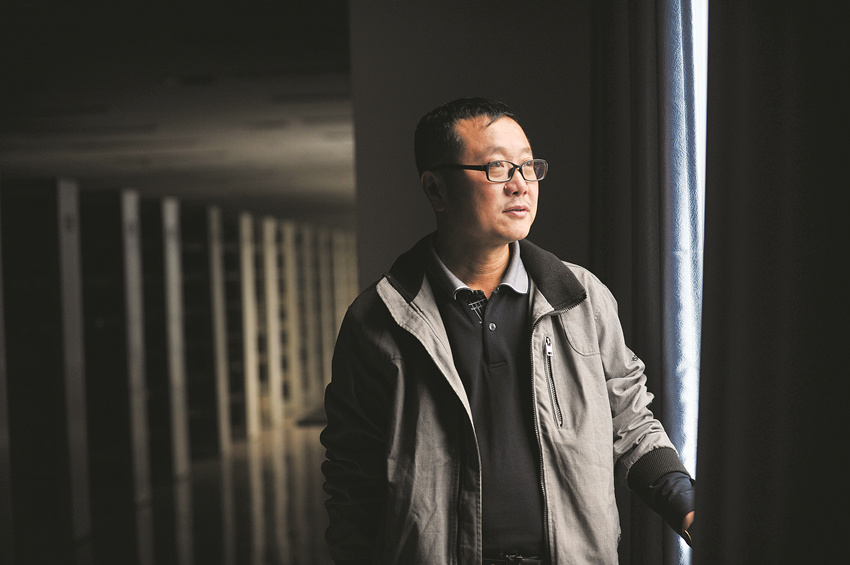
The Three-Body trilogy by Chinese science fiction writer Liu Cixin is an international cultural phenomenon. Business and government leaders have studied the books and drawn lessons from them.
Former US president Barack Obama specially asked to meet with Liu during a recent visit to Beijing and has called the books "wildly imaginative, really interesting". The trilogy was recommended by Facebook founder Mark Zuckerberg. In 2015, the first volume won a Hugo Award for science fiction, a first for an Asian author.
According to Xinhua News Agency, the first volume of the trilogy has sold more than 160,000 copies in English translation and over 1 million in Chinese - unprecedented numbers for a Chinese science fiction novel.
Wu Yan, a leading science fiction scholar and professor of humanities at Southern University of Science and Technology in Shenzhen, Guangdong province, says: "Lei Jun, CEO of Xiaomi, thinks this work gave him secret ideas about how to do market competition. It gave him some very important ideas about how to make a market work. I've heard that all his company members were told to read this book, study this book and use this book as a kind of guide to new developments in the market. Not only him. I've heard that 360, Tencent and Baidu also pay attention to this book. In the business area, they give respect to science fiction."
However, in an interview with China Daily, Liu warns against drawing too many analogies from his stories. For example, the uncertainty of living on the home planet of the aliens in The Three-Body Problem, the first book of the trilogy known formally as Remembrance of Earth's Past, is not a metaphor for some era in Chinese history, he says.
"The book discusses the fact that the biggest feature of a physical three-body system is that there are no known ways to predict its operation," Liu says. "With three suns, people would not know when the next day would begin. The words mean what they mean."
Furthermore, an alien attack on Earth should not be seen as representing China's "century of humiliation", he says.
"On the Earth, the most appropriate analogy is the Mayan or other American civilizations when they first meet the Spanish invaders. But it's really about the relations between the future Earth and other stars. Although Chinese civilization has been impacted by foreign civilizations, it was not destroyed and the impact has been limited. The inheritance of Chinese culture has continued," says Liu.
Yao Haijun, chief editor of Science Fiction World, China's leading science fiction magazine, said The Three-Body Problem has drawn attention from Western readers partly because they seek to understand China. "It has also set up a link between China and the West, through which foreign readers can attempt to hypothesize about the future of the country," he told Xinhua.
Liu makes it clear that his work reflects the concerns of all peoples.
"It is not my purpose to show the reality of China from a science fiction perspective. This may not meet the expectations of Western readers. My purpose is very simple - that is, science fiction itself. The content in the book is not a metaphor for reality. If it is understood this way, the logic of the book will be absurd. This is a common misunderstanding of readers. I prefer to be understood as a sign that Chinese writers are now taking off in imaginative literature and science fiction writing. However, no matter how readers understand it, I am happy that I have readers in the West," he says.
In addition, he says writers from the golden age of British and US science fiction influenced his work.
"Science fiction in China is 100 percent imported from the West. There was no science fantasy in China's long history of culture. So as a writer of science fiction, I am very close to Western works. This refers only to science fiction literature, not literature in a broad sense. At present, science fiction is very marginal in Chinese literature. China's realist literature is deeply rooted in native Chinese culture, but science fiction is not, which has caused my work to be closer to European and American works."
"H.G. Wells showed me that science fiction can reflect reality in a way that is not seen in mainstream literature," he adds. "Although my science fiction is not intended to critique reality, he left a deep impression in this regard. However, my novel is not in that genre."
"Arthur C. Clarke is very pure and shows science fiction itself. He has a solid foundation in science and a rich, science-based imagination. He is deeply moved by the relationship between man and the universe and nature. His two works, 2001: A Space Odyssey and Rendezvous with Rama, are the most impressive for me. He used imagination to create a lifelike world. The details are vivid, which has a great impact on my writing. I want to write such works," Liu says.
Asked to analyze the difference between Western and Chinese culture, Liu says a key factor is how the civilization or its religion views the future.
"Religious backgrounds are where we can see the difference. Specifically speaking, Western culture always considers the end of the world, drawing on the Bible. However, Chinese culture has no end-of-days complex and seldom considers the end of the world, so the attitudes about an end of the world catastrophe are quite different. In the subconscious of Chinese culture, human history goes forward and forward. To me, it's an example of how Chinese and Western ways of thinking are different," he says.
"Compared with Western culture, Chinese culture is more optimistic," Liu adds. "The entire Christian background and other religious backgrounds are absent. Even if religion appears, it has not become culturally dominant. I'm not saying which one is better, though."
In the second volume of the trilogy, The Dark Forest, the central problem with contacting an alien civilization is explained. Suppose an advanced civilization on planet A detects another civilization on planet B. Since planet A knows nothing about the motives or future decisions or capabilities of planet B, decisionmakers on planet A could easily conclude that the safest course is to destroy planet B while they have the chance. Of course, planet B follows exactly the same logic.
Some see the dark forest as a metaphor for highly competitive Chinese markets. Ken Liu (no relation to the author), the award-winning translator of The Three-Body Problem, told AllChinaTech, "Commentators viewed the harsh environment in which IT companies competed ruthlessly to the cosmos of The Three-Body Problem in which every civilization saw survival as its highest priority.
The dark forest is also widely discussed among international relations theorists because it closely resembles "realist" ideas that states inevitably compete to maximize their own power because they fear the power of other states.
However, Liu Cixin himself says the dark forest problem does not dominate relations between nations on Earth. Even in future interstellar relations, a dark forest is only one of many possibilities.
"The relationship between different groups of human beings on Earth is very different from that between mankind and creatures from other planets. The conflict between a newly rising power and a veteran powerhouse has occurred frequently in history. However, war is not always the only solution.
"We are the same species on Earth and are more likely to understand each other. Civilizations are not isolated from each other. They can exchange and discuss many things that they do not understand. This opportunity does not exist between interstellar civilizations. The dark forest applies to civilizations in different star systems, not between humans. This is the readers' biggest misunderstanding of my book," he says.
Problems can be solved through a peaceful and win-win approach. I do not think there will be a massive international war," he adds.
davidblair@chinadaily.com.cn