China's rise proves naysayers wrong









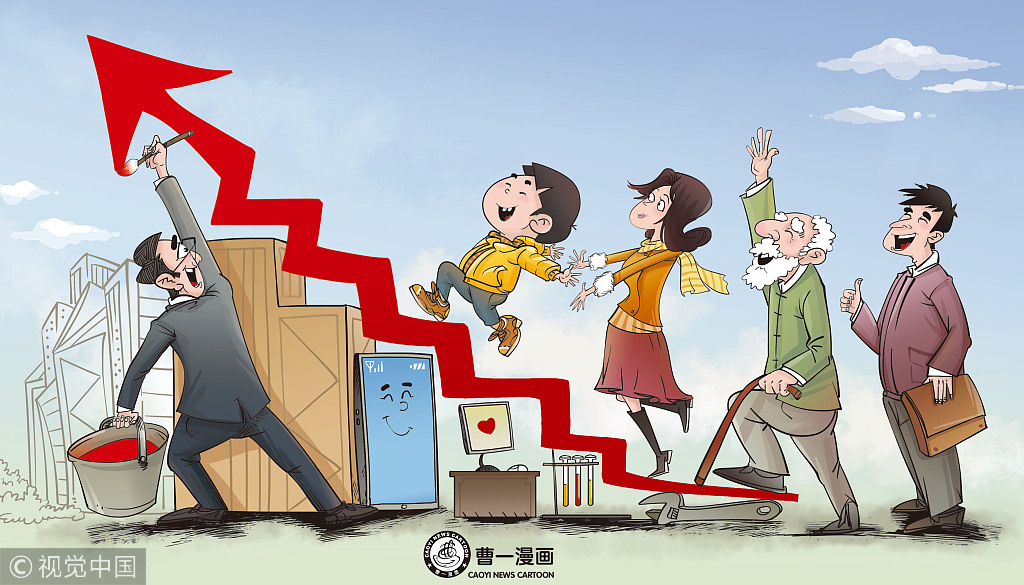
China's recently released 2017 data on gross domestic product confirm it: the country's dramatic rise, with the concomitant increase in its global economic relevance, is not slowing down.
There has been fresh media chatter about the reliability of Chinese data, owing to reports that some provinces have been overestimating their economic performance in recent years. But for all we know, other provinces may have been doing the opposite. And the provinces that have admitted to inflating their data are not large enough to have a significant impact on the overall national data.
Moreover, two key points are often lost in the debate on China's official statistics, which it first started releasing in the late 1990s. First, the debate is relevant only if China is increasing the degree to which it overestimates its data. Second, the published data should be considered in the context of China's trading partners' own figures, as well as those of major international companies that do business in China.
As for the 2017 data, most of the media focus has been on China's reported real (inflation-adjusted) GDP growth, which, at 6.9 percent, represents the first acceleration in a couple of years and an improvement even on the government's soft target rate of 6.5 percent. But the more important figure is China's nominal GDP growth translated into US dollars. Owing partly to a strengthening renminbi, China's total economic output grew to $12.7 trillion in 2017, representing a massive increase of 13 percent ($1.5 trillion) in just 12 months.
Clearly, those who have warned that China is following in Japan's footsteps and heading for a longterm deflationary cycle have been far off the mark. Such simplistic comparisons are never particularly useful. Not only has China averted the risk of deflation; it has done so with an appreciating currency.
When my former Goldman Sachs colleagues and I first started tracking the rise of BRIC economies (Brazil, Russia, India and China) in the early 2000s, we figured China would take until the end of 2015 to catch up to Japan. Yet 2018 has barely started, and already China's economy is two-and-a-half times larger than Japan's, five times larger than India's, six times larger than Brazil's and eight times larger than Russia's. It is also larger than the entire eurozone.
China's staggering $1.5 trillion expansion in 2017 means that, in nominal terms, it essentially created a new economy the size of South Korea, twice the size of Switzerland, and three times the size of Sweden. The latest data suggest China could catch up to the United States, in nominal terms, sometime around 2027, if not before. Within a decade after that, the BRIC countries collectively could catch up to the G7 economies. Of course, such an achievement would be driven largely by China.
One final consideration for the global growth outlook is the Chinese consumer. Many commentators still see China as solely an industrial power. But consumption in China has increased to nearly 40 percent of GDP. Since 2010, Chinese consumers have added about $2.9 trillion to the world economy. That is bigger than the United Kingdom's entire economy. British trade negotiators should take note: after Brexit, the Chinese market will be more important to the UK than ever.
Yet, in addition to its annualized data, China also released its December data, which revealed monthly reported-retail-sales growth of a slightly disappointing 9.4 percent year-on-year. One hopes this is the result of not a consumption slowdown, but Chinese policymakers' tightening financial conditions in the second half of 2017.
As China's importance to the global economy increases, its upside and downside risks will have far greater implications on the rest of the world. And a consumption slowdown would be bad not just for China, but also for the rest of the global economy, which is now depending on China's shift from industrial production to domestic consumption.
The author, a former chairman of Goldman Sachs Asset Management and a former UK Treasury minister, is honorary professor of Economics at Manchester University and former chairman of the British government's Review on Antimicrobial Resistance.
Project Syndicate