



New energy vehicles boost sharing economy









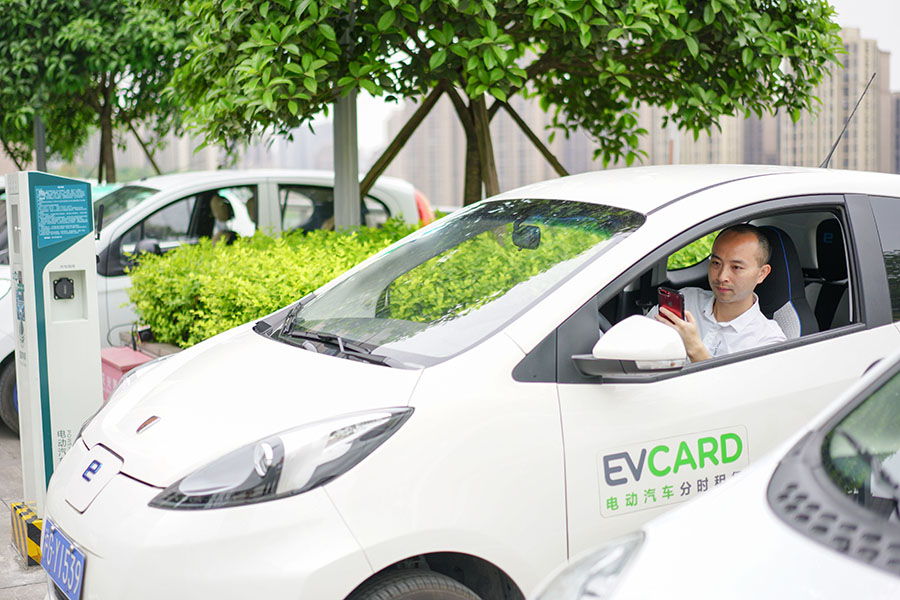
Chinese car-sharing firms are taking the fast lane to a green tomorrow by using new energy vehicles for their services.
In doing so, they are also exploiting opportunities brought by the country's booming new energy vehicle segment and the drive toward clean energy, industry observers said.
At the China EV100 Forum, an event in the field of electric vehicles, held in Beijing in January, Rong Wenwei, chairman and general manger of Shanghai International Automobile City Group Co Ltd, or SIAC, said, "China didn't take a long time to get into the car-sharing sector but has made rings around other countries. To differentiate from them, up 95 percent of shared cars in China now are NEVs (new energy vehicles)."
The forum highlighted that Chinese car-sharing services are expected to spawn a 1.8 trillion yuan ($285 billion) market by 2018.
China recently announced a series of policies to stimulate growth in the new energy vehicle segment, calling for more intensified efforts to develop environmentally friendly transportation that is powered by alternative energy sources and based on the sharing economy concept.
China is now the world's largest market for new energy automobiles, with around 1.7 million such vehicles on its roads as at the end of 2017, according to the China Association of Automobile Manufacturers.
A JD Power survey of consumer satisfaction with mobility solutions in China indicated that 19 percent of consumers are "very willing" and 51 percent are "slightly willing" to no longer own a car if mobility alternatives are available.
The car-sharing sector, part of the country's sharing economy, allows users to locate cars using mobile apps, which is similar to popular shared bike services.
So, car-sharing firms are expanding their footprint using new energy vehicles. This, experts said, could well transform the traditional way of using cars eventually.
The entire fleet of Shanghai-based car-sharing service provider Evcard comprises 27,000 new energy vehicles, which are used by its more than 1.8 million subscribers. This makes Evcard one of the world's largest car-sharing firms.
Launched by Shanghai-based automotive manufacturer SAIC Motor and SIAC, Evcard has since set up 12,000 branches and 55,000 parking lots in 60 cities.
"As a leader in NEV car-sharing services, our company has helped reduce transportation cost," said Rong, who is also the chairman of Evcard.
According to the firm's estimates, at half a yuan per minute, it would cost 30 yuan to drive an Evcard vehicle around for an hour. This is much lower than the average taxi fare for the same duration.
Chen Xiaohong, professor of transportation engineering at Tongji University, said: "In terms of sharing economy, NEVs can help reduce traffic jams as well as air pollution. They are also an ideal way to optimize resources including parking lots.
"The ultimate goal of developing a city is that transportation should grow efficiently when road resources become limited, and that's why car-sharing really matters."
Besides Evcard, car-sharing firms such as Gofun, launched in 2016 by State-owned Beijing Shouqi Group, and Car2go, launched by German automotive group Daimler, are pressing new energy vehicles into their services.
Shao Dan, a senior researcher at the Shanghai Urban and Rural Areas' Construction and Transportation Development Research Institute, said, "A new development model involving big-scale car-sharing services would also require policies that support new transportation services and social management."




















