



Expensive dinners, quality reunions









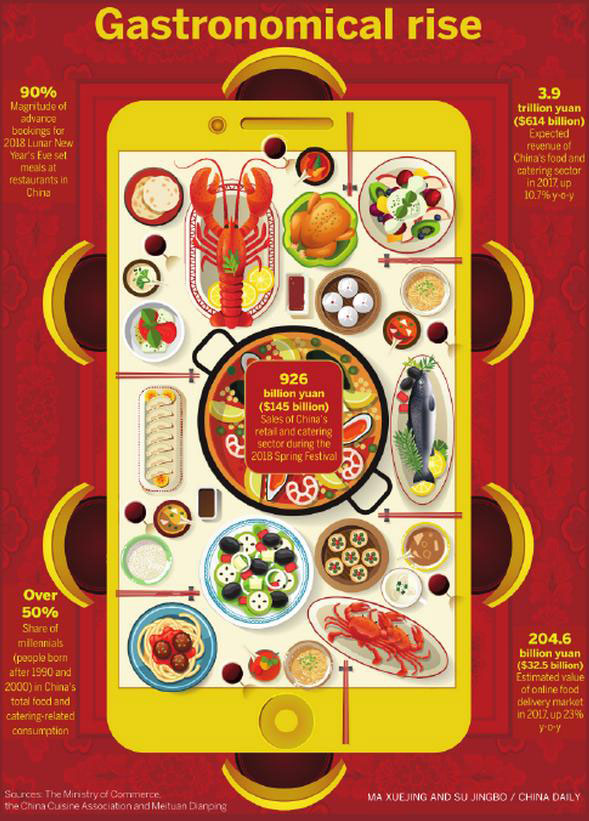
Consumption upgrade nets $145 billion for the retail and catering sector during this month's Spring Festival holiday
Lobsters from the United States, cherries from Chile, and chicken from a rural county of China … Food from different corners of the world added color, flavors and value to Qin Xin's Spring Festival Eve family reunion dinner on Feb 15.
Hailing from Anhui province, Qin, 24, works with an internet-based firm in Beijing. She spent around 800 yuan ($127) on buying fresh food online, including meats, fruits and seafood, which made up 70 percent of the total food spend for this Chinese Lunar New Year's Eve dinner. Last year, the bill was at least 20 percent lower, but she didn't mind spending more this year.
"My family members, including my 92-year-old grandma, loved all the fresh foreign food as they had never tried it before. This enlivened the dinner atmosphere. The extra money spent was well worth it."
Qin is one of the millions of Chinese consumers who spent more on food this Spring Festival, contributing 926 billion yuan toward sales revenue of the retail and catering sector. That's 10.2 percent more year-on-year.
That's a clear effect of China's consumption upgrade. Also, more families are choosing to dine outside or order food online rather than cooking elaborate meals at home. Why, media reports suggest over 90 percent of some special Lunar New Year's set Eve meals at restaurants on Feb 15 were pre-booked.
But Spring Festival-related spending is just one manifestation of the ongoing upgrade of consumption in China. Consumers nowadays crave, and buy, top-quality products and services, said Wang Bingnan, vice-minister of commerce in a news conference. Not just that. They even care for healthful foods.
There was a time when the Chinese Lunar New Year's Eve family reunion dinners comprised main dishes made of different varieties of meats. Now, however, more and more Chinese are preferring organic foods, green vegetables and other healthy products, Wang said.
The last year saw an increasing number of people willing to spend more on food, especially quality food. For its part, the catering sector upgraded itself too, becoming more internet-enabled and quality-driven.
According to a report of the China Cuisine Association, the food and catering sector's 2017 revenue is expected to surpass 3.9 trillion yuan, up almost 11 percent year-on-year.
"In the past, people sought to fulfil basic needs like food and clothing. With the improvement of lives, people now pay more attention to variety, quality and brands," said Wang from the Ministry of Commerce.
The last two years saw an increase in online fresh food consumption. The market expanded; so did consumer spending, according to report of CBNData, a Shanghai-based market data analytics provider.
"Fresh food is now sourced from new channels, not just traditional markets. I now enjoy more diversified choice than before," Qin said. "Take shrimp, for example. On JD, I can buy shrimp from at least 10 countries and regions, including Argentina, Vietnam, Malaysia, Ecuador and Canada.
"Another thing is that ordering fresh food online is very convenient and fast, with just a few clicks or taps. Within one or two days, food will be delivered."
Qin said such advantages would encourage her to buy more fresh food online in the future.
Li Xiang, senior analyst from CBNData, said modern technology, including the internet, is driving the consumption of online fresh food.
"Major e-commerce companies have tapped into the fresh food sector and made more investments in the supply chain and logistics infrastructure, which provide customers with a better experience," she said.
Another trend in food consumption is that more consumers are willing to pay for quality, the CBNData report said.
Consumers are willing to buy natural or organic foods even if they are more expensive than normal varieties. Demand is growing for specialties and agri products, especially varieties with proper labels that clearly indicate in the local language the place of origin, date of packing and other quality-related details.
For example, some consumers prefer to buy "Yangcheng Lake crab" instead of common crab, the report said. (Yangcheng is a lake in Jiangsu province.)
According to CBNData rankings, crabs from Yangcheng Lake, sea cucumbers from Dalian, Liaoning province, and passion fruit from the Guangxi Zhuang autonomous region were among the top three bestsellers in the specialties and agri products last year on Tmall, Alibaba's online marketplace featuring well-known brands.
"Customers are more conscious of brands. So, informative labels on products can increase customers' loyalty," said Li.
That's not just a view but fact. Chicken from Qingyuan, a rural county in Guangdong province, proved to be a market success after its packaging included a label stating its place of origin. Its sales in 2017 increased by more than 2.5 times, despite its price being over 28 percent higher than chicken from other areas.
Li said e-commerce companies are encouraging e-tailers agri products to embrace branding and labels to increase sales.
The National Museum of China cooperated with Tmall to launch a variety of rice known to have been used by ancient Chinese emperors. Branded Emperor's Rice, it is sourced from different places in China known as the places of origin of royal rice.
Branding entails standards and rules for food relating to plucking and delivery, which are enforced strictly by e-commerce players.
For example, for a kind of cherry sold online, the e-commerce firm concerned specifies that each cherry should be bigger than 26 mm with its degree of sweetness exceeding 20 percent. Also, each cherry should have accumulated more than 700 hours of winter nights (roughly 60 nights) on the tree before it was plucked.
"The most important factor that customers care about is quality. Hence, higher standards are common on e-commerce platforms with regard to how they select, buy and deliver food," said Li.




















