China-US confrontation not inevitable









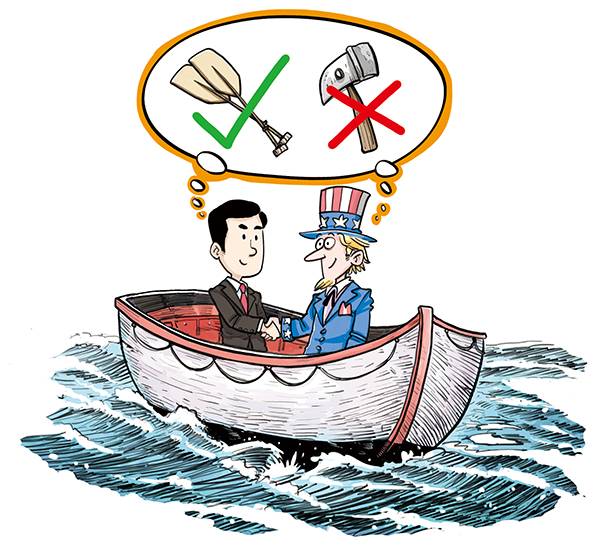
Very recently, Yan Xuetong, one of China's leading strategic thinkers and dean of the Institute of International Relations at Tsinghua University, and also the author of Ancient Chinese Thought, Modern Chinese Power, wrote an opinion piece for The Washington Post in which he argued that US President Donald Trump "can't start a Cold War with China".
However, the usual question asked is: Will Trump start a war with China?
Let's try to answer this question first and then move to Yan's thesis that Trump cannot start a war with China.
When broaching the idea of a US-China war, the first thought that comes to mind among most strategists and pundits that focus on US-China relations is the "Thucydides Trap" expounded on by Graham Allison in his recent book Destined for War.
Allison's theory is taken from the ancient Greek writer, Thucydides, who put forth his classic treatise in the History of the Peloponnesian Wars. Thucydides argues that the situation of a status quo power (Sparta) challenged by a rising power (Athens) was the recipe for war. And it was followed by several wars.
Following up, Allison notes the Belfer Center at Harvard University studied 16 of the major world conflict situations in modern times and found that in 12 cases, major wars erupted as a consequence of the Thucydides Trap.
Adding greater resonance to the hypothesis, many observers see the United State (the status quo power) as in a state of quite rapid decline and China (the challenging power) as rising very fast. This seems to make a clash even more likely.
The new National Security Strategy report recently published by the US Department of Defense appears to confirm this thesis. In it, the US' paramount threats are China and Russia. It is no longer terrorism. (The Islamic State group has been defeated and terrorism elsewhere is not on the upswing.) Rebuilding US forces that were depleted under two previous presidents due to unwise wars and spending on other things requires more money and a plan to fix this. Following this narrative China and Russia have been designated prime US adversaries.
But this begs the question: What kind of war?
One might argue that the US and China are already at war: a trade war, an intelligence war, a cyber war, a space race cum war, a proxy war (with the US supporting its ally Japan in the South China Sea over disputed islands there, and more).
Arguably to most, war means something different, namely an "all out" war or nuclear war. So Trump's domestic foes, the liberal media, Hollywood, academe, in their obsession to put an end to Trump, paint him as a leader who recklessly will start such a war.
But this matter was seemingly resolved by several previous US presidents. The possibility that a president could be drugged, kidnapped or that he might act in a fit of rage and launch a nuclear attack was studied and the system fixed accordingly. The result? The president has to get the concurrence of others (presumably several, most of them residing outside of Washington and some not known to anyone). This protocol means a US president cannot start a war by himself.
But Yan means something else when he says that Trump cannot start a war with China "even if he wants to". Yan says the US and China must avoid "excessive international responsibility" lest they exhaust themselves from overstretch.
The proof is quite visible. Trump wants to stop the US decline. He is focused on the economy, jobs and other aspects. President Xi Jinping's policy is to avoid sending troops to Afghanistan or otherwise get into a foreign quagmire. Both also eschew making their conflict an ideological one that might make a small incident escalate.
Then, Trump has shown respect for China as no other US president has. His grandchildren are learning Chinese and whenever there has been an opportunity, they have displayed this to Xi and to the Chinese public. Trump is, on paper, not opposed to China's Belt and Road Initiative-the biggest building project ever that will change the structure of the global economy. Xi has pledged to fix the US' trade deficit. He has pared back China's growth in defense spending and has ostensibly conceded that the US is the supreme military power in the world and that it will remain so in the foreseeable future.
The two leaders have, in fact, agreed on a working asymmetric relationship. One leads the world in the economic realm; the other is ahead in military terms. And other would-be powers are not in the running. Thus an untidy multipolar system will not likely push the US into a conflict with China. In fact, the two countries' adversarial stance does not fit the classic Thucydides Trap.
Trump and Xi also realize a good working relationship between the US and China is a sine qua non for the world economy to remain stable, nuclear proliferation to be controlled, the environment to be protected, and much more.
Finally, US-China relations were at a low point during the last years of the Barack Obama administration-worse than at any time since before former US president Richard Nixon engineered a rapprochement. They are much improved now.
Hence it appears the US-China relationship, despite their competition in different spheres, is not likely to turn into a military conflict. Whether war won't happen or cannot happen seem academic. Both views are true.
The author is the Stanley J. Buckman professor (emeritus) of International Studies at Rhodes College in Memphis, Tennessee.