



A lifetime searching for cures









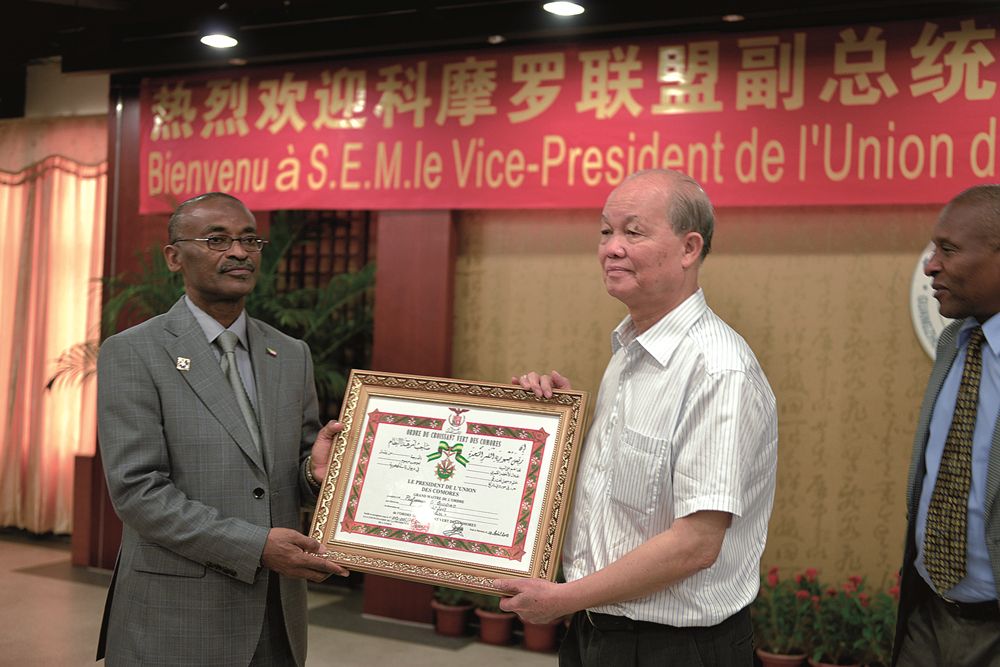
Veteran researcher from long line of TCM practitioners is devoted to finding treatments for malaria and cancer
Although he will be 82 years old this year, Li Guoqiao still works late into the nights on his lifelong quest to apply compounds derived from traditional Chinese medicine to treating malaria and cancer. He works so late that he says coffee is his favorite food.
"My father, my grandfather and my great-grandfather were TCM practitioners," says Li, chief professor at Guangzhou University of Chinese Medicine. "TCM is based on thousands of years of experience and is effective against specific diseases. Malaria is the number one killer in infectious diseases, and cancer is number one in noncommunicable diseases. So I chose applying TCM to these two as my lifetime target.
"I have seen many poor families die of malaria in Hainan and Yunnan, plus in Cambodia and the Comoros and throughout Africa. The disease takes the lives of young children. It tears families apart. I felt I must find the quickest and cheapest way to eliminate it," Li says.
In the late 1960s, Vietnam requested help from the Chinese government to fight malaria. In 1967, a research program called Project 523 tested many compounds and approaches based on TCM. Eventually, the team was able to isolate the active ingredient artemisinin from the sweet wormwood shrub, which traditionally has been used to treat malaria.
In the early stages of Project 523, artemisinin was shown to be effective in clearing the malaria parasite from laboratory rats. Li's major contribution was to show that artemisinin was highly effective in curing human malaria patients, especially those infected with strains of the malaria parasite that were resistant to previous front-line drugs. Artemisin quickly cleared the parasites from the blood of malaria patients - more rapidly than any other anti-malarial drug. A key factor is that it was able to pass the blood-brain barrier and cure patients infected with often-fatal cerebral malaria.
Li, who taught acupuncture at the university from 1961 to 1967, was initially assigned to examine whether acupuncture could be effective against malaria. After 1969, he even infected himself with malaria, but found that acupuncture was ineffective.
"I turned to doing research on cerebral malaria patients for four years and found some new ideas that were not even in the textbooks," he says.
"In October 1974, the director of the 523 project went to the county in Yunnan where I worked and handed the project of researching the clinical effects of artemisinin to my team. We quickly confirmed its effectiveness, after which I was engaged in the research of artemisinin for the treatment of cerebral malaria for years, and I was the first one to do clinical tests of it," Li says.
He recalls an especially memorable case from that time: "At 9 pm, I received a call from a hospital in Gengma county, a remote part of Yunnan province. The patient had cerebral malaria and had a stillbirth at noon. She had lost a lot of blood and could not be transfused. She had been given a dose of artemisinin, but was still near death. Maternal cerebral malaria has the highest fatality rate.
"A lab technician and I spent the night preparing blood serum and drugs. We caught a bus at 5 am and arrived at the foot of the mountain at 8 am. We hiked up the mountain and finally arrived at the hospital at 9 pm and continued the artemisinin treatment. The patient came out of the coma 50 hours later and was found to be negative for the malaria bacteria within 72 hours."
Traditional methods of dealing with malaria focus on mosquitoes - either trying to eliminate them or stopping them from biting people by using indoor spraying or distributing insecticide-infused sleeping nets.
Li has been a pioneer in applying an alternative approach called mass drug administration, which aims to eliminate the malaria parasite directly from the human population. The idea is to give artemisinin to all (or, as much as possible) of the population at one time - thus eliminating malaria within a target region. Since malaria is not carried by animals, eliminating it from humans can get rid of the disease. Artemisinin is usually administered in a compound with another anti-malaria drug, because malaria is unlikely to be resistant to both.
He first tried mass drug administration in South China's Hainan province. "From 1975 to 1980, I engaged in research on MDA in Hainan, as it is the hottest zone in China. We handed medicine to patients three times a year in order to control the morbidity. But the effect was not very good, because only 60 to 70 percent of the people took the treatment. A lot of the elderly and children did not know we were sending out medicine, so they would not line up for it. Plus, at that time, the side effects of the medicine were relatively strong."
Cambodia is the second place where Li and his team tested the mass administration of artemisin compound therapy. He found high rates of uncontrolled malaria in the Mekong region. "At that time, the traditional way to control malaria was by eradicating mosquitoes, but I thought the key was to eradicating the plasmodium that humans carried. In the hot areas, over half of the people carried the parasite, reaching 80 to 90 percent in some regions."
"In 2004, there was an epidemic outbreak of malaria in Cambodia, so they allowed me to do a test. At that time I tried a method to hire one person with a high school education as 'head warder' in every village. He registered all households, found out how many people were infected, then took the medicine house-to-house," Li says. In three years, the malaria rate fell by 95 percent. However, people brought in malaria from outside the target area, so the rate of infection rose again.
In 2006, Li and his team began a mass drug administration program in the island country of Comoros in East Africa. Li worked on the program there until 2008, when he had to return to China after having a stroke.
In a test case on the small Comoran island of Moheli, the cases of malaria fell by 94 percent within two months. Li also found that the malaria parasite had been greatly reduced both in humans and in mosquitoes: "The humans that carried the malaria parasite fell from 23 percent to 1 or 2 percent, and the portion of mosquitos carrying the parasite fell from 3 percent to nearly zero," Li says.
After applying mass drug administration of an artemisinin combination therapy to the Comoros' two other major islands, malaria cases fell from 103,000 - around one-eighth of the population - in 2010 to fewer than 2,000 cases in 2014. Deaths fell from 54 to zero, according to data from the Comoros Ministry of Health.
However, Li says his task is not finished. Without further work, malaria could come back.
"Studies in Cambodia and the Comoros show that (mass drug administration) is the only way to control malaria quickly, but it failed to eliminate malaria," Li says.
"The first important point I proved in the Comoros was that the number of plasmodium-carried mosquitoes reduced as the number of human plasmodium-carriers decreased. The second point is, even after the MDA, there are still five to eight malaria patients every month. Though the number is small, there is a risk that the malaria could come back," Li says.
So Li continues his lifelong work. He and the team at Guangzhou University of Chinese Medicine are now working on a method, called PCR (polymerase chain reaction), that they have shown can effectively test for malaria using only one drop of blood.
"The cost of using PCR was $10 per person, which was too expensive for the local people. My team started to research our own reagent and succeeded. We reduced the cost from $10 to $1 a person, which makes PCR a popular, safe, fast and cheap way to check for malaria and ensure it does not come back" after mass drug administration, Li says.
Contact the writers through davidblair@chinadaily.com.cn










