Expectations for the 2018 annual two sessions









The opinions expressed here are those of the writer and do not represent the views of China Daily and China Daily website.

The month of March is a particularly political time in China. As a result, I could imagine how the whole world is now waiting with great anticipation for the two top-level national political bodies, the National People’s Congress and the Chinese People’s Political Consultative Conference which is known two sessions. The two sessions are a significant bellwether which offers a review of government’s accomplishments in 2017, government’s objectives and priorities in 2018, government’s plans and actions to improve quality and effectiveness growth, which will set the nation’s economic direction for the year. Various signals suggest China’s growth did speed up in 2017, which could give the government the room it needs to tackle an accumulation of serious financial, environmental and social problems this year. Which make me think that Premier Li Keqiang's work reports would likely emphasize more on the qualitative expansion. We expect some policy easing this year to support the qualitative expansion. But I think this option may be off the table if the Chinese government thinks inflation accelerated more than anticipated. Growth would then slow and could weigh on worldwide growth. China’s economy grew 6.9 percent in 2017, topping both the official target and 2016’s growth. For 2018, IMF tipped China to set its GDP growth target at roughly 6.6 percent in order to leave room for its deleveraging campaign. China’s leadership has a long-term target and is more inclined to plan for the next generation and beyond. This common goal not only profits the Chinese people, but also the entire world.
As 2018 marks the true commencement of China’s much heralded “New Era.” Much of Xi’s 19th Congress speech was concentrated on “realizing the Chinese Dream of national rejuvenation”. The Chinese Dream has four parts: Strong China (economically, politically, diplomatically, scientifically, and militarily); Civilized China (equity and fairness, rich culture, high morals); Harmonious China (amity among social classes); Beautiful China (healthy environment, low pollution). So, Premier Li Keqiang work report would emphasize more on qualitative growth which means realizing the Chinese Dream by encouraging local government to focus more on how to develop consistent with qualitative objectives. Chinese governments will have to work harder under qualitative objectives because they are more difficult to measure. The old ways of boosting local GDP by building incompetent schemes have passed. The qualitative objectives comprise of, making Chinese citizens enjoy more convenient lifestyles with the aid of cutting-edge technologies, enjoying a healthier life with less pollution, making people richer, such as creating higher wages and more employment opportunities, which “sees China moving closer to the center stage and making contributions to mankind”. In terms of making contributions, air population was a hot-subject in 2017, so, the Chinese leadership might be looking at how to make the skies blue again while listing a series of measures to be taken to help clear the air, such as “round-the-clock monitoring” of industrial pollution. Also, we expect the work report to emphasis on China push to improve the health and well-being of China’s almost 1.4 billion inhabitants.
Xi Jinping initially mentioned his intent in October 2016 when he unveiled the “Healthy China 2030” initiative, China’s first national-level medium to long-term strategic plan for national health and wellbeing. The relatively active reform agenda for health care associated sectors proposes overseas firms will face a steadily opening business environment as China strives to improve the health of its citizens by 2030.
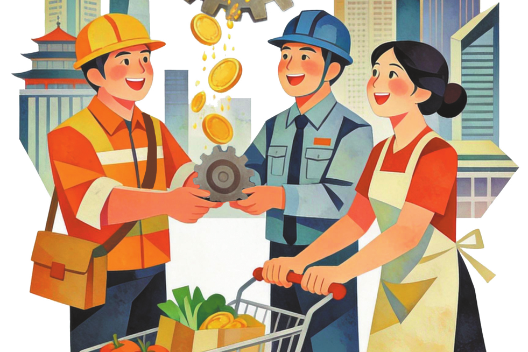
In terms of employment creation, the Chinese government created over 13 million employments in 2017, an upsurge of 370,000 compared to 2016. Although the Chinese government is expecting more jobs to be created as the country reforms its economy amid the acceleration of urbanization and the promotion of the Belt and Road Initiative. However, there are concerns regards a new incoming enormous labor force with over 8 million graduates flooding the market and a supply-demand mismatch gap for skilled workforces. The settling of over-capacity workforces, as well as rural migrants, will remain a hard task as well. China will try to maintain macro-policy continuity and stability and take steps to fend off economic risks.
In terms of risk, curbing of financial risk and bolstering stability will continue to be top objectives for the Chinese leadership. The recently launched Financial Stability and Development Committee (FDSC), will take on the role of policy formulation precisely for this purpose. Apart from managing systemic monetary risks, it will provide an inter-agency regulatory framework and act as a macro supervision for monitoring monetary activities as well. Building inflationary pressure and concerns about debt flow to overextended sectors, such as real estate, means the government will take more category-based and targeted measures to regulate the real estate market as well as the measured approach to monetary policy in 2018. In recent years, China has been cutting excess capacity in heavy industries as part of its so-called supply-side reforms while pushing for novel growth drivers, like technology, and moving up the value chain. For that reason, the present Chinese leadership will focus more on quality over quantity in driving economic growth and further fast-tracking supply-side reforms.
This probably means a slowdown in production of raw materials, like aluminum and coal. The Chinese leadership will try to lessen investment in non-strategic infrastructure; and heavier government backing for value-added industries, like new materials, I.T and robotics, and health care — all of which are part of the Made in China 2025 agenda. It also means extra streamlining and consolidation of incompetent State Own Enterprise and strategic opening-up of additional sectors to private sector competition and in some circumstances overseas competition.
We expect the work report to emphasis on the Belt and Road Initiative. The initiative’s new inclusion in the Party Constitution secures institutional support and underscores its centrality to myriad government priorities. We can expect that the Belt and Road Initiative will remain a central part of China’s foreign policy as Xi Jinping aspires to craft global standards for the next generation technologies and infrastructure. The real test, however, lies ahead; nonetheless, no matter how daunting the real test ahead might look like, in the Chinese leadership view, “History is created by the courageous”.
The author is the Executive Director of the Center for Nigerian Studies at the Institute of African Studies, Zhejiang Normal University.