Small cities seeing big realty moves









Sales trends give residential sector significance in China's growth story
The crucial property industry, one of the drivers of China's economic boom of the last three decades, will continue to stabilize and grow this year, if expectations of deputies attending the ongoing annual session of the National People's Congress are any indication.
Their expectation is in line with a consultancy's forecast. After a long time, changing consumer preference, brought about by market dynamics and tighter regulations, will prompt China's property industry to focus on smaller cities rather than metros this year.
Home sales in metros are sluggish even in the Chinese New Year that began on Feb 16, and resilient in lower-tier cities. The trend is expected to continue, industry experts said.
This is significant because much of China's stunning high economic growth over the last two decades was fueled by rapid creation of housing and infrastructure in big cities such as Beijing, Shanghai, Shenzhen, Guangzhou, Tianjin, Chengdu and Chongqing.
During the first 10 days of February, transaction volume in first-tier cities slumped 33 percent month-on-month, that of second-tier cities plunged 18 percent, and third-tier cities dropped 9 percent, according to a report in the Economic Information Daily, which cited data from consultancy Centaline Property.
There were virtually no online transactions in first-and second-tier cities during the Chinese New Year holiday, while third- and fourth-tier cities became major contributors to residential market deals, especially smaller cities near first-tier cities, said analysts.
In Shanghai, new residential property measuring a mere 1,817 square meters was traded between Feb 15 and Feb 21-the second lowest level since 2012 after last year, according to Lu Cheng, vice-president of Centaline China.
Both property developers and home-buyers regard 2017 as the harshest year in terms of restrictions. In March last year, the Beijing municipal government launched a series of policy tightening measures, including raising the down payment for second homes and shortening the repayment period for mortgage loans. Since then, more than 100 cities published their own property policy tightening measures.
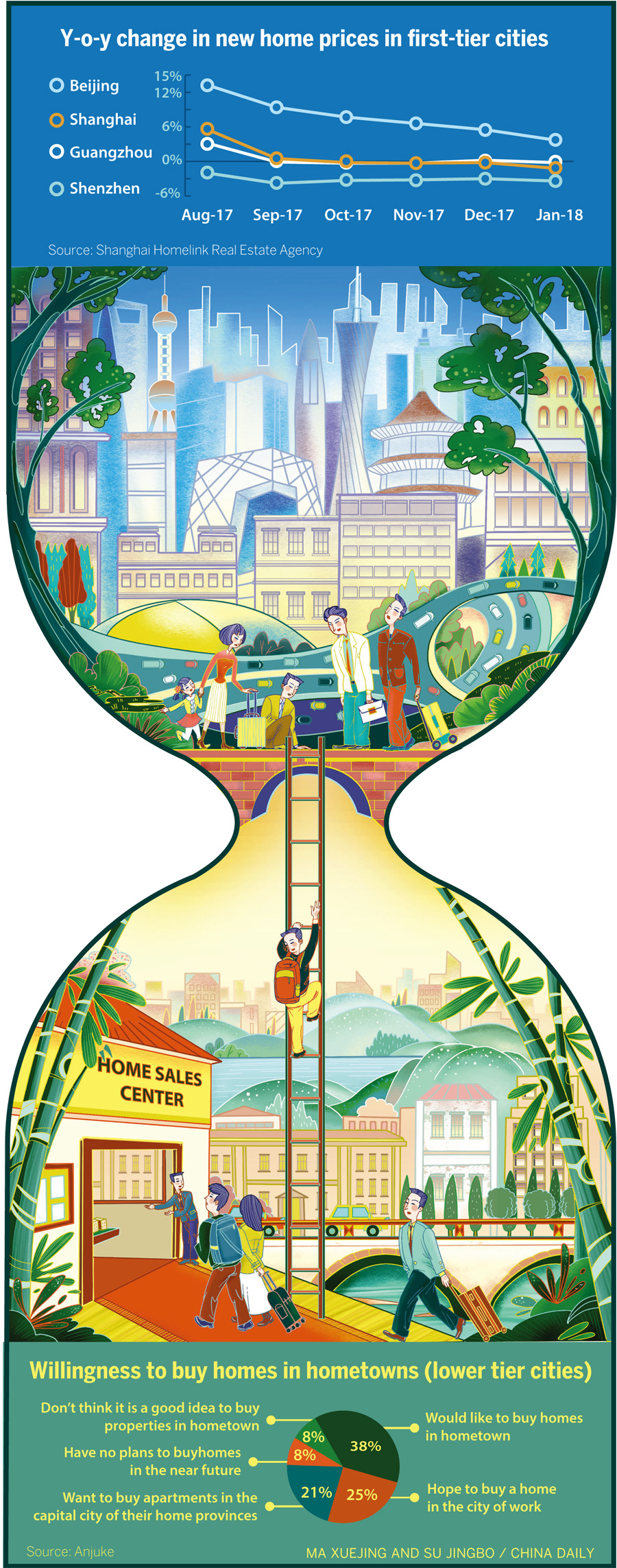
As a result, the overheated property market started to cool down, especially in major cities. As of January, new home prices in first-tier cities have moderated in growth rates to negative, and their pre-owned home price growth rates have declined for 16 months in a row, according to the latest data from the National Bureau of Statistics.
"The days are gone when new property projects are quickly sold out once becoming available for sale. Under the rigid regulations, most homebuyers take a more prudent stance, and trading period for both home trading and mortgage applications are extended," said Zhou Jing, head of project sales, JLL Shanghai, a property consultancy.
Analysts said since the effect of tightening measures will be felt in first- and second-tier cities this year, lower tier cities are expected to outperform major cities in 2018.
Lower tier cities' housing markets are also backed by those who work in major cities but cannot afford the high home prices there. In order to improve the living conditions of their families, they choose to buy apartments in their hometowns, according to a recent report by online property information provider Anjuke.
The report showed 38 percent of the people polled said they would like to buy homes in their hometowns, 21 percent wanted to buy apartments in the capital city of their home province, 25 percent hoped to buy a house in the cities where they work, 8 percent had no plans to buy homes, and another 8 percent did not think it was a good idea to buy properties in their hometowns.
"Buying home is still a hot topic in smaller cities like my hometown Jinhua in Zhejiang province, with considerable people making the purchase during the Chinese New Year holiday," said Yan Yuejin, research director of the E-House China R&D Institute.
"Average people have been doing more homework on property policies and mortgage measures before they make their decisions in the past few years."
More than half of those buying properties in their hometowns are aged above 30, and merely 19 percent of them are single, according to the report, adding that 80 percent of them come from third-and fourth-tier cities, and 70 percent of them are working in first- and second-tier cities.
The ever-expanding Chinese high-speed railway network has shortened travel time between work and home. Employers are according premium to human resources, as well as expanding to smaller or newer markets in China, which is encouraging talented professionals to think long term and create assets, in the form of homes in lower-tier cities, according to Zhang Bo, chief analyst of Anjuke.
"As more industries are going to the middle and west of China, many people who come from these areas and work in East and South of China are moving back home, as the salary gap is becoming narrower," said Yan.
This is stabilizing the residential property market and will present an arena for property developers and agencies to enhance their competitiveness, said Lu.
In January, the average interest rate on home loans availed by first-time homebuyers was 5.43 percent nationwide, up 0.93 percent month-on-month, and up 21.75 percent year-on-year, the Shanghai Observer reported. Efforts will be made to curb bubbles in the property sector through monetary policy tightening.
For example, cities like Sanya in Hainan province and Zibo in Shandong province announced in February that they will cap prices of some of their new residential apartments. This suggests that some property markets in China may still be overheated.
Compared to home sales, home rentals are regarded a hot spot in the property market, more so because the central government has been emphasizing that homes are for people to live in, not for investors to seek high returns.