Quality over quantity: China re-inventing itself









The opinions expressed here are those of the writer and do not represent the views of China Daily and China Daily website.
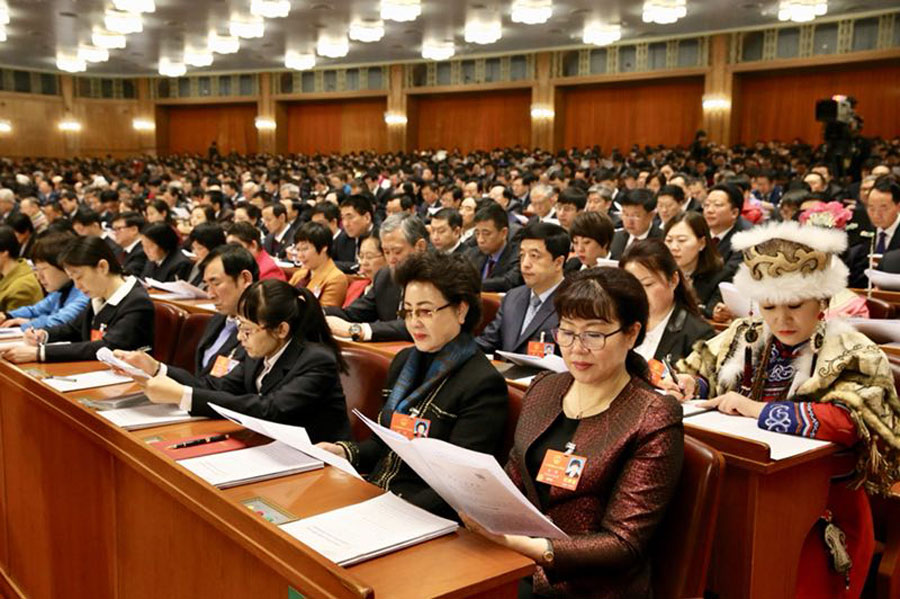
When State Council Premier Li Keqiang delivered the Government Work Report before delegates at the First Session of the 13th National People’s Congress on March 5, 2018, it was all about quality of growth, rather than quantity.
Unlike past work reports citing growth figures and economic success, Li presented a blueprint projecting the nation's plans for re-inventing itself in the decade ahead.
His speech began by outlining China's emphasis on a vast range of technologies, from quantum communications, space exploration, e-commerce, mobile banking, high speed transport networks, to its nation-wide push to promote a youth driven internet innovation economy. Today China is the world’s largest investor in artificial intelligence, having upgraded and converted its once cheap export toy industry into sophisticated robotics research and development production.
Cities across China are opening innovation incubation centers, shared work space, alongside their plans for driving smart, green and blue infrastructure and transport systems. "We have rolled out the Internet Plus Government Services model and adopted measures such as the one-stop service model," Li emphasized in his "commitment to innovation-driven development, and a focus on unlocking public creativity," all to be heavily supported and promoted by the government in the years ahead.
Education needs to support China's drive toward high-tech. Under plans announced in the work report, four percent of China's GDP is being committed to education. While students in America graduate from university straddled in debt that will take lifetimes to re-pay, in China youth is a national asset that must be invested in through education aimed at preparing youth to be practical and employable. While China’s education system is fiercely competitive and often criticized by westerners as too stringent and not supporting free-flow creativity, nobody can question China’s technology innovation advances, many of which are leap-frogging the west. Nowhere is this more evident then in environmental technology.
A large part of Li's work report was devoted to environmental protection and resource conservation. China’s policy of Ecological Civilization calls for a massive transition from fossil fuel to green energy. In the past some 80 percent of China's energy needs came from coal which left the nation with dirty skies, and polluted water, causing a crisis of food and health security. By 2050 eighty percent of the nation’s energy will be green and clean. This massive program will be driven at the outset by state fixed asset investments followed by private sector commercialization of technologies supported through innovation, requiring an entirely new approach to education as nearly every professional and worker will need to approach services and industry with a view toward conservation rather than consumption.
Streamlining seemed to be an overarching theme of Premier Li's government work report, with 44 percent of government red tape to be slashed, the consolidation of government functions that overlap and in turn create investor confusion. China's future government structure may be expected to be simpler, more institutionalized, and hopefully. Establishment of an independent inspectorate for government is aimed to check corruption. After a near half decade anti-corruption campaign, the intention is to institutionalize checks and balances so that government offices can be clean, lean, and green. Officials are now subject to natural asset evaluations that determine promotion or demotion, making them very environmentally conscious. A complete change from the days when the environmental was pushed aside in favor of high growth.
Premier Li's report did not shy away from the challenges that lie ahead. While 68 million people have been pulled out from poverty, large pockets remain. This will require new urban infrastructure and transport to address land rights that have remained a stone unturned, but key to resolving issues of medical and pension benefits for farmers. Entire upgrades in health care are needed for a system that is overburdened unable to address the sheer volume of care required for the old and unwell. The overconcentration of populations in coastal cities will require relocation back to villages, but to do so these villages will need to be upgraded to become cities attractive to live in. This will require smart, green and blue infrastructure for the planned "ecological cities" that will become the blueprint of China's future.
And all of this will have to be paid for of course. However, in Premier Li's report, even the management of funds is subject to higher scrutiny. He called for prudent monetary supply. China will not go the route of deficit spending to print money as the hallmark of America’s decade of quantitative easing that has arguably laid the path for future global financial volatility. The emphasis of Li’s work report warned against such practices and emphasized the need for stability and low risk, managed through meticulous financial micro-management rather than deregulation.
Past government work reports traditionally emphasized higher rates. Premier Li presented 6.5% as the expected growth rate for 2018, a lower threshold then the 7.1% achieved in 2017. This change of tone signals China’s newfound focus on quality rather than quantity of growth. Everything about this year’s government work report emphasized raising quality -- from energy to government efficiency, from education to asset management, from nutrition to resource conservation -- it was all about improving quality. It was not a work report reciting or praising the past, but rather a rational and detailed blueprint laying a pathway for the future -- a future of China re-inventing itself.
Laurence Brahm is Founding Director of Himalayan Consensus Institute, an environmental think-tank, and Senior Research Fellow at China Center for Globalization.