



Institutional reform for better governance









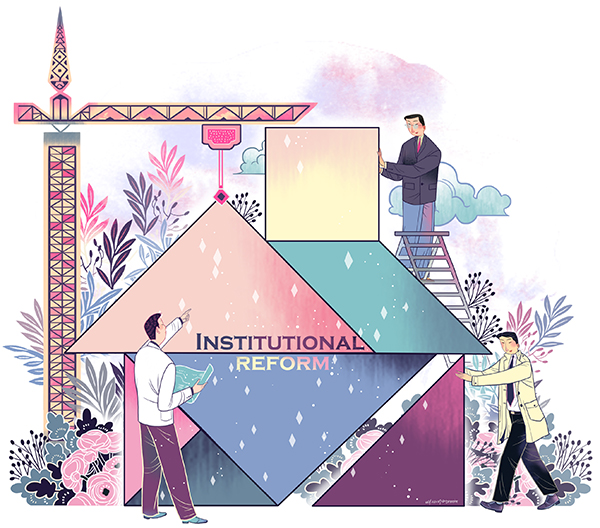
The Third Plenary Session of the 19th Communist Party of China Central Committee made the decision to deepen the reform of Party and State institutions, saying the reform will facilitate the modernization of the country's governance system and capability from a strategic and long-term perspective.
Since the 18th National Congress of the CPC in late 2012, the Party Central Committee with General Secretary Xi Jinping as the core, based on the problem-resolving principle, has deepened the Party and State institutions' reform, and achieved significant progresses in important fields.
Faced with the new requirements raised by the new tasks in the new era and as mapped out by the 19th Party Congress, intensifying institutional restructuring and continuously promoting the modernization of the country's governance system and capability are historically and practically inevitable.
For developing socialism with Chinese characteristics
To deepen the reform of Party and State institutions is an inevitable requirement for adhering to and developing socialism with Chinese characteristics in the new era. Party and State institutions, as important means to build socialism with Chinese characteristics, need to continuously improve themselves to meet the requirements of socialist market economy, and implement the five-sphere integrated plan and the four-pronged comprehensive strategy.
To deepen the Party and State institutions' reform is an inevitable requirement for strengthening the Party's long-term governance capability. The leadership of the CPC is the defining feature of socialism with Chinese characteristics. And the Party and State institutions need reforms to perfect the institutional arrangements for the Party's overall leadership, in order to improve its governance system and enhance its ability to make decisions based on overall situations.
To deepen the reform of Party and State institutions is also an inevitable requirement for self-improvement and self-development of the socialist system, which can offer institutional support and guarantee for China's reform in various fields. Despite the breakthrough progresses made in some key fields since the 18th Party Congress, some deep-rooted contradictions and problems are yet to be resolved, so bolder measures must be taken to reform the country's institutions.
The overlapping of functions and responsibilities of some Party and State organs remains a prominent issue, which, along with a series of other issues such as unreasonable division of power and duties among different institutions, underscores the need to deepen the reform of Party and State institutions, in order to offer institutional support and guarantee for continuously deepening reform and overcoming difficulties in the economic, social, political, cultural and ecological fields.
To deepen Party and State institutions' reform is an inevitable requirement for realizing the "Two Centenary Goals" of building China into a modern socialist country, and realizing the rejuvenation of the Chinese nation. To realize such goals, China must solve the existing institutional problems that have hampered its efforts to resolve some concrete issues such as defusing major risks, alleviating poverty, controlling and preventing pollution, and further advancing institutional restructuring.
Distinct characteristics of institutional reform
While deepening the Party and State institutions' reform, we must adhere to the Party's overall leadership as the core principle. The decision taken by the Third Plenum of the 19th CPC Central Committee makes it clear that strengthening the Party's leadership in various fields is the primary task of deepening the reform of Party and State institutions.
Different from previous rounds of institutional reform, which involved only government bodies and the administrative system, the newly unveiled reform draft is a comprehensive one that involves the Party, governments, legislatures, political advisory bodies, and judicial and military institutions at various levels, as well as social organizations and non-governmental organizations.
The latest reform, which is based on scientific design, is no less than an institutional revolution that is of profound significance, as it does not shy away from reshuffling of power and interests. The decision shows the necessity to break the barriers hindering the market's decisive role in resource allocation and the government's strengthened role in administration, so as to achieve high-quality growth and build a modern economic system.
This round of reform is scientific. The decision conforms to the principle of coordination and efficiency. Therefore, similar affairs need to be handled by one department; the number of organs needs to be reduced to make the system more efficient; Party and administrative organs need better coordination to reduce their overlapping duties while guaranteeing the Party's centralized, unified leadership; a ministry needs to be set up to better serve the veterans; and the provincial-, city-and county-level organizations need to dock with those ministries whose function is involved with centralized, unified leadership of the CPC Central Committee, or national legal, administrative and market unity, while the local ones can be more flexible in dealing with local social and economic affairs.
The fruits of this round of reform need to be safeguarded, as the decision of the Third Plenum of the 19th CPC Central Committee makes it clear that the various Party and State institutions should be regulated according to law, including their functions, responsibilities, duties, and procedures.
To advance the reform steadily
To deepen the reform of Party and State institutions is a systematic project that faces arduous and complex challenges, and we must adhere to the correct direction and keep our ideology and action in line with Xi Jinping Thought on Socialism with Chinese Characteristics for a New Era and resolutely safeguard the authority and centralized, unified leadership of the CPC Central Committee with Xi Jinping as the core.
Any reform program should be carried out in accordance with law, and some revisions should be made to extant laws and regulations as soon as possible to facilitate its implementation. Under the centralized, unified leadership of the CPC Central Committee, the reform of central and provincial-level institutions should be carried out first, followed by institutional reforms at lower levels.
China has a vast territory and a large population, and there exist huge differences among different regions, so any institutional reform should be based on top-level design and suitable to actual local conditions.
To advance institutional reform is challenging, as it involves many ministries and personnel. Some adjustments need to be made soon, while some need time. It's important for the Party committees and governments at different levels to maintain normal function of related departments while solving new problems.
The author is a member of the Political Bureau of the 19th Communist Party of China Central Committee. This is an excerpt from his article that was originally published in People's Daily.





