



Moviemakers help to set the picture straight









The film industry is growing stronger and focusing more on China's rise on the world stage, as Xu Fan reports.
When Jia Zhangke made his directorial debut with The Pickpocket in 1997, annual box-office takings in China were about 1 billion yuan ($158 million). By last year, the figure had rocketed to nearly 56 billion yuan.
When interviewed at the Great Hall of the People on Sunday on the sidelines of the National People's Congress, Jia, an NPC deputy, said he was excited about the transformation of the movie industry in China, which boasts the largest number of film screens in the world.
With revenues from domestic movies accounting for nearly 54 percent of last year's combined box-office total, and the recent Spring Festival holiday seeing a surge of about 67 percent year-on-year, Chinese movies have seen an unprecedented rise, mainly as a result of a number of mainstream blockbusters.
Last year, Wolf Warrior 2 made 5.68 billion yuan to become the highest-grossing fictional movie of all time in China. Meanwhile, Operation Red Sea has soared to become a sensational hit, raking in 3.36 billion yuan since it opened on Feb 16.
'New Mainstream'
For most industry observers and researchers, this box-office bonanza exemplifies the rise of so-called New Mainstream Movies.
The term, coined by film buffs a few years ago, refers to patriotic movies that not only instill positive energy, but also please mass audiences.
With the overwhelming popularity of these hits, including The Taking of Tiger Mountain (2014) and Operation Mekong (2016), the nation's movie industry is being reshaped.
"In the past, movies that publicized conventional values found it hard to win in the mainstream market because most of them were dull and preachy," said Yin Hong, professor of film and television studies at Tsinghua University in Beijing.
"Moreover, for some time, commercial blockbusters barely reflected mainstream values, as most of them were full of negative elements such as materialism, violence and conspiracies."
According to Zhao Baohua, a veteran scriptwriter and movie critic, and deputy director of the Chinese Film Literature Association, the surge in the number of mainstream-value blockbusters indicates that moviemakers have figured out a way to solve the problem-by merging formerly opposing sides, so the movies are educational yet still generate revenue.
Speaking of the huge commercial success of recent mainstream blockbusters, Zhao said the films resonate with Chinese audiences and their pride in the country's rise.
Actor-director Wu Jing's Wolf Warrior 2 is the story of a former Special Forces operative and his heroic face-off with ruthless mercenaries as he evacuates Chinese citizens from a war-torn country in Africa.
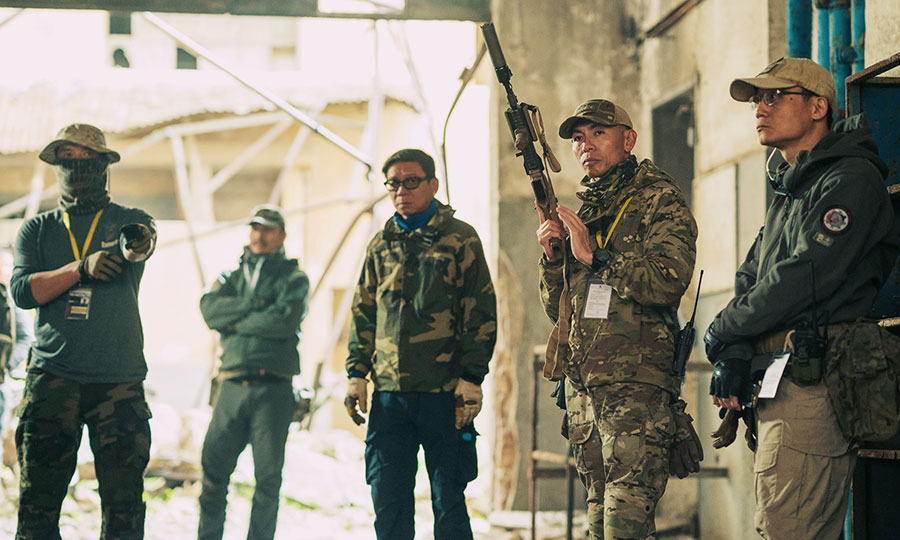
Hong Kong director Dante Lam's Operation Red Sea has a similar theme to Wolf Warrior 2-it was based on the true story of the evacuation of Chinese civilians from strife-torn Yemen in 2015-but focuses more on depicting the ensemble heroes.
Also directed by Lam, Operation Mekong was based on a cross-border manhunt by Chinese police to apprehend a drugs ring in the Golden Triangle.
Adapted from a hit novel and helmed by Tsui Hark, also from Hong Kong, The Taking of Tiger Mountain tells the tale of a 1940s Communist hero who leads a squad to crack down on a group of bandits.
"Hong Kong directors have worked and grown up in a market that requires movies to be attractive to, and quickly understood by, audiences. Thus, they use their own methods to tell Chinese mainland revolutionary history or show heroes, and make the stories more appealing," Yin said.
Strengthened support
This year, China is demonstrating its determination to strengthen support for mainstream movies.
On Jan 30, the State Administration of Press, Publication, Radio, Film and Television issued a statement announcing the establishment of a "People's Cinema" chain, which will select 5,000 of the country's 50,000 movie halls to screen quality mainstream films.
Each hall must have at least 100 seats. That means Guangdong province, which will have 594 such halls, will top the list, followed by Jiangsu province, with 437, and Zhejiang province which will have 383.
Most cinema operators believe the initiative will encourage domestic filmmakers to produce more high-quality mainstream movies.
Zhuxuanlyu, or "main melody", was one of the most-familiar movie genres to Chinese born in the 1970s and '80s.
Millions of people share memories from their school days of being shown movies that eulogized heroes from the revolutionary era or those who were role models in contemporary China.
Zuo Heng, a movie researcher with the China Film Archive, recalled that the "main melody" concept was first highlighted by the State administration in 1987 as a way of encouraging filmmakers to produce works that emphasized national spirit and pride.
Signature hits included The Birth of New China (1989), an epic that related the country's arduous history in 1948 and 1949, and the biographical drama Jiao Yulu (1990), which focused on an iconic CPC cadre who dedicated his life to the people.
Reflecting on the success of Jiao Yulu, Zuo said the film reached a high unrivaled by most commercial films of the time, thanks to its breakthrough narration-which employed a tragic, poetic tone-and star power, with the lead played by award-winning actor Li Xuejian.
When the movie opened across the country, tickets quickly sold out in most theaters, and venues recorded audiences of 90 percent, according to reports.
However, that level of success only belonged to a few outstanding movies, while most of the others failed to attract the public as a result of cliched storylines and stereotypical protagonists.
Reinventing tradition
Statistics from the State Administration of Press, Publication, Radio, Film and Television show that China's movie industry was in a bad way, with theater admissions falling from 29.3 billion in 1979 to 10.5 billion in 1992, a decline of about 64 percent.
In an effort to rectify the situation, some filmmakers tried to reinvent traditional revolutionary movies by using commercial production techniques-an easy way of trying to win a market, Zuo said.
Director Ye Daying's Red Cherry (1995), about two orphans tortured by German invaders in the 1940s, and Feng Xiaoning's Red River Valley (1997), based on Britain's invasion of Tibet, attempted to look back at history from a more human perspective.
The result was uplifting. Red Cherry became a box-office champion in 1995, gaining attention at several international film festivals, and was selected as China's entry for the Best Foreign Picture category at the 68th Academy Awards in 1996.
Despite those successes, Hong Kong movies, which were in their heyday, and Hollywood blockbusters, such as Titanic-which saw audiences flocking to cinemas when it opened in the Chinese mainland in 1998-flooded movie theaters and video halls, main places of entertainment for young people, and cast a shadow over struggling, traditional filmmakers.
Breakthrough
The turning point came about a decade ago, as the domestic movie industry took off, heralding an unprecedented expansion.
For most cinema researchers, the Founding trilogy, produced by the China Film Group, the largest State-owned studio, marked a milestone in the reinvention of main melody movies.
The Founding of a Republic (2009), the first film in the franchise and made to celebrate the 60th anniversary of the founding of New China, was a surprise hit.
In the past, such ideological dramas were usually low-budget and seldom recruited star names.
However, in an attempt to draw internet-obsessed young people back to the big screen, the movie featured a cast of around 200 well-known faces, including kung fu giants Jackie Chan and Jet Li, who played cameos and usually gave their services for free.
A joke that went viral online claimed "Blink for a second during the 135-minute span and you may miss a favorite star", illustrating that the public's enthusiasm for the movie was mainly aroused by star power.
A similar strategy of casting popular idols as politicians or military leaders was adopted for the follow-ups, The Beginning of the Great Revival (2011)-aka The Founding of a Party-and The Founding of an Army (2017).
However, the follow-ups failed to have the same box-office impact as The Founding of a Republic as a result of their pale storylines and the idols' undistinguished performances.
"Audiences are becoming more discerning about what they want to see on the big screen," Zuo said.
Meanwhile, an interesting trend has emerged: Just as State-owned studios are trying to commercialize revolutionary movies, private film companies have started showing an interest in making patriotic stories.
The Bona Film Group, a private company in Beijing, has become a frontrunner thanks to the consecutive successes of The Taking of Tiger Mountain, Operation Mekong and Operation Red Sea.
Hark, the director from Hong Kong, is known as a master who reinvented martial arts movies with special effects-studded spectacles, turning The Taking of Tiger Mountain, a well-known Communist espionage story, into a dazzling action thriller packed with visual effects.
Lam's two Operation movies have also won acclaim for their condensed gunfire, explosion and chase sequences.
"Now, Chinese mainstream movies are closer to their Hollywood counterparts. They have shaken off stereotypical scripts to express a universal value understood across borders," said Yin, from Tsinghua University.
"They will get even better, and there will be more in the future."


- Beijing-Pyongyang passenger rail service to resume Thursday
- Shanghai and Jiangsu integration boosts sports-tourism development
- China Eastern Airlines restores direct flights between Shanghai and Stockholm
- RedNote targets AI-run accounts with new governance rules
- China's draft law on ethnic unity aims to serve as global model, political adviser
- Spring blossoms complement the Honghe Hani Rice Terraces in Yunnan





