



The Chinese Dream and its future outcome









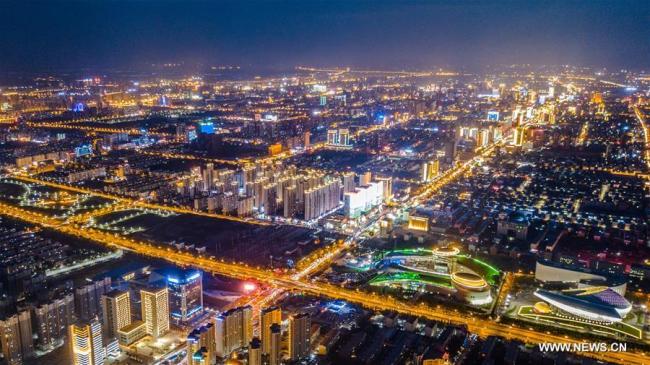
China is rapidly regaining its position of "country in the center of the world"(China in Chinese is literally country in the middle). The Government Work Report, issued after the Annual Parliamentary Session on March 5th, is the latest proof of China's commitment to supremacy. I am going to dig a bit into China's recent policies and developments to analyze with you what is going on. Will the West collapse? Should we (non-Chinese people) be worried? Will China attract more and more foreign capital?
China has a Dream
Xi Jinping's words have been included into the Chinese constitution. We are entering what he called "Socialism with Chinese characteristics for a New Era": this New Era puts China in the center of the world's political and economic interests. Yes, the U.S.A. are still the first economy in the world, but China is right behind with a huge potential.
Do you recall the American Dream? The post-war individualist quest for affirming a person's position in the newly-established wealthy society. Well, the Chinese Dream is the complete opposite. It is a collectivist dream, for which everybody, with hard work, determination, and bravery, cooperate to make China (not the individual) a great nation, improving its standard of living and economic affluence.
To achieve the Chinese Dream, the country is following three main internal politics' guidelines:
1.Making China a prosperous nation, reducing poverty and expanding the increasingly rich middle class;
2.Spreading the Internet to the far West and North regions, creating a Digital China;
3.Improving technology levels in first, second and tertiary industries (produce quality over pace) and eradicate corruption.
As a matter of facts, the latest speech of Premier Li Keqiang reflects these three internal politics' instructions.
Making China a Prosperous Nation
As reported by the Chinese Premier Li Keqiang during the opening session of the People's Congress of China, the country's primary objective is to make China a prosperous nation. Doing it means that nobody should be left behind, despite more than 40 million people live with less than USD95 cents per day. The Government so far used different tactics to increase wealth, such as devoting more than USD360 billion in loans, judging local officials for their efforts to ameliorate living standards, extending State-Owned banks' microloans to allow villagers sell goods in the e-commerce. And results have been great: in five years poor people shrunk from 100 million to 43 million, as underlined by official statistics. 11 million new urban jobs should be created in 2018, and will be directed especially to rural migrants living in metropolis.
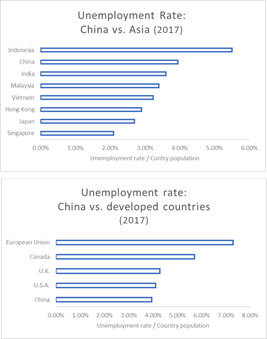
This year, China introduced a new indicator to monitor poverty, the "surveyed unemployment rate". In 2018, the jobless rate should remain under 5.5% of the total population; while it is forecasted to decrease to 4.05% by 2021. Comparing China's unemployment rate with the rest of the world is pretty interesting. The two graphs below show that the position of China changes by adopting different points of view. If we compare China's unemployment rate with some of the most developed countries in the Asian region, we can say that some work still needs to be done. If we then consider that China is the biggest and most populous country in the area, the graph results become surely impactful. In parallel, if we compare China with the rest of the world's most developed countries, we see that it actually has the lowest rate.
In addition, the Chinese Ministry of Human Resources announced that, from January to September 2017, 10.97 million new jobs have been created. This is impressive, and the Government will continue reaching positive results.
Broadening the Internet access, creating a Digital China
A large impact on this new wave of employment is due to the Internet economy, which helps young entrepreneurs, start-ups, foreign brands, and rural workers. Most recently, the e-commerce boom made the country reshape its transportation routes. As first-tier cities are saturated with products by now, new e-consumers are emerging in second-tier cities and inner areas. In other words, local producers and, especially, foreign cross-border sellers need to get ready to face the requests of new, different consumers.
To support the e-commerce development towards remote regions, the P.R.C. plans to build 200.000km of rural roads, as highlighted by the Government Work Report. In addition, data roaming fees will be slashed 30% to move towards the creation of a Digital China. At the same time, 5G mobile communications will be developed to let China's +753 million mobile Internet users be more and more interconnected.
Expanding the Chinese wealthy middle-class: reducing consumers' prices
China's middle class is expected to grow from 430 million today to 780 million people by the early 2020s. Creating jobs and reducing poverty equals to producing a wealthy society in which consumers gain the power to choose. With an increasing disposable income, modern urban realities, mushrooming shopping malls, access to education and to bombarding marketing messages, the flourishing middle class is becoming sophisticated, picky, and haughty.
And this is actually a positive trend for foreign companies in B2C sectors. As the aim in the next years is to increase internal consumption, foreign enterprises should rapidly get equipped to satisfy the Chinese demand. The middle-class prefers to buy international brands (especially cosmetics, baby care goods, lifestyle brands, food & beverage, …) rather than Chinese ones, as the formers convey prestige and quality.
To follow up the middle-class requests, China will host the first International Import Expo this year; while it already started to cut import tariffs. Beijing, indeed, recently reduced tariffs for 200 products in an effort to decrease consumers' prices and boost internal consumption. This adds up to the previous cut (in 2015), in which 187 products were benefited.
The first results of these reductions are already available:
?Total Import Growth: +20.4% from May 2009 to January 2018;
?Total Imports as of December 2017: +USD170 million;
?Consumer Price Index as of January 2018: -1.5% from December 2017.
Improving investment dynamism & technology levels
In this big ploy for the Chinese Dream, taxes also pay a key role. If the Chinese economy is set to become more competitive, innovative, and advanced, taxation must become flexible and light. The amelioration of the Chinese taxation system begun with the VAT reform, first piloted in Shanghai in 2012, and then expanded nationwide in 2016. With the abolition of the Business Tax (or VAT reform), China saved almost RMB920 billion, making companies happy. To keep it up, China will lower tax rates in manufacturing and transportation industries (many logistic companies will benefit from preferential tax treatments), and it will increase thresholds of small tax-payers' annual revenues. In other words, future reforms will relieve tax burdens. Foreign-invested enterprises must be aware of any changes to fully comply with the new regulations.
Tax reductions should boost the industrial upgrading: companies should be able to better allocate their resources and foreign investors should be more attracted to the country. As a matter of facts, after a slow-down, foreign-direct investments to China increased last year. As of September 2017, they amounted at more than USD 144 billion, registering 0.22% increase from the previous year. Interestingly, according to the Ministry of Commerce, 35652 new foreign-invested legal entities were registered last year. That figure counts both Wholly-Foreign Owned Enterprises (WFOEs) and Joint Ventures (JVs).
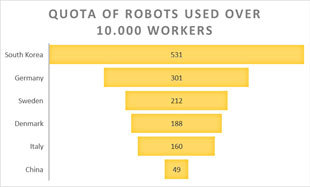
Reforms and incentives are also supporting the economic environment's upgrade into a high-technology and sustainable one. China needs to start producing quality over quantity, especially in view of the Made in China 2025. Launched in 2015, the project's purpose is to completely renovate Chinese production, transforming it into a hotbed of innovation and technology. Huge State-Owned Enterprises will be the first in line to drive this transformation: processes will be automated and digitalized. The path towards a fully automated productive system may be still long (but 2025 is not tomorrow): in China there are 49 robots over 10.000 workers; while South Korea reaches 531 robots, Germany 301, Sweden 212, Denmark 188, and Italy 160. These numbers can only encourage Chinese manufacturers to learn new know-hows and improve. We should not forget that China already boasts a few of the most high-valued tech companies in the world (i.e. Alibaba Group, Tencent, Xiaomi, Huawei, etc.). This means Chinese brains learn fast and commit to reach results.
As for now, the dependency on foreign know-how can be regarded as an advantage for non-Chinese entities. In Europe for example, Chinese manufacturers appreciate Germany's automated machines and Italian high-end modern processes. In 2016, Chinese investors spent over USD 10 billion in the acquisition of German companies, focusing on robotics and environmental technology industries. 168 Chinese groups invested in Italy by the end of 2016, making it the third country for Chinese investments in Europe, after the U.K. and Germany. Consequences of acquisitions are not the disruption of a country's productive system, nor the forced appropriation of intellectual capital, as many thinks. On the contrary, Chinese investors aim at exporting technology to China in a win-win situation: the acquired company can benefit from a new market demand, expanding its horizons, and eventually increasing revenues.
Attractiveness & Stability
Attractiveness and stability are two keywords for China's nearest future. Indeed, and as partly mentioned above, foreign companies investing in the P.R.C. under certain conditions should not be taxed, according to Beijing's Finance Minister. Also, foreign talents should be able to enter the country more easily than before (especially in R&D, biotechnologies, and technology industries). As for stability, China is being a peaceful country in opposition to the more warmongering U.S.A., and it is seeking a new globalization characterized by inclusiveness and cooperation (again in a win-win situation).
The Chinese Dream targets the great renovation of China, to be pursued with calm, strength, and determination. It is a dream made of people that work in the same direction, to achieve better standards for future generations. Nobody is excluded, foreigners are welcomed to participate.
Stephane Grand is the principal of an international accounting and management consulting firm in China. Stephane has advised hundreds of foreign investors over the last 25 years of his presence in China. He holds a Ph.D. in Chinese corporate law from La Sorbonne (Paris), a Master's degree from the Fletcher School (Boston), and an MBA from HEC (Paris). He is an active commentator of business in China.





