Giant radio telescope to reach even farther









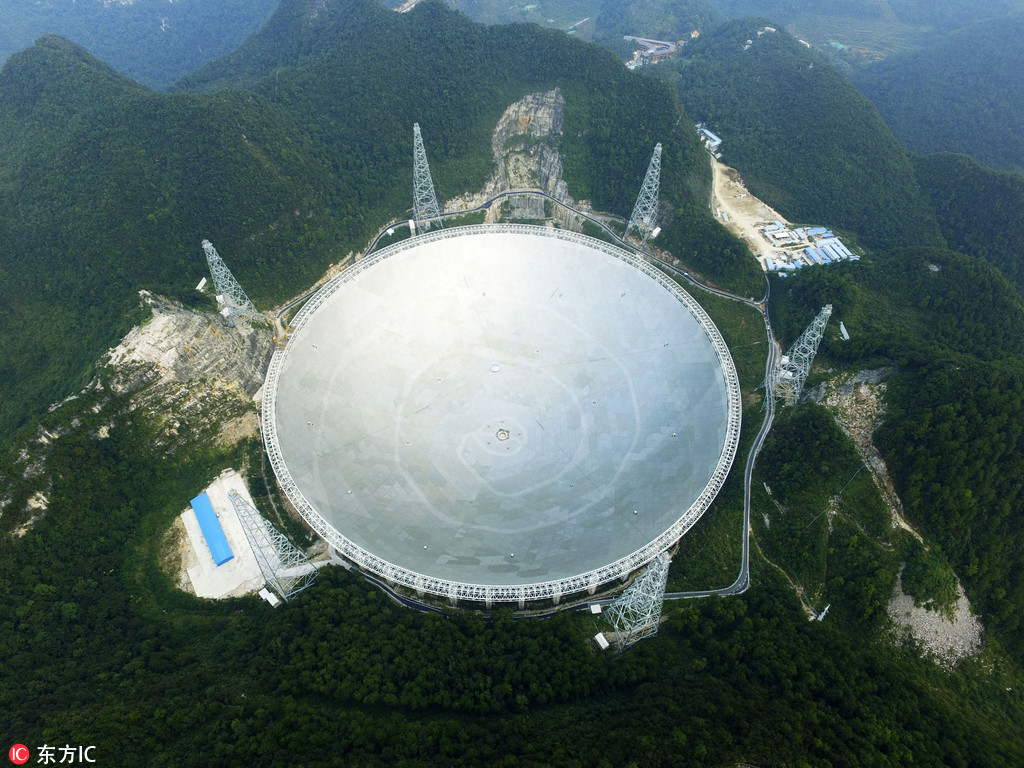
China will finish upgrading the world's largest single-dish radio telescope next month to help scientists discover more stellar objects that are unique and farther from Earth, according to a project insider.
The Five-hundred-meter Aperture Spherical Radio Telescope, known as FAST, has had more precise and efficient signal receivers installed, said Liu Oufei, deputy chief engineer of the telescope's receiver and terminal systems.
The upgrade includes a more advanced 19-beam receiver system to replace the current single-beam receiver, which was easier to calibrate and test when FAST was launched in 2016, he said.
"Previously, it was like having only one ear listening to the sky for cosmic signals," he said. "Now we have 19 ears, which can significantly increase our efficiency and ability to detect farther and fainter signals."
The new receiver will be at least six times more accurate than the old model, and can survey the night sky 19 times faster, drastically shortening the time needed for data collecting, he said. Before the update, it usually took around 20 days to survey the sky.
Chinese scientists are also looking at setting up smaller radio telescopes around FAST to create a telescope array that has greater resolution and data accuracy, Liu said.
The surrounding telescopes would consist of two to 10 radio telescopes measuring 30 or 50 meters in diameter, and resolution of the array would be about 100 times greater than now, according to proposals from the FAST observation station of the National Astronomical Observatories of China, part of the Chinese Academy of Sciences.
"We have the engineering know-how to achieve these goals, but it ultimately comes down to the scientists and their projects to determine whether new telescopes are necessary," Liu said. "Everything regarding the expansion is still in its early stages and is subject to change."
Located in a natural depression in Guizhou province, FAST consists of 4,450 triangular panels that form a receiving dish about the size of 30 soccer fields.
FAST's main missions include finding and studying pulsars, which are superdense, superbright rotating remnants of massive stars that eject beams of powerful electromagnetic radiation from their poles.
The beams are so bright that scientists can detect them millions of light years away, hence pulsars are called "the lighthouse of the galaxy," Liu said. Pulsars can also spin at an extremely stable rate due to their incredible mass and momentum, "like the universe's most precise clock".
Using these two traits, pulsars can be used to track time and coordinates for space navigation with unprecedented accuracy, Liu said, adding Chinese scientists are already working on real time positioning systems involving pulsars.
"Finding more pulsars is not only crucial in understanding the nature of the universe," he said. "They also have profound and practical uses in greatly improving our navigation capability, both for cars traveling on roads and spacecraft flying through space."
Since its launch, FAST has discovered 51 possible pulsars, 11 of which have been confirmed by international organizations. FAST is still in a trial operation phase, but once fully operational, it theoretically could discover some 5,000 to 7,000 pulsars a year, Liu said.
Scientists first discovered pulsars in 1967. Since then, more than 2,500 have been found, most of which are in the Milky Way galaxy, according to the Max Planck Society, a nonprofit research organization based in Germany.
"Every pulsar is unique, just like our fingerprints," Liu said. "FAST will play an irreplaceable role in greatly expanding our pulsar roster."






- China's Global Governance Initiative receives positive feedback at forum
- China's Xizang sees steady tourism growth in 2025
- First-of-its-kind pearl auction held utilizing Hainan FTP
- Agarwood exhibition steeps Shanghai museum in fragrance
- The Fujian Coast Guard conducts regular law enforcement patrol in the waters near Jinmen
- IP protection for new fields to improve